Tag: PPC Services

  • Navigating PPC Cost: A Comprehensive Guide to PPC for Businesses

    Navigating PPC Cost: A Comprehensive Guide to PPC for Businesses

    Tips From Pay-Per-Click (PPC) Experts

    Pay per click advertising is a cornerstone in digital marketing, allowing businesses to appear prominently in search engine results and other digital platforms. The effectiveness of PPC for businesses, however, hinges significantly on understanding and managing PPC costs.  

    This blog aims to demystify PPC budgeting, providing valuable PPC tips and insights into allocating funds effectively for PPC services.  

    Understanding PPC Cost  

    A crucial aspect of launching a successful PPC campaign is grasping the various elements determining PPC costs. These costs are influenced by factors such as industry competitiveness, keyword specificity, and the choice of advertising platform.  

    Understanding the difference between cost per click (CPC) and other pricing models is fundamental for any business, especially for a pay per click agency like Agency Partner Interactive. Knowing how much you spend and understanding how that translates into tangible results is essential.   

    Setting a PPC Budget with a Clear Goal  

    The first step in effective PPC budgeting is setting clear, achievable goals. Whether you aim to increase website traffic, boost sales, or enhance brand awareness, these objectives directly influence your PPC strategies and, subsequently, your PPC budget.  

    For instance, a web development company might have different budgetary needs than a retail e-commerce business, where the latter may focus more heavily on immediate sales conversions through product-specific keywords.  

    The same goes for email marketing campaigns, which require a different allocation than content marketing efforts. The budget should align with your digital marketing strategies, ensuring every dollar spent contributes to your overarching business goals.  

    PPC Tips: Budget Allocation Strategies  

    Once goals are set, the next step is to strategize budget allocation. This involves decisions like concentrating on high-performing keywords or diversifying across various campaigns.  

    A balanced approach often works best, especially for businesses new to PPC. This might include allocating a portion of the PPC budget towards tested and successful ads while reserving some for experimenting with new PPC tips and strategies.  

    The aim is to find a sweet spot where your PPC for businesses yields optimal results without overspending.  

    Managing and Adjusting Your PPC Budget  

    Effectively managing your PPC budget is a dynamic process. It involves regular monitoring of campaign performance and making necessary adjustments.  

    For instance, a pay per click agency adjusts its bids on specific keywords based on its performance and reallocates the budget from underperforming ads to those yielding better results. Tools like Google Analytics play a crucial role here, providing insights that guide budget adjustments.  

    Remember, the goal is to stick to a PPC budget and adapt it to maximize campaign effectiveness.  

    Maximizing ROI on PPC Spend  

    To ensure you get the most out of your PPC spend, focus on strategies that enhance your return on investment (ROI). This includes optimizing ad quality, refining targeting strategies, and continuously testing and tweaking your ads.  

    A digital marketing agency specializing in PPC, like Agency Partner Interactive, can offer valuable PPC tips on how to increase ad relevance and click-through rates, thus improving your overall ROI. Remember that maximizing ROI often requires a blend of various digital marketing strategies, including SEO, content marketing, and email marketing, alongside your PPC efforts.  

    Common Mistakes to Avoid for Your PPC Campaign 

    When budgeting for PPC, it’s essential to be aware of and avoid several common pitfalls:  

    • Neglecting the SEO Budget: Focusing solely on PPC while overlooking SEO is a frequent oversight. Balancing your investment in both can lead to more sustainable long-term growth.  
    • Overlooking Landing Page Optimization: High ad costs with low conversion rates often result from under-optimized landing pages. Collaborating with an experienced web design agency like Agency Partner Interactive can ensure your landing pages effectively convert PPC traffic into valuable customer actions.  
    • Ignoring the Power of Testing: Not testing different elements of your PPC campaigns, like ad copy, keywords, and targeting, can lead to suboptimal performance. Regular testing and tweaking are essential to refine your strategy and improve ROI.  
    • Overlooking Campaign Analytics: Failing to analyze campaign data can lead to missed opportunities for optimization. Use analytics to understand user behavior, campaign performance, and areas for improvement.  
    • Setting and Forgetting Your Campaigns: PPC requires ongoing management. Simply setting up a campaign and not monitoring it can lead to a wasted budget and missed opportunities for improvement.  

    Avoiding these mistakes can significantly enhance the effectiveness and efficiency of your PPC campaigns.  

    Aligning Your SEO Budget and PPC with Agency Partner Interactive  

    Setting the right budget for PPC is vital for any business’s digital marketing strategies plan. It doesn’t matter if you’re starting or a big company looking to improve your paid strategies, knowing about PPC cost and managing your PPC campaign well is crucial.  

    At Agency Partner Interactive, we’re dedicated to helping businesses with their digital marketing strategies. Our extensive knowledge and proficiency in these fields establish us as a distinguished leader in the digital marketing industry.  

    Take our project with a Dallas logistics company, for example. They wanted more visibility and to hire the correct drivers. This company approached us intending to enhance visibility and attract qualified drivers. We significantly elevated their online presence through our strategic combination of SEO, content marketing, and PPC.  

    Within a year, our efforts skyrocketed their engagement by 446% and boosted organic traffic by 438%. This remarkable success story clearly demonstrates how a well-executed digital marketing plan with a solid PPC budget can lead to extraordinary outcomes.   

    With Agency Partner Interactive, your journey towards impactful digital marketing strategies is just a step away. Let us help you harness the full potential of your PPC campaigns and drive your business towards remarkable growth and visibility. 

    FAQs: PPC Tips & Strategies  

    Q: What is PPC and how does it benefit my business?   

    A: PPC, or pay per click, is a form of digital advertising where you pay each time someone clicks on your ads. It’s beneficial for businesses as it allows for targeted advertising, ensuring that your ads are seen by users who are most likely to be interested in your products or services.  

    Q: How does Agency Partner Interactive approach PPC strategies?   

    A: At Agency Partner Interactive, we tailor PPC strategies to align with your business goals. This involves analyzing your market, selecting the right keywords, creating compelling ad copy, and continuously optimizing campaigns for the best results.  

    Q: Can you explain PPC cost and how it’s calculated?   

    A: PPC cost primarily depends on the competitiveness of the keywords you’re targeting and the bidding strategy you choose. Costs can vary widely based on industry, target audience, and the specific goals of your campaign.  

    Q: What makes a PPC campaign successful?   

    A: A successful PPC campaign effectively reaches its target audience, delivers a high ROI, and meets the set business objectives. This often involves a combination of intelligent keyword choices, compelling ad copy, optimized landing pages, and continuous performance monitoring.  

    Q: How important is landing page optimization in PPC?   

    A: Landing page optimization is crucial in PPC as it significantly affects conversion rates. An optimized landing page should provide a seamless user experience, relevant information, and a clear call-to-action aligned with the ad that directed the user there.  

    Q: What kind of businesses can benefit from PPC services?   

    A: PPC is versatile and can benefit a wide range of businesses, from a web development company seeking to attract new clients to a retail e-commerce store looking to increase sales.  

    Q: How does PPC fit into overall digital marketing strategies?   

    A: PPC is a key component of digital marketing strategies, offering immediate visibility and targeted traffic. It complements other digital marketing efforts like SEO, content marketing, and email marketing by providing a direct and controlled channel to reach potential customers.  

    Q: What should I consider when setting a PPC budget?   

    A: When setting a PPC budget, consider your business goals, the competitiveness of your market, and the expected cost per click for your chosen keywords. It’s also important to factor in the potential return on investment.  

    Q: How does Agency Partner Interactive manage PPC budgets for clients?   

    A: Agency Partner Interactive manages PPC budgets by continuously monitoring campaign performance, adjusting to maximize ROI, and ensuring that every dollar spent contributes to achieving the client’s business objectives.  
  • Houston PPC Agency Insights: Why Home Service Businesses Need a Targeted Ad Strategy Now

    Houston PPC Agency Insights: Why Home Service Businesses Need a Targeted Ad Strategy Now

    Today, more than ever, home service businesses need to invest in a targeted ad strategy. With the surge in online searches for home services ranging from plumbing to HVAC repair, it’s essential to be visible where your customers are looking.  

    This blog post will explore why targeted advertising, especially Pay-Per-Click (PPC), is crucial for your business. We’ll also cover how not having a PPC campaign built into your business strategy could mean missed opportunities and reduced profitability. Let’s get started! 

    Why Opt for PPC Services in Houston’s Home Service Sector? 

    The Houston housing market presents unique opportunities and challenges for home service businesses. 

    As of January 2023, more homes are up for sale than last year, a 2.49% year-over-year increase in housing supply. This could mean people are waiting longer to buy homes, potentially creating a bigger market for home improvements, maintenance, and repairs. 

    Also, more rental homes are empty in Houston, with a rental vacancy rate of 10.5%, higher than the national average of 5.8%. This could affect how often they hire home services. 

    So, what should you do? You want your ads to be seen directly by people thinking about and looking for a house and can make a compelling case for why your services are necessary, beneficial, and cost-effective. An effective PPC strategy is vital in this landscape to ensure you’re using resources wisely but are reaching the right people at the right time.  

    What is Pay-Per-Click Houston? 

    If you’re new to Houston digital marketing, think of PPC as a way to buy visits to your site instead of earning it organically. This business strategy can be beneficial because it allows for targeted traffic, immediate results, and easy ROI tracking (Return on Investment).  

    Why does PPC matter for home service businesses? The answer is straightforward: PPC is a powerful lead generation and conversion tool.  

    It is a quick way to get your message to potential customers looking for products or services like yours. By placing your business in front of people actively searching for your services, PPC is a direct channel to prospective customers.  

    Why a Targeted Houston Business Strategy is Important 

    A targeted business and ad strategy begins with understanding and segmenting your audience. Not all homeowners seek the same services, and PPC allows you to be precise in whom you reach.  

    Personalized messaging can grab attention and result in better ROI by reducing wasted ad spend on people unlikely to convert. Simply put, you’re not just shooting in the dark; you’re making every shot count. 

    Houston PPC Services: Seasonal Trends  

    Timing is everything, especially if you’re in the home services business. Think about it: people usually buy houses in the summer—June, July, and August, specifically. So, if you know when people are buying, you know when they’ll need your services.  

    Running PPC ads that target these busy months can give you an edge over your competitors, depending on the services you provide. This way, you’re the first name customers see when searching for home services, boosting your sales and revenue. It’s all about being at the right place at the right time!  

    Pinpointing the Right Keywords for Houston Digital Marketing 

    Choosing the right keywords is essential in PPC campaigns and can differentiate between a missed opportunity and a new customer. Start by considering your services, then identify the terms people might use to search for those services. Use tools like Google’s Keyword Planner or SEMRush to understand search volume and competition for your chosen words. 

    But keep going; make sure to update your keyword list based on performance data periodically. The better your keyword selection, the better your ads will perform, helping you reach those homeowners or renters when they’re searching.  

    Web Design Agency Houston Strategy 

    A robust Houston digital marketing campaign starts with a fast, user-friendly, and responsive website. Even if you offer in-person services, your website development and design is what makes that vital first impression. As a home business service web design agency, Agency Partner Interactive can help build a custom website design that let’s you unlock the doors to greater and greater opportunities. Here are some PPC agency services that work hand in hand with a revenue-generating home service website: 

    Local Geo-Targeting 

    Geo-targeting is an essential tactic for home service businesses in Houston. By setting your ads to appear only in the areas where you operate, you maximize the relevance of your ads and, by extension, your chances of conversion. Use Google Ads’ location targeting options to fine-tune your reach.  

    Audience Segmentation  

    All clicks are not created equal, especially when you pay for them. That’s why audience segmentation is critical.  

    Platforms like Google Ads and Facebook Ads allow you to divide your audience based on demographics, online behavior, and more. You can target homeowners rather than renters if that’s your preference and even concentrate on a specific age group. These platforms give you the tools to do just that, allowing your advertising spend to go further. 

    Monitoring and Adapting: PPC Services for Effective Home Service Ads 

    Your ad campaign needs regular updates and ongoing optimization to perform at its best. This means regularly looking at your analytics to see what’s working and what’s not.  

    Maybe a particular keyword is draining your budget but not leading to conversions. Or an ad is performing exceptionally well in a specific location. Keep an eye on metrics like click-through rates and conversion rates to guide your adjustments. Regular A/B testing can also be beneficial in understanding what resonates with your audience. 

    By taking a strategic approach to your PPC ads, you’ll meet the immediate needs of your home service business and set yourself up for long-term success. 

    Why Use a Multi-Channel Approach from an Internet Marketing Agency 

    Using a multi-channel approach means you can cast a wider net, reaching potential home service customers wherever they are online. Whether through PPC, social media, or email marketing, each channel can boost the others, creating a more dynamic and effective business strategy. 

    Choosing a Houston Digital Marketing Agency for Home Services Business 

    Securing a distinctive edge can be challenging in a competitive market like Houston’s, especially within the home service sector. But the right business strategy and ad methods, such as Pay-Per-Click (PPC), can be the driving factor for growth and profitability for your business.  

    Introducing Agency Partner Interactive, your go-to Houston PPC agency and web development firm for home service businesses.  

    With years of experience in digital marketing services such as PPC services, PPC campaign management, and much more, our team crafts custom strategies that yield scalable results and faster ROI.  

    One of our home service clients specializing in tree care services experienced a whopping 1,014% growth in conversions in just one year through a targeted local SEO and PPC management strategy.  

    Why hesitate? Dive into the power of an award-winning internet marketing agency, and see this monumental growth for yourself! Whether you’re interested in a Houston digital marketing, PPC agency expertise, or a Houston web design and development agency to bring your vision to life, we’re here to maximize your advertising ROI and ensure you connect with the right audience at the right time. 

    Schedule your free consultation with Agency Partner Interactive, your trusted web design agency, and start unlocking your business’s full potential! 

  • The Best Remarketing Strategies for Google Ads

    The Best Remarketing Strategies for Google Ads

    Google Ads remarketing can be a great way to keep your business in front of potential customers, but using the right strategies is key. In this blog post, we’ll share some of Agency Partner’s favorite simple tips for getting the most out of your Google Ads remarketing campaign. Whether you’re just starting out or looking to optimize your current strategy, we’ve got you covered!

    Apply A/B Testing

    We love a good A/B test for how much you can learn from such a simple process. Find out what works best for your company, your industry, and your audience by optimizing with all the data an A/B test can gather for you.

    Try Dynamic Remarketing

    While standard remarketing puts your ads in front of internet users who have already recently visited your site, dynamic remarketing makes it possible for those ads to be automatically tailored even more to what your previous visitors are most likely to respond best to. This can be anything from customizing layouts to optimizing timing.

    Expand Your Targeted Segments

    Maybe your ‘customer needs’ focus is too narrow. Expand the range of who your ads are reaching by targeting new user segments with different ads. Consider the users of your mobile app, too, and what their needs are versus those who access your site on a desktop. Never underestimate the impact on conversion of user experience.

    Change Up Your Max Bids for CPC

    If you prefer the control with setting manual bids instead of relying on automatic bids, take another look at what you’ve set as your maximum amount per CPC or cost per click. It may be worth upping the budget so that you increase your chances of having your ad top the high search volume pages.

    Leverage Cart Abandonment Opportunities

    Cart abandonment has gotten a lot of attention from marketing departments lately, and for good reason. A visitor who already went so far as to click or press ‘Add to Cart’ shows much higher purchase intent than a visitor who just took a lingering glance at a product page.

    Savvy remarketing to these easy converts may mean offering a small discount to help get them through the finish line of making the purchase. They’re certainly a segment worth a higher CPC bid in our opinion.

    Make the Most of Remarketing Time Limits

    Capitalize on the modern short attention span and set your automations to reach out to your remarketing targets quickly before they lose interest or completely forget about why they initially were interested in your product or service. If you have multiple remarketing ads running, you can customize different durations for each of them!

    Note: It’s recommended to start with a duration of 30 days, meaning your ad reaches visitors who didn’t take further action on your site in the previous 30 calendar days. Adjust from there to find the best time limits for your particular audience’s response.

    Set Up Responsive Ads

    Similar to dynamic remarketing, this option helps automatically adjust your ads to the best dimensions for whatever space it appears in. It’s a big time-saver for sure!

    Reassess Your Frequency Cap

    What’s one of the worst things you can do as a marketer? Annoy your audience to the point it creates a negative brand perception. When making these settings and planning your remarketing campaigns, think about your real motivation with them – you’re not bombarding visitors with your brand or client’s existence; you’re just gently reminding a visitor of that item they may want to revisit.

    Keep this in mind, especially when figuring out how often an ad is shown to a user, and it may have to be trial and error as there is no set universal number. How much is too much for your specific audience?

    Avoid Negative Brand Associations

    Maybe there are particular brands or publications you don’t want your own brand to associate with and advertise on. Google Ads allows you to set specific sites and their categories you want excluded from your remarketing campaign displays.

    Widen Your Target Location and Language Settings

    Unless you’re a local business and want to keep it that way, consider expanding the locations you reach and the languages your site can be translated into. It’s such a simple switch that can help make sure you’re maximizing audience potential.

    Remarketing can be an extremely effective way to reach out to customers who have already shown interest in your product. By using the strategies we’ve outlined in this post, you should be able to create a remarketing campaign that drives traffic back to your site and increases conversions. Need help getting started? Contact our team of experts at Agency Partner. We’d be happy to help you get the most out of Google Ads and increase ROI for your business.

  • What is PPC management?

    What is PPC management?

    Expert Tips For What is PPC management?

    PPC management is no easy task. Deep knowledge of advertisement strategies, their relevant platforms, and how to make ad bids only scratches the surface of role complexity. For those who need the highlights, we’ve got a handy guide to get you started understanding this important role of modern marketing campaigns!

    So, What Is PPC?

    PPC, or pay-per-click, is a part of online marketing where advertisers agree to pay a fee every time an ad is clicked. Pretty straightforward, right? It’s like buying visits to your site, which is important as organic reach is getting harder and harder to achieve in the ever-growing digital market. One of the most common types of PPC these days is SEM, or Search Engine Marketing, used to describe any advertising meant to help make searching for a certain website even easier. (This is an umbrella term that includes SEO under it.) PPC helps build brand awareness, highlight brand specs, and get quicker results from specific audience types. PPC services are a cost-effective tool as money is only spent by advertisers once the ad is clicked through rather than simply displaying the ad.

    PPC ads go way beyond just a search engine results page or SERPs; you’ll see them on YouTube, Facebook, Pinterest, and even LinkedIn. Wherever a product or service has a target market, PPC ads are likely already there. This makes understanding and adjusting your business’ target audience data all the more critical. It also encompasses affiliate marketing, retargeting campaigns, paid search marketing, and price comparison advertising.

    The PPC Manager

    PPC management services like that of Agency Partner typically oversee the development & execution of ad spend on effective PPC campaigns to meet goals and ROI, both short and long term. They’ve got to be skilled at managing those budgets while also strategizing to build and bolster accounts & critical relationships. PPC services track metrics like view impressions, conversions, total sales value, and click-through rates to help strategize campaigns, optimize bid management, craft ad copy, and even more. With these metrics, they can also calculate the profit by subtracting total cost from total sales value.

    Who uses PPC?

    The two most popular PPC platforms are Google and Microsoft Advertising. Generally, industries like retail and travel spend the most on PPC, while consumables and home improvement spend the least. Text ads, mobile, and remarketing tend to be the most effective forms of PPC.

    These platforms can help professional PPC management services do things like configure website traffic to support your ultimate business goals, whatever they are. PPC can benefit smaller businesses looking to scale up efficiently by offering granular targeting, access to immediate site traffic, comprehensive customizing, and quick results, all with a low entry barrier. Keep in mind that PPC campaigns do not boost your SEO rankings, though regardless, they can still connect your business to a much wider digital audience. PPC and SEO can work synergistically to create a cohesive marketing campaign.

    What Does A PPC Manager Do?

    • Keyword Research

    It’s almost impossible for a site to succeed without knowing what keywords users are searching for! Research is needed to know what to target and utilize when crafting ad copy for campaigns. For a smaller company’s campaign, targeting mid-tier rankings can be a wise option to gain an initial authoritative ranking before scaling as they grow, and it takes an intelligent PPC manager to know how to do that! SEMRush and Moz are excellent resources for analyzing keyword performance.

    The biggest responsibility, though?

    • Campaign Creation, Monitoring, and Strategizing

    Someone’s got to build out the ads, strategize bidding, set targets, AND optimize and monitor the campaigns! First off, a bid is the max amount of money an advertiser is willing to spend for each click on an ad, and the budget is the total amount to spend on this campaign. The bidding process works pretty much like a classic auction – Advertisers make a bid on an ad impression as long as the set budget won’t be maxed out, and the impression goes to the highest bidder. So that particular ad wins that spot on the page.

    These auction bids are made autonomously, and PPC managers oversee their optimization. They’ll need to track campaign analytics daily and update bids as needed per those reports. If some targeted keywords in the ad copy are performing better than others, their bids should be increased ASAP. Conversely, the bids for keywords underperforming may need to be lowered, so the budget is fully optimized!

    So How Do I Become A PPC Manager?

    Being a PPC Manager is perfect for someone with analytical and creative skills, excellent communication, and especially time management – you may be leading multiple accounts at once between search ads, display ads, social media ads, and even e-commerce ads!

    • Start developing a deep understanding of what PPC is and how it works – you read this article, so you’re already off to a good start!  
    • Build strong copywriting skills – these will be important for creating effective ad copy.  
    • Take an online course or two to earn certification – we suggest the Googe Ads and Facebook Blueprint Certification.
    • Familiarize yourself with PPC tools – knowledge of Analysis, Google Ads Editor, SEMRush, etc. will be a big bonus when getting started.
    • Study industry trends and current best practices – we recommend the Agency Partner blog, not that we’re biased or anything…
    • Look for freelance and contract work to build your resume – everyone has a start from somewhere!

    Feel a little overwhelmed? The role of PPC management is undoubtedly a big task, and the Agency Partner PPC Management team can take care of all of it for you. Head over to our Contact Us page to get started today!

  • How to Determine How Much to Spend on PPC Advertising

    How to Determine How Much to Spend on PPC Advertising

    Expert Tips For Setting a Pay Per Click Ad Budget

    Pay-per-click (PPC) advertising is the lifeline of many businesses across the world. In fact, more than seven million advertisers invested 10 billion in PPC ads in just 2017, according to Social Media Today

    Also, PPC advertising remains one of the major generators of one-page conversions. Like any marketing strategy, you must be cognizant of how you are spending your PPC budget.

    You can’t mindlessly throw away dollars to an unrefined campaign, and you don’t want to limit the potential of your campaign by not investing in it properly. With that said, knowing how much you should spend on PPC advertising is essential.

    This guide will explain key methods for determining the budget for your campaign commensurate the results you’re looking for.

    Things to Consider Before Determining Your PPC Budget

    Striking a balance between quality and quantity is important for any PPC campaign. However, you can’t do this without first defining the results you need and understanding the characteristics of your target audience. 

    Ideally, you’ll need to recognize certain qualities about your target audience, which include:

    • Buying cycle
    • Visitor frequency
    • Geographic location
    • Target cost per lead (CPL)
    • Lead quality

    These are all qualities you must understand about your intended lead. If you’re not yet sure what this lead looks like, you can start by asking the following questions:

    • What can I afford to spend?
    • How do I “value” a lead?
    • What is my website’s conversion rate?
    • How many leads do I need from my PPC campaign?

    Let’s take a closer look at the information you’ll need to be aware of before determining your PPC budget.

    How Much Do You Need to Spend to Get Started with PPC?

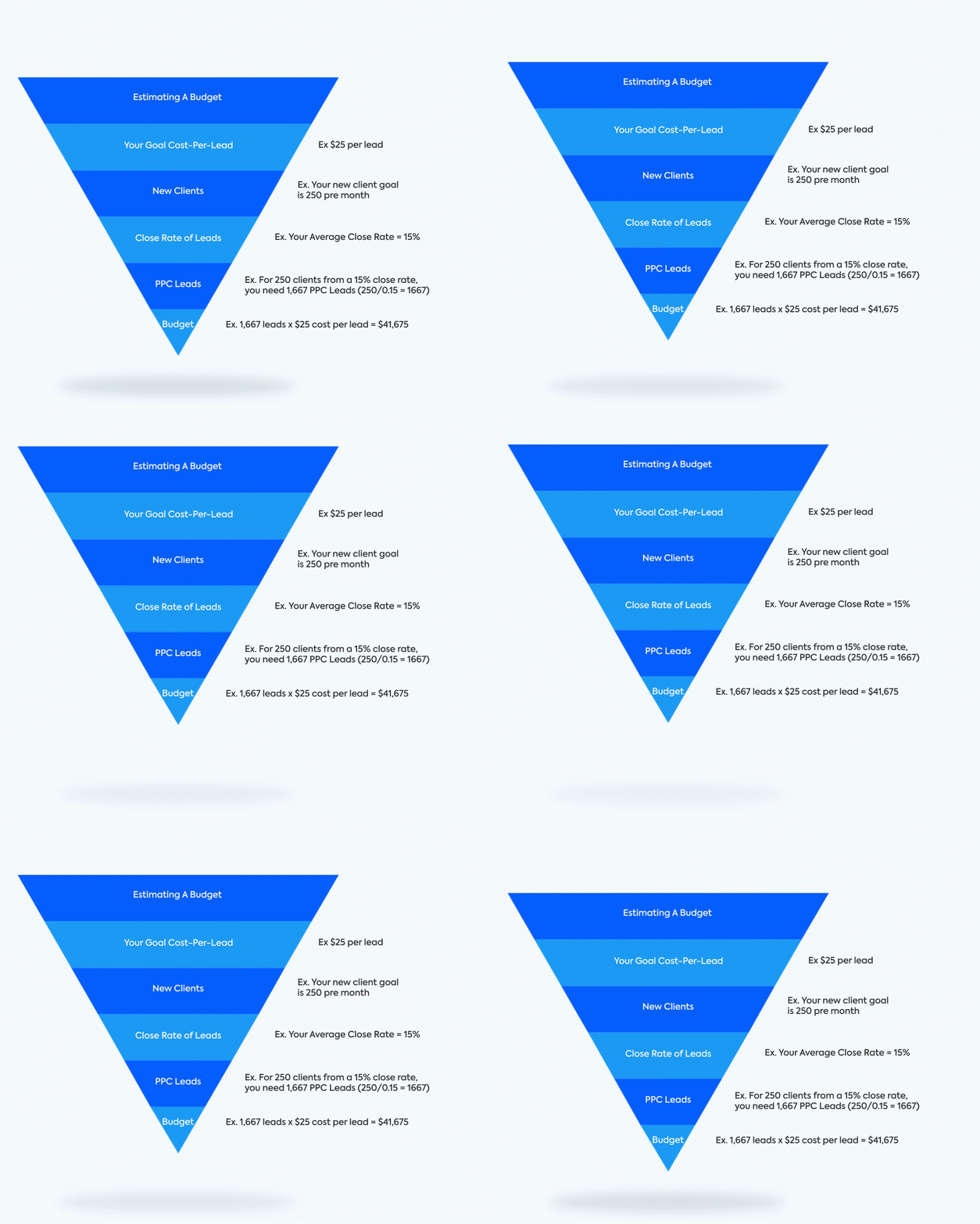
    Once you know the answer to the questions above, you can perform some basic mathematical calculations to help you define your overall budget. Take a look at this image to further understand how this math will work.

    How-to-Determine-How-Much-to-Spend-on-PPC-Advertising.
    Let’s say that you need at least 250 leads per month from your PPC campaign and you have a conversion rate (close rate) of 15%. This means you’ll need 1667 conversions every month to convert 250 leads every month.
    If your CPL is $25, you can expect to spend $1,388 every month or $41,666.67 annually to achieve this goal. 

    Is There Anything That Affects How You Value Leads?

    All leads aren’t created equal. Some leads will enter your funnel fully ready to do business with you. These are called qualified leads. On the contrary, others will need to be nurtured.

    The value of leads will depend strongly on the following factors:

    • Geography: Are your leads valued more or less based on where they live? Are you willing to spend more money on leads from specific areas?
    • Bounce rate: How are your leads interacting with your website? What’s the average bounce rate for your website and what do your web users do after they click on your website?
    • Precedence: What have past qualified leads shown you?

    Controlling the quality of leads that are derived from your PPC campaign is simple. You can utilize negative keywords to stop using search terms that don’t bring in qualified leads

    You can also manipulate the placement of your ads and adjust them based on the time of day they appear. Doing this will ensure that you are putting your budget to great use. 

    For example, if you analyze the performance of your ads during all days of the week, you may see that your CPL on Saturdays is higher than other days of the week, especially for international traffic. 

    At this point, you should ask yourself, “are the leads I’m bringing in over the weekend worth the increased cost? Should I dial back my budget just a bit? This is where bid adjustments come into play.

    Changing the schedule of your ads can help you save money overall, but it’s not the only way. Finding other growth opportunities is vital to saving more money and nailing down your PPC budget.

    How to Find Growth Opportunities?

    Will increasing your budget result in more leads? How can you define the marginal gain for every cent you are spending? Ultimately, it can be challenging to see how changes in your budget can influence your entire campaign.

    Though, Google does offer some tools that can assist marketers in this task. If you’ve used Google Adwords for your campaign, then you’ve likely seen the “limited by budget” notification in your account.

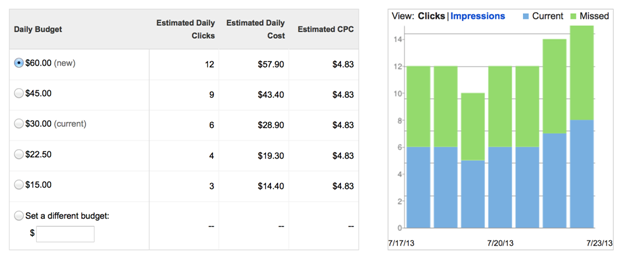
    If you have, then Google provides a helpful resource that will inform you just how much more leads you would receive if you increase your budget. Just take a look at this snapshot.

    ppc-budget
    This shows that Google can estimate the growth of your campaign based on your daily budget. For this user, increasing their daily budget will lead to more daily clicks. The user also has an option to set a different budget and see custom metrics for how that will impact the potential of their campaign.

    Is There Anything to Consider Before Setting My Budget?

    There are various scenarios that can affect your PPC budget, which include:

        • Search vs. the Display Network
        • Keyword Considerations
        • Search Engine (Google vs. Bing)
        • Device (desktop/tablet vs mobile)

    To set the right budget, you’ll need to do some experimentation. Little changes can significantly impact your budget. Therefore, once you understand the growth opportunities for your campaign, you can move forward in increasing or decreasing your budget.

    Over time, you can figure out if your budget is efficiently leading to the results you’re after. Finally, you can deliberate with your marketing team to optimize your campaign to reach your objectives.

    This is the basis of creating a successful campaign and spending the correct amount of money to do so. 

    Improve Your PPC Campaign Today!

    As you can see, defining an accurate budget for your campaign takes a lot of knowledge and effort. If this is something you don’t have, then contact Agency Partner Interactive today to learn more about our PPC services. 

    Not big on reading? That’s okay. Watch “How to Determine How Much to Spend on PPC Advertisinginstead.

    Using the power of Artificial Intelligence, we turned this blog into a video for you. Check it out below!


  • The Beginner’s Guide To PPC Strategies For Service Companies

    The Beginner’s Guide To PPC Strategies For Service Companies

    Tips From Professional Pay-Per-Click (PPC) Marketers

    Many business leaders falsely believe that Pay-Per-Click (PPC) Campaigns are ideal for eCommerce retailers. Nothing can be further from the truth than this because many businesses utilize PPC Services to drive more leads and revenue.

    If you’re running a service company, you should have a definite campaign in place to attract more leads, receive increased phone calls, and capitalize on wide-open sales opportunities.

    With that said, are you new to the concept of PPC? If so, continue reading to familiarize yourself with PPC and how you can leverage it to make more money online.

    Begin Brainstorming

    The first thing you should do when setting up your PPC Campaign is understanding your target audience. Sure, if you’re a contractor, you would apparently know that your target audience is home and business owners.

    However, do you know where these consumers shop? Are you familiar with the exact demographics of your target audience? Understanding this information is pivotal toward realizing where your audience will conduct a search for your business.

    If you’re reaching homeowners, then it’s reasonable to assume that Google and Facebook are excellent platforms to post your ads. If your services are geared toward young adults, then Facebook may be a great option.

    With any marketing strategy, knowing your target audience is key. The principle is true for a PPC campaign.

    Begin With Keyword Research

    Keyword research is an important aspect of PPC. Knowing which Keywords your audience searches for online will help you to bid on high-volume search terms.

    This means that your ads will show up more frequently at the right time to increase your conversions. Google Adwords Keyword Planners is a great tool to conduct basic and extensive Keyword Research.

    However, it’s best if you consult a Digital Marketing Company to guide you in the right direction to ensure that your budget is utilized properly to net you a high return on your investment.

    Organize and Structure Your Keywords

    Once your keyword is complete, it’s time to gather your keywords and organize them into neat groups. The best practice for structuring your keywords is to organize them according to a generic, brand, competitor, and related terms.

    Again, consulting a digital marketing company is ideal during this stage. If you’re a plumber, then you should rely on an internet marketing company that provides pay per click for plumbers.

    You should do the same if you’re an electrician or another contractor that needs specialized PPC services.

    Write Superb Ad Copy

    Once your ads are designed, writing copy for it is the next major step. Ad copy is what your audience will see when your ad is presented to them.

    Ads that contain enticing language that encourages consumers to press action almost always leads to successful campaigns. However, be mindful of making your ad copy seem robotic or dull.

    Oftentimes, you’ll need to tweak your ad copy to achieve better performance with your ads. Does all of this sound like something you have the time or expertise to you?

    If not, contact Agency Partner Interactive today to speak to a member of our sales team.

    Not big on reading? That’s okay. Watch “The Beginner’s Guide To PPC Strategies For Service Companies?” instead.

    Using the power of Artificial Intelligence, we turned this Blog into a video for you. Check it out below!