Tag: email marketing expert

  • What is an Email Marketing Specialist and What Do They Do?

    What is an Email Marketing Specialist and What Do They Do?

    Expert Tips For What is an Email Marketing Specialist and What Do They Do?

    The statistics don’t lie.

    According to HubSpot, “email generates $42 for every $1 spent, which is an astounding 4,200% ROI, making it one of the most effective options available.”

    But don’t think it’s as simple as typing up some copy and hitting send. Email marketing specialists know all the ins and outs of every element for achieving such strong results, from automations and design to audience segmentation and even accessibility!

    Email marketing has consistently shown a strong return for the last ten years in a row. It’s become critical for a company’s success and is a highly in-demand field for expertise! Let’s dig a little deeper into what it is exactly, who runs it, and how to get into the game of becoming an email marketing specialist!

    What is email marketing?

    Put simply, email marketing is the use of electronic messaging to engage with audiences and build relationships. Inform your audience, drive sales, build relationships between your brand and your customers. Think newsletters, announcements, deals/specials, surveys—it’s all part of the larger picture. Email is highly personalized and can be used for both one-off or automated messages; it allows you to communicate directly with customers and prospects as well as gather important data on their habits and preferences.

    It’s common for people to confuse marketing with advertising.  Marketing is about building relationships with customers and creating an experience for them that goes beyond simple transactions. It’s understanding human behavior, knowing what they want and need, and working to provide it. Marketing should be genuine and transparent; you’re not trying to inflate a product or service, but rather bring value to your customer base. Advertising falls under marketing, but generally means paid content (i.e., TV commercials, billboards) as opposed to organic messaging (blog posts and, you guessed it, email).

    Think of it this way: marketing is about helping people find you while advertising is trying to get them to notice you, and email marketing brings that help directly to your audience’s inbox…with permission, of course!

    What is an email marketing specialist? What do they do?

    An email marketing specialist or “email marketer” is someone who knows how to create messages that engage an audience and provide value. They manage every aspect of a company’s emails: how they look, sound, and (most importantly) perform. Typically they work within a company, but many email marketers freelance as well. These professionals work closely with everyone from marketing managers to IT specialists to sales teams; depending on how advanced the campaigns are, an email marketer might handle everything!

    Typical responsibilities include:

    • Craft both long-term and campaign strategies
    • Test and optimize emails for readability and accessibility on multiple devices
    • Design layouts
    • Monitor email campaign performance
    • Maintain multiple databases
    • Apply audience segmentation and targeting
    • Perform A/B tests
    • Track and analyze campaign results

    And especially

    • Always be willing to keep learning and move with the technology

    Agency Partner’s own email marketing lead expert stresses the utmost importance of utilizing automation – “Automations allow email marketers to work smarter not harder.” Who doesn’t love that?

    How to Become an Email Marketing Expert

    Digital marketing is still a new area for much of formal education, so the parameters for entering the field are pretty flexible! Since few institutions offer a specific digital marketing degree, common bachelor’s degrees preferred by employers are:

    • General marketing
    • Business admin
    • Graphic design
    • Communications

    Those should tell you a lot about what to expect in the job! With educational platforms like SkillShare and Coursera, you can easily earn a certification in email marketing itself to help you start building your credibility from home and even for free! No matter what route you take, the job will definitely require you to develop a few skills for sure, such as:

    • Writing attention-grabbing subject lines
    • A sharp eye for design and formatting
    • Understanding analytics and how to interpret them
    • Audience insight
    • Campaign strategy

    *****

    To summarize, as Agency Partner’s email expert puts it, “Email marketers constantly need to balance aesthetics with function. It’s important to have a keen eye for design as well as the knowledge of how to apply that design for functionality…Email marketing is all about emailing the right person, at the right time, with the right message. Personalization, tagging, and audience segmentation are crucial.”

    It’s a lot to manage for sure! Need some help with your company’s email marketing? Agency Partner’s team of specialists are one Contact Us page away to get started with crafting your strategy and developing campaigns to build your audience and drive your sales, one inbox at a time!
  • 3 Automated Email Campaigns for Ecommerce: A Practical Guide

    3 Automated Email Campaigns for Ecommerce: A Practical Guide

    Automated email campaigns for ecommerce send relevant messages when a subscriber or customer meets a defined condition, such as joining your list or leaving checkout without completing a purchase. Unlike a scheduled newsletter, an automated workflow responds to an event or a change in customer status.

    Three useful starting points are welcome emails, abandoned checkout reminders, and educational nurturing sequences. Each needs a clear purpose, suitable audience, and stopping rules. Automation should make communication more relevant, not simply increase the number of messages customers receive.

    Before You Build an Ecommerce Email Workflow

    Confirm that your store and email platform exchange the information each workflow needs. This may include subscription status, checkout activity, completed purchases, and product availability. Available events depend on your platform, integration, and tracking setup.

    Define who can enter a sequence, when a message should be sent, and what should stop it. Apply your permission requirements and suppression settings before activation. An email address entered during checkout should not automatically be treated as permission for every marketing campaign.

    If implementing these connections requires changes to the store itself, discuss the integration scope as part of your ecommerce website development project. Email strategy and campaign management should be agreed separately where needed.

    1. Welcome New Subscribers With a Clear Introduction

    A welcome workflow helps subscribers understand what they signed up for and what to expect next. Start when someone becomes eligible for marketing messages through your signup process, including any confirmation step you use.

    What to Include

    Thank the subscriber, explain what your store offers, and deliver any resource or offer promised during signup. Keep the next action clear, such as exploring a relevant product collection or reading a buying guide.

    A later message can answer common questions about product selection, delivery, or returns. Use genuine customer feedback only when you have permission and can represent it accurately.

    Example subject line: Welcome to [Store Name]: Find Your First Favorite

    Timing and Exit Rules

    Send the initial welcome when the subscription is confirmed and the promised content is ready. Test the spacing of later messages rather than assuming every store needs the same sequence.

    If the subscriber purchases, update the remaining content so it does not keep treating them as a first-time buyer. Coordinate welcome emails with other campaigns to avoid overlapping promotions.

    2. Follow Up on Abandoned Checkouts Without Overwhelming Shoppers

    An abandoned checkout workflow follows up when an identifiable shopper starts checkout but does not complete the order. Cart abandonment and checkout abandonment are different events, and your platform may not support both in the same way.

    Only send to eligible contacts under your permission rules and platform settings. Anonymous browsing alone does not provide an email recipient you can contact.

    Build a Useful Reminder

    A first reminder can show the selected products and provide a working return-to-checkout link. A later message might answer questions about sizing, delivery, returns, or payment options.

    Discounts are optional. Before adding one, consider product margins, existing promotions, and whether the offer could encourage customers to wait for a coupon. Avoid false stock warnings, invented deadlines, or unsupported product claims.

    Example subject line: Still Considering These Items?

    Test Timing Instead of Applying a Fixed Schedule

    Choose an initial delay that fits the purchase decision and your platform’s event accuracy. A low-cost replenishment product and an expensive custom item may need different approaches.

    Start with a limited sequence and assess completed purchases, complaints, and unsubscribes before expanding it. More reminders are not automatically more effective.

    Recheck eligibility before every message. Stop the sequence when the customer buys or opts out. Handle unavailable products, expired offers, and invalid checkout links so the email does not promise something the store can no longer deliver.

    3. Nurture Interest With Product Education

    Some subscribers need help deciding what to buy rather than another promotional offer. A nurturing workflow can provide useful information based on interests they have shared or eligible activity your platform records.

    Match the Content to the Decision

    Explain product differences, practical use cases, compatibility, or care requirements. For example, a bag retailer could help shoppers compare capacity, laptop fit, and materials instead of repeatedly sending the same product promotion.

    Clearly label hypothetical examples. Do not present fictional customers, invented results, or unverified testimonials as real evidence.

    Example subject line: Which Option Fits Your Everyday Routine?

    Change the Journey After a Purchase

    Once a subscriber buys, stop sending irrelevant acquisition messages. Where appropriate, move them into a separate customer journey with product guidance or suitable follow-up communication.

    Avoid recommending products they just bought unless there is a genuine reason. For replenishment messages, consider the product’s likely usage cycle rather than sending every customer the same reminder.

    Pause or adjust promotional sequences when customer circumstances make them inappropriate, such as an unresolved delivery problem or a recent return.

    Protect Deliverability and Subscriber Choice

    Use a recognizable sender identity, accurate subject lines, and clear unsubscribe options. Maintain suppression lists and coordinate message frequency across automated flows and scheduled campaigns.

    Ask your email provider or technical team to verify domain authentication and the sender requirements that apply to your sending volume. Google’s email sender guidelines explain its authentication and unsubscribe requirements, including additional requirements for bulk senders.

    Technical sender requirements do not replace privacy and marketing obligations. Have the appropriate team review your collection methods, recipient eligibility, tracking, and message content for the markets you serve.

    Test Each Workflow Before Activation

    Use test contacts and orders to check entry conditions, message content, links, and exit rules. Confirm that a completed purchase stops checkout reminders and that an unsubscribe prevents further marketing sends.

    Preview emails on mobile and desktop. Check personalized fields, product images, offer conditions, and fallback text when customer information is missing.

    Test interactions between workflows. A subscriber should not receive a welcome offer, an abandoned checkout reminder, and a general promotion together simply because each automation was configured separately.

    Measure Outcomes, Not Just Email Activity

    Review completed orders, clicks, unsubscribes, complaints, and revenue after discounts and returns. Treat open rates as a supporting signal rather than proof that a person read the message.

    Your email platform’s attributed revenue is not necessarily the same as additional revenue caused by the campaign. Where your audience size and tools allow it, compare a flow against a suitable holdout group that does not receive the marketing sequence.

    Test one meaningful change at a time, such as message timing, product guidance, or an incentive. Avoid declaring a winner from a small number of orders.

    Frequently Asked Questions

    Which ecommerce email automation should I set up first?

    Start with a workflow supported by reliable data and a clear customer need. A welcome sequence can be a manageable starting point for a store actively collecting subscribers. Abandoned checkout emails may be useful when checkout events, recipient eligibility, and purchase-based stopping rules are working correctly.

    How many abandoned checkout emails should I send?

    There is no universal number. Begin with a limited sequence, review customer response, and coordinate it with other messages. Stop reminders after purchase or opt-out, and avoid repeatedly contacting shoppers who do not engage.

    Should every automated email include a discount?

    No. Product guidance, delivery information, and answers to common questions may be more appropriate. Use incentives selectively and assess their effect on margins and customer behavior.

    Plan Ecommerce Email Campaigns Around Your Customers

    Useful automation connects reliable store data with relevant messages and clear stopping rules. Begin with a manageable set of workflows, test the customer experience, and improve the sequences using business outcomes.

    For help planning your approach, explore Agency Partner Interactive’s ecommerce email marketing services and discuss your audience, platform, and campaign requirements.

    Using the power of Artificial Intelligence, we turned this blog into a video for you. Check it out below!


  • A Beginner’s Guide to Successful Email Marketing

    A Beginner’s Guide to Successful Email Marketing

    Expert Tips For Email Marketing

    Marketing strategies usually have the purpose of attracting qualified leads to do business with you. Email marketing is very different in this regard. In email marketing, you already have qualified leads in your email list and the purpose is to convert them.

    Email marketing takes all of the hard work out of prospecting for potential customers. The more your email list grows, you will have the attention of hundreds and even thousands of people that could potentially purchase your products and services.

    What you do with this attention will impact the performance of your email marketing campaign. If you want to bypass a bit of the learning curve of making rookie mistakes in your first campaign, continue reading to learn all you need to know about email marketing.

    What is Email Marketing?

    Email marketing is the process of converting prospective customers in an email list. An email list is a collection of people, known as subscribers. If you’ve ever visited a website, then you’ve likely seen a prompt urging you to sign up for a newsletter or email list.

    Here’s an example of what this looks like:

    beginners_guide
    Successful companies have large email lists, which are ideal for eventually converting new customers and encouraging repeat transactions from existing ones. Email marketing is a valuable means of creating an engaged audience for your business.

    Why is Email Marketing Important?

    Email marketing delivers the highest return on investment (ROI) than any other marketing initiative. This speaks volumes of how email marketing can benefit your business.

    Still not impressed?
    If not, then check out these benefits of beginning an email marketing campaign for your company. 

    • Quality Collection of Leads – Email lists are full of qualified leads who can convert at any moment. 
    • Ease of Conversion – Unlike other marketing campaigns, subscribers are simple to convert. You don’t have to craft long-form content and engage in extensive keyword research. 
    • Increased Website Traffic – You can take advantage of your email list to achieve a continual flow of website traffic. Increased visibility will lead to more conversions sooner or later.
    • Feedback – More than any other marketing strategy, you can understand what your subscribers are feeling by sending out surveys and optimize your campaign for better results.

    As you can see, you can’t afford to not have an email marketing campaign. Are you looking for insights on how to start and grow your campaign? The next section will discuss core email marketing techniques you need to employ immediately.

    What are Essential Email Marketing Tips?

    If you’re new to email marketing, understanding how to navigate your campaign can be challenging. The good news is that email marketing is pretty straightforward. Let’s go over the basics of beginning your successful campaign. 

    Segmentation:

    Segmentation involves putting subscribers in specific categories. Each category receives a different marketing message. For example, inactive subscribers will be placed in a category where they will be sent re-engagement emails
    On the other hand, subscribers likely to convert will be sent custom messages to get them across the threshold. You can’t expect your email list to grow by sending the same emails to all of your subscribers.

    This will cause them to tune out and eventually unsubscribe. Instead, send relevant email messages by segmenting your entire email list.

    Personalization:

    According to HubSpot, personalized emails deliver exceptionally high transaction rates. Personalization is the next step of segmentation. It involves creating a personal and relevant email message to each subscriber. 

    Again, your email list won’t grow if you copy, paste, and send similar emails to every subscriber. It’s important to realize that people receive dozens of emails every day and will quickly become annoyed if they see that your correspondences don’t appeal to them.

    Although it may take more time and effort, sending personalized emails is key to your overall success at email marketing. 

    Subject Lines:

    What is the first thing you notice before opening an email? It’s, of course, the subject line. Emails with a personalized subject line have an open rate of 7.4% and a click-through rate (CTR) of .4%.

    It’s pivotal to create emails with captivating subject lines. This will increase the CTR of your emails and make sure you are generating positive ROI from your campaign. 

    Welcome Emails:

    Perhaps the most important aspect of any email marketing campaign is the welcome campaign. It serves the following functions:

    • Welcome emails set the tone for the entire campaign.
    • Welcome emails allow you to begin segmentation. 
    • Welcome emails increase engagement and allow you to introduce yourself.

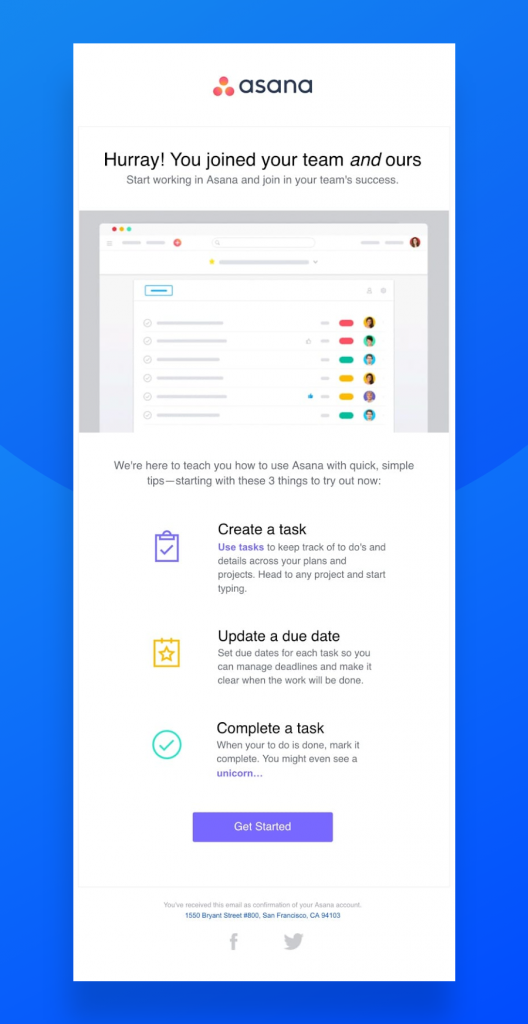
    If you need inspiration on how to create the perfect email campaign, then take a look at this welcome email from Asana. 

    asana
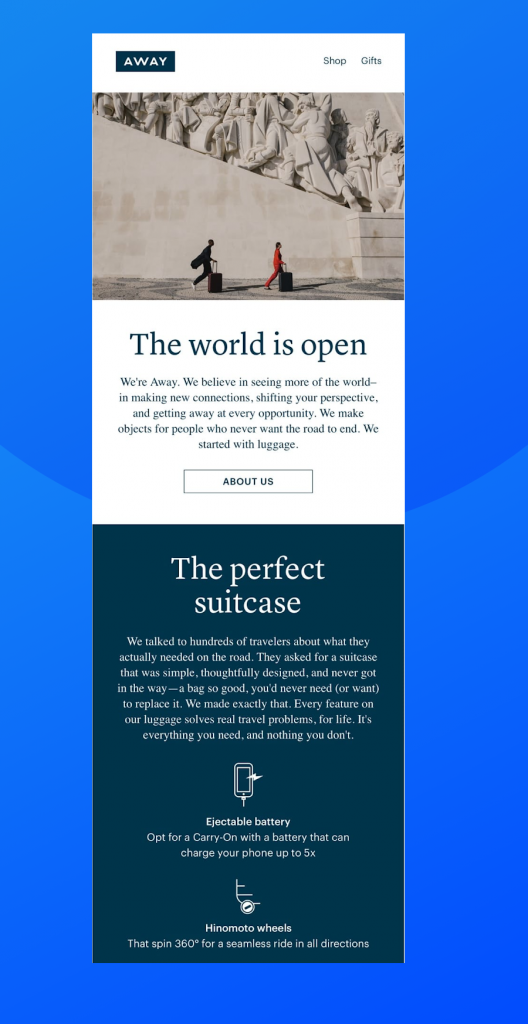
    Or, you can check out this one from Away. 

    away
    These welcome emails do more than just say hello. They give subscribers something to look forward to. 

    Remarketing:

    There will be a time where your emails will not reach everyone on your email list. If you notice that your email list has a bunch of inactive subscribers, you should begin a re-engagement series. 

    These series of emails will attempt to reach subscribers that haven’t interacted with your emails in a while.

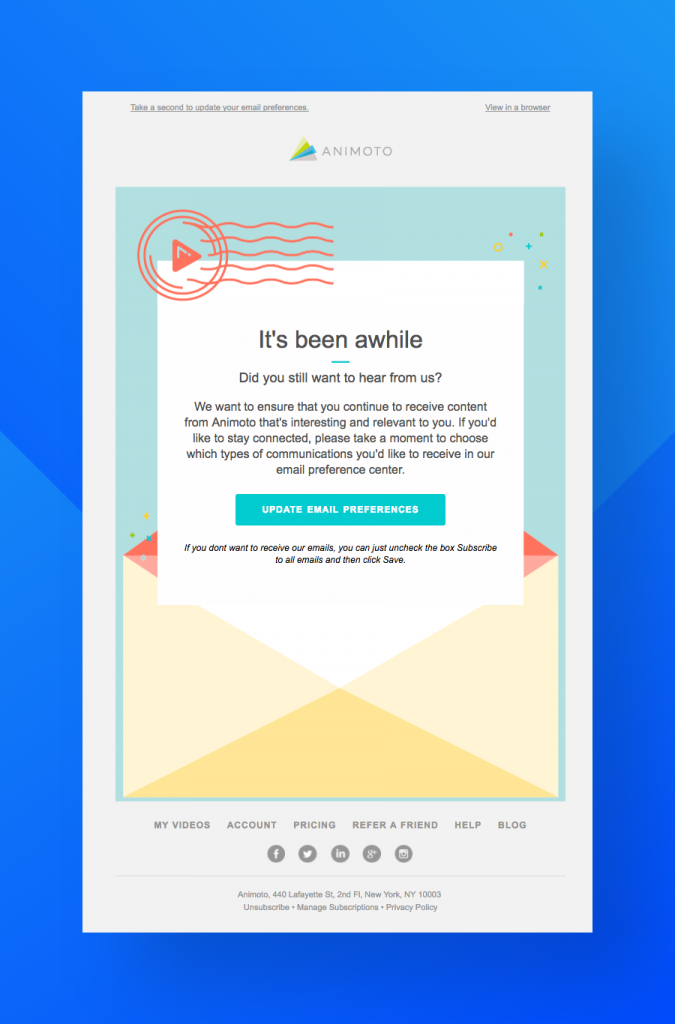
    Reengagement emails look like this:

    beginners_guide
    As you can see, re-engagement emails are a formality in email marketing. However, these emails are simply an attempt. If inactive subscribers don’t engage with your campaign in a while, it would be best to let them go. 

    Email Copy:

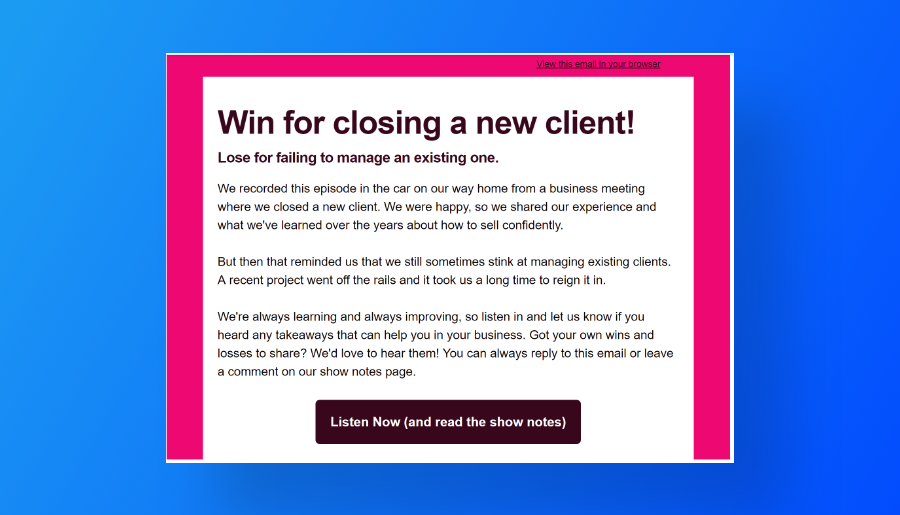
    If you want people to engage with your emails, you have to sound like a real person. Emails aren’t essays. Therefore, it’s not time to show off any extravagant words. A great, conversational email looks something like this. 

    guide

    Give Us a Call Today!

    Email marketing is a simple concept, but carrying out a successful campaign takes a lot of work. Hiring an experienced digital marketing agency may be in your interest if you need assistance.

    If you want to learn more about how you can hire Agency Partner Interactive, give us a call at (877) 682-2012 or click here to receive a free quote.   

    Not big on reading? That’s okay. Watch “A Beginner’s Guide to Successful Email Marketing” instead.

    Using the power of Artificial Intelligence, we turned this blog into a video for you. Check it out below!


  • The Future of Email Marketing

    The Future of Email Marketing

    Expert Tips on Email Marketing

    Email marketing is still the top marketing initiative that generates the highest ROI. When it comes down to it, this actually makes sense. Other marketing initiatives like SEO and PPC are designed to generate qualified leads and lead them to purchase. On the other hand, once you have an email list, you already have a bunch of qualified leads that are ready to listen and are close to purchasing. 

    Does this mean that email marketing is simple?

    Of course not! 

    People receive several emails every day, some even from your competitors. Making your emails stand out is a real challenge. To stay on top of the curve, educating yourself on the latest email marketing trends is a must.
    This article will outline four major email marketing trends you should consider to reinforce your current campaign. 

    1. Leverage User-Generated Content

    User-generated content is defined as content chosen by the user. For example, when a person subscribes to receive precise property listings in their area from a real estate agency, they are activating user-generated content.

    Oftentimes, brands can lose sight and send messages that they believe are relevant only to experience low engagement metrics and open-rates. The most obvious solution to combat this is giving your subscribers the type of content they want. 

    To do this for an already established email list, you can send a survey allowing your subscriber to hand-pick the content they receive and the frequency in which they receive it. 

    If you are starting to build your email list, you can create a subscriber opt-in box that makes the previous feature possible. Overall, you should strive to send emails that your subscribers will look forward to. 

    Otherwise, they won’t open them and you’ll waste your vital marketing spend. 

    2. Study Your Audience and What Works

    Despite what you see from online articles and videos, there isn’t a one-size-fits-all marketing strategy. The best marketers and business leaders take risks and experiment often.

    email_marketing
    Not every audience is the same, so would it really make sense to copy an email marketing strategy you saw from a marketing agency to your real estate subscribers? Clearly, both audiences crave something different.

    For a real-estate audience, emails with a sliding carousel of potential listings would be helpful. That way, your subscribers won’t have to do a lot in visiting your website and refining their search.

    For a marketing audience, simple text-based emails have like this long proved to be effective.

    There are a lot of ways to understand what works in your particular industry, but to be sure it will work for your audience, you should study them. Look for key metrics that prove either your emails aren’t being read or that no one is visiting your website from your campaign.

    Once this happens, it will be easier for you to craft the right messages your subscribers will listen to and respond to. 

    3. Practice Segmentation

    Experienced marketers know segmentation is a key component of effective email marketing. Ideally, you should segment your entire list, even if it means leaving just one contact in a category by themselves.

    Why?  Deep personalization can lead to the best open rates. In one survey, it resulted in up to a 29.95% open rate and a click-through rate of 5.03%. It may be time-consuming and tedious to separate your email list into such granular categories, but you want to be able to reach every potential customer in a relatable fashion.

    After all, when a person opts-in to your email list, they are giving you sensitive information like their email address.

    Show them that you value their time by crafting an email just for them. 

    4. Make Your Emails Compatible

    Most people access their inboxes from a mobile device. This means that your emails should be optimized to be compatible with all mobile devices. You can do this by following these tips:

    • Reduce email content.
    • Don’t use text in images; instead, use text HTML. 
    • Develop a visual hierarchy in emails.
    • Avoid text alignment and be aware of excessive sections of center-justified text.
    • Use alt text for all images.
    • Use bigger line spacing and font sizes.
    • Make sure HTML tables can be read by screen readers.

    Mobile-friendliness is extremely important nowadays, not just for your website. Take the above tips to ensure that your emails are compatible with any platform. 

    Give Us a Call Today!

    Do you want to put certified email marketing experts in your corner? If so, give us a call today at (877) 682-2012 or click here to receive a free quote. 

    Not big on reading? That’s okay. Watch “The Future of Email Marketing” instead.

    Using the power of Artificial Intelligence, we turned this blog into a video for you. Check it out below!