Tag: Digital marketing services

  • 9 Social Media Trends You Need to Know for 2024

    9 Social Media Trends You Need to Know for 2024

    With over 3.8 billion people using social media worldwide, staying on top of the latest trends isn’t just a strategy—it’s a necessity. If you’re navigating the dynamic world of social media marketing, staying ahead of the curve is crucial. As we approach 2024, it’s essential to adapt to the evolving landscape and integrate the latest social media marketing trends. Here’s an updated guide to the top trends that are reshaping how businesses connect with their audience. 

    Social Retailing Revolution 

    Digital and social media marketing are no longer just about engagement; they’re becoming increasingly transactional. In 2024, expect to see a surge in social commerce, with brands leveraging Instagram marketing, Facebook marketing, and TikTok marketing to create immersive shopping experiences. Features like live demos, shoppable posts, and direct in-app purchases will dominate, pushing brands to integrate seamless buying processes within social platforms. 

    • Live Demos: Real-time product demonstrations on social platforms to engage and convert viewers. 
    • Shoppable Posts: Instant purchasing options embedded within social media posts to streamline the buying process. 
    • In-App Purchases: Complete transactions without leaving the social media app, enhancing user convenience. 
    • Integrated Shopping Experiences: Seamless integration of browsing and buying to keep the user experience fluid and engaging. 
    • Personalized Recommendations: Leveraging AI to offer tailored product suggestions directly within social media feeds. 

    Proactive Customer Service on Social 

    Customer service is making a big comeback on social platforms, with an emphasis on proactive interactions and real-time engagement. Brands will leverage advanced APIs and integrated tools to offer support directly through social channels, enhancing accessibility and responsiveness. This trend reiterates the importance of maintaining a strong customer service presence to boost brand loyalty and satisfaction. 

    Recruitment via Social Media 

    The recruitment landscape is evolving with platforms like TikTok becoming mainstream channels for discovering talent. In 2024, companies will increasingly post job openings and search for potential candidates through social media, emphasizing their culture and values to attract the right fit, particularly among Gen-Z candidates. 

    Humanizing Brands 

    Today’s consumers expect more than just quality products; they seek brands with which they can identify. Showcasing your brand’s human side—be it through behind-the-scenes content, employee spotlights, or customer stories—will help in building a more relatable and engaging brand image. 

    • Behind-the-Scenes Content: Share glimpses of daily operations or product creation processes to connect authentically with audiences. 
    • Employee Spotlights: Highlight the individuals behind the brand to personalize your company and enhance relatability. 
    • Customer Stories: Feature testimonials or stories from satisfied customers to demonstrate impact and build trust. 
    • Live Interaction: Engage in real-time with followers through Q&A sessions, live tours, and more to foster a deeper connection. 
    • Community Involvement: Showcase your brand’s participation in local events or charitable activities to highlight community commitment and values. 

    Increased Accountability 

    Consumers are holding brands accountable like never before. Issues like sustainability, ethical practices, and corporate responsibility are hot topics. Brands need to not only commit to their values but also transparently show their progress and real actions. 

    Authenticity in Branding 

    Authenticity is no longer optional but a strict requirement. Digital marketing agency Dallas stresses that consumers can easily spot insincerity, making it crucial for brands to be transparent about their practices and beliefs. Authenticity will lead to greater trust and loyalty from consumers. 

    User-Generated Content on TikTok 

    User-generated content (UGC) remains at the forefront of content strategy, particularly on platforms like TikTok. Encouraging your audience to create content related to your brand not only enhances engagement but also supports authenticity. Hosting challenges, featuring user stories, and actively interacting with such content can greatly boost your brand’s presence. 

    LinkedIn’s Rise as an Influencer Platform 

    With the continuing trend of remote work, LinkedIn is expected to increase its focus on creators and influencers, making it a key platform for professional branding and networking. Utilizing LinkedIn for thought leadership and professional content can significantly enhance your professional brand. 

    • Creator Mode Enhancements: Leverage new features designed to boost visibility and engagement for professionals sharing original content. 
    • Professional Networking: Use LinkedIn’s robust networking tools to connect with other industry leaders and potential collaborators. 
    • Thought Leadership Content: Publish insightful articles and posts that establish your expertise and attract a following within your industry. 
    • Interactive Webinars and Live Events: Host or participate in LinkedIn Live sessions or webinars to discuss industry trends and share knowledge. 
    • Personal Branding Opportunities: Optimize your profile with rich content and strategic keywords to stand out to recruiters, collaborators, and followers. 

    #NoFilter Content 

    The shift towards authenticity will see a rise in #NoFilter content, where brands post more natural, less edited content. This trend aligns with the growing consumer preference for genuineness over polished perfection. 

    As we look towards 2024, these social media trends offer valuable insights for brands aiming to stay competitive and resonate with their audiences. If you’re looking to refine your strategy and ensure your social media efforts are ahead of the curve, consider partnering with a Digital marketing services provider like Agency Partner Interactive. With extensive experience in social media marketing Dallas and beyond, they can help your business navigate these trends effectively. 
  • SEO Tips for E-commerce Website in 2024

    SEO Tips for E-commerce Website in 2024

    The digital marketplace is ever-changing, making SEO crucial for e-commerce. As we approach 2024, it’s important for online businesses to implement strong SEO Strategies for E-commerce to gain more organic traffic, enhance customer engagement, and stay competitive. Here are the most effective SEO techniques to boost your store’s visibility and performance. 

    Understanding the Basics of E-commerce SEO Best Practices 

    E-commerce SEO Best Practices is about optimizing your online store to improve visibility and rankings in search engine results. This multifaceted approach includes keyword research, on-page optimization, content enhancement, and mastering technical SEO. The goal is straightforward: amplify your visibility to attract potential customers searching for products you offer. 

    Key SEO Strategies for E-commerce in 2024 

    1. Conduct Thorough Keyword Research 

    Keyword research is the bedrock of your SEO strategy. Begin by identifying high-value keywords that potential customers use to find products similar to yours. Utilize tools such as Google Keyword Planner, Ahrefs, SEMrush, and Moz to discover both high-volume and niche terms that can drive targeted traffic to your site. 

    Focus on both short-tail and long-tail keywords. Short-tail keywords are broader terms with higher search volumes but greater competition. Long-tail keywords are more specific and often have lower search volumes but attract more qualified traffic. 

    Example: For organic skincare products, focus on keywords like “organic skincare essentials,” “natural face creams,” or “eco-friendly skincare.” Use long-tail variations such as “best organic moisturizers for sensitive skin” to capture specific search intents. 

    2. Optimize Your On-Page Elements 

    Refining your website’s on-page elements like title tags, meta descriptions, headers, and product descriptions is essential for SEO. 

    • Title Tags: Ensure your title tags are under 60 characters and include primary keywords. They should be compelling to encourage clicks. Example: “Buy Organic Skincare Products – Natural Face Creams & Moisturizers.” 
    • Meta Descriptions: Craft meta descriptions that are enticing and keyword-rich to improve click-through rates. Example: “Discover our range of organic skincare products, including natural face creams and moisturizers. Shop now for healthy, glowing skin!” 
    • Headers (H1, H2, H3): Use headers to structure your content, making it easier to read and crawl. Include keywords naturally within these headers. 
    • Product Descriptions: Write unique, detailed product descriptions that highlight key features, benefits, and specifications. Avoid using manufacturer descriptions and instead, tailor them to reflect your brand’s voice. 

    3. Prioritize High-Quality Content Creation 

    Content is king in the SEO Strategies for E-commerce. Develop and publish high-quality content that addresses the interests and needs of your target audience. Regularly updated content like blogs, guides, and product reviews can attract new visitors and establish your site’s authority. 

    • Blog Posts: Write informative and engaging blog posts targeting long-tail keywords. Example: “10 Reasons to Switch to Organic Skincare Today” can drive interest and traffic to related product categories. 
    • Guides and Tutorials: Create comprehensive guides and tutorials that help users solve problems or make informed decisions. Example: “The Ultimate Guide to Natural Skincare Routines.” 
    • Customer Stories and Reviews: Showcase customer stories and reviews to build trust and demonstrate the effectiveness of your products. 

    4. Enhance Site Structure and Navigation 

    A well-organized site structure aids both user experience and search engine indexing. Implement clear categories and subcategories and consider using breadcrumb navigation to enhance both usability and SEO. 

    • Clear Categories: Organize your products into logical categories and subcategories. Example: “Skincare > Face Care > Moisturizers.” 
    • Breadcrumb Navigation: Implement breadcrumb navigation to help users and search engines understand your site’s structure. This also improves the user experience by showing the path to the current page. 

    5. Implement Advanced SEO Techniques 

    Advanced E-commerce SEO Tactics can give your e-commerce site an edge over the competition. 

    • Structured Data: Use schema markup to provide search engines with specific information about your products, such as prices, reviews, and availability. This can enhance visibility through rich snippets. 
    • Mobile Optimization: Ensure your site is fully responsive, as mobile usability is a critical ranking factor. Optimize images, use mobile-friendly layouts, and reduce page load times for better mobile performance. 
    • Technical SEO: Regularly audit your site for SEO health, focusing on site speed, secure connections (HTTPS), XML sitemaps, and robots.txt files. 

    6. Build and Maintain Quality Backlinks 

    Acquiring high-quality backlinks from reputable sources within your industry boosts your site’s authority and drives referral traffic. Engage in guest blogging, influencer collaborations, and content marketing strategies to build a strong backlink profile. 

    • Guest Blogging: Write guest posts for authoritative blogs in your niche, including a link back to your site. 
    • Influencer Collaborations: Partner with influencers to review and promote your products, earning valuable backlinks. 
    • Content Marketing: Create shareable content, such as infographics, that others in your industry may link to. 

    7. Encourage and Manage Customer Reviews 

    Positive customer reviews significantly influence purchasing decisions and bolster your SEO efforts. Encourage reviews through post-purchase emails or incentives and manage your online reputation by responding to feedback promptly. 

    • Post-Purchase Emails: Send follow-up emails requesting reviews. 
    • Incentives: Offer discounts or loyalty points in exchange for reviews. 
    • Third-Party Platforms: Encourage reviews on platforms like Google My Business and Yelp to enhance your local SEO. 

    8. Stay Updated with SEO Trends and Algorithm Updates 

    SEO is ever-evolving. Stay informed about the latest trends, algorithm updates, and best practices in technical SEO for E-commerce to continually refine your strategies and maintain a competitive edge. 

    • Algorithm Updates: Regularly monitor updates from search engines like Google and adjust your strategies accordingly. 
    • SEO Trends: Keep an eye on emerging trends, such as voice search optimization, AI-driven SEO tools, and personalized search results. 

    Advanced E-commerce SEO 2024 

    Adopting these e-commerce SEO strategies in 2024 will significantly improve your online store’s search engine visibility, attract more organic traffic, and ultimately increase sales. Remember, SEO requires patience and persistence, but the benefits it delivers are worth the effort. 

    Ready to elevate your e-commerce SEO? Contact Agency Partner Interactive today for expert SEO and digital marketing services tailored to your online store’s needs. Let’s boost your business together! 

    Get in Touch Now: Don’t wait to transform your e-commerce SEO strategy. Reach out for professional assistance and start seeing tangible improvements in your online store’s performance! 

  • How Much Should Working with a Digital Marketing Agency Cost in 2024?

    How Much Should Working with a Digital Marketing Agency Cost in 2024?

    If you’re pondering the cost of hiring a digital marketing agency, let’s just say, digital marketing is pretty much essential now. The digital world isn’t just evolving; it’s exploding with opportunities and innovations at breakneck speed. In this era, staying off the digital radar can cost you more than you might imagine—lost visibility, missed connections, and foregone revenue. But what does it truly cost to jump into the digital marketing game? 

    Understanding these 2024 marketing expenses can be daunting, but we have got your back. We’re here to simplify the costs of digital marketing and guide you through the financial domain that surrounds it. Let’s break down the marketing agency pricing 2024 and explore everything in-between, ensuring you make the most informed decisions for your 2024 marketing strategy. 

    Understanding the Pricing Models 

    When it comes to digital marketing agency costs in 2024, there is no such thing as a fixed price tag. Agencies can charge in a multitude of ways – hourly rates, monthly retainers, or project-based pricing. And what drives these digital marketing agency costs 2024? Factors range from the type of services you need to the expertise of the agency you choose. 


    Pricing Model  Description  Typical Use Cases  Cost Influencers 
    Hourly Rates  Agencies charge a fixed rate for each hour of work performed.  Best for small, specific tasks or when you need specialized expertise on an ad-hoc basis.  Complexity of tasks, agency’s expertise, geographic location. 
    Monthly Retainers  A fixed monthly fee for a bundle of services.  Ideal for ongoing services like SEO, social media management, and regular content creation.  Scope of services, duration of the contract, agency’s reputation. 
    Project-Based Pricing  A flat fee for the entire project, regardless of the time it takes to complete.  Suitable for one-time projects like website redesigns or campaign launches.  Project scope, deliverables, project duration, technical complexity. 


    Breaking Down the Services 

    Let’s get into specifics. If SEO is what you need, remember, it’s a marathon, not a sprint. The ongoing effort to stay on top of search results could mean a steady investment, affecting your Digital Marketing Agency Costs 2024. For content creation, consider the variety and volume of content you need—this could include blogs, videos, and social posts, all tailored to engage and convert your audience. This influences the Marketing Agency Pricing 2024. 

    Social media isn’t just about posting; it’s about creating a brand identity and connecting with your audience on a personal level. Effective social media strategies are a key part of digital marketing services offered by the best digital marketing firm. And PPC? It’s all about paying for visibility, and it can offer fast results, but at a price, impacting the Cost of Hiring a Digital Marketing Agency and 2024 Digital Marketing Rates. 

    The Cost Spectrum of Digital Marketing Agencies 

    Digital marketing agency pricing in 2024 varies widely, affecting your overall 2024 marketing expenses. Newer or less experienced agencies might offer lower rates but consider whether they can really deliver the results you need, impacting the cost of hiring a digital marketing agency. Mid-range agencies generally offer a good balance of cost and quality, ideal for growing businesses that need reliability without breaking the bank, reflecting the marketing agency pricing 2024. Premium agencies, while costly, provide top-tier digital marketing services and are typically suited for large-scale companies with complex needs, influencing 2024 digital marketing rates. 

    Cost Determinants in Digital Marketing 

    Where your agency is based can influence costs due to economic factors. The experience level of the agency is also essential—more experienced agencies charge more but also bring a wealth of knowledge and a proven track record, impacting your digital marketing agency costs 2024. Custom strategies cost more than generic plans but can offer better results and a higher ROI, affecting your marketing agency pricing 2024. 

    Budgeting for Digital Marketing in 2024 

    For small businesses just starting, setting a realistic budget for digital marketing is crucial. You might not need to go all-in right away. Scale up as you begin to see the value it brings to your business. 

    Package  Monthly Budget  Included Services 
    Basic Digital Marketing  $1,000 – $3,000  Basic SEO, some content creation, social media management 
    Intermediate Package  $3,000 – $10,000  Comprehensive SEO, regular blog posts, aggressive social media, PPC 
    Comprehensive Package  $10,000 – $20,000+  Advanced SEO, extensive content creation, robust social media, full PPC 
    Project-Based Costs  $5,000 – $50,000 (one-time)  Website redesign, specific campaigns 
    Hourly Rates  $100 – $300 per hour  Specialized expertise, ad-hoc tasks 

    Evaluating Your Investment 

    How do you know if what you’re spending is paying off? Track your campaigns every day, use analytics to monitor performance, and adjust strategies as needed. The goal is to ensure that every dollar spent maximizes your return on investment. 

    Cost-Saving Tips for Digital Marketing 

    Even if funds are tight, you don’t have to compromise on quality. Focus on cost-effective marketing solutions in 2024 by identifying which aspects of digital marketing yield the best results for your business. And don’t be shy about negotiating with agencies; they might offer flexibility in pricing, especially if you commit to a longer-term partnership, affecting your overall digital marketing agency costs 2024 and marketing agency pricing 2024. 

    Choosing the Right Agency 

    The best digital marketing firm for your business should understand your industry and share your vision for growth. They should act less like a hired service and more like a partner. Be wary of agencies that promise the moon on a stick for pennies on the dollar—true expertise comes at a cost, but it should also come with transparency and a clear strategy. 

    The Future of Digital Marketing Costs 

    Looking ahead, digital marketing costs are likely to evolve as new technologies and platforms emerge. Staying informed and adaptable will help you plan your marketing budgets more effectively and keep your strategies fresh and relevant. 

    Conclusion:  

    As we wrap up, remember that investing in digital marketing is not just a cost but a significant part of your business strategy that drives growth. Plan wisely, choose the right partners, and keep a close eye on your investments. 

    Ready to Take Your Digital Marketing to the Next Level? 

    Ready to boost your digital marketing and see some real results? Partner with Dallas’s top agency, Agency Partner Interactive! Whether you’re just starting out or looking to scale up, we offer smart, cost-effective solutions that help your business grow. 

    Contact us today and let’s chat about how we can help you reach your digital marketing goals. Let’s start crafting your success story together! 

  • Navigating Ethical AI in Content Creation: 8 Best Practices for 2024

    Navigating Ethical AI in Content Creation: 8 Best Practices for 2024

    Artificial Intelligence (AI) has become increasingly prevalent in content creation, revolutionizing how content is generated, curated, and distributed. However, as AI technologies advance, so do the ethical considerations surrounding their use. In this article, we will explore the 8 best practices for navigating ethical AI in content creation in 2024, highlighting key strategies from content marketing best practices to maintaining accountability in AI usage. 

    Understanding the Role of AI in Content Creation 

    AI’s automation capabilities serve as a digital assistant, seamlessly integrating into digital marketing and content creation workflows. By handling repetitive tasks, AI allows human creators to channel their energy into more creative endeavors, fostering innovation and originality in content development. Additionally, AI’s data analysis functions as a digital microscope, diving deep into vast datasets to uncover hidden patterns and trends in digital marketing services. This invaluable insight guides content strategy, ensuring that creators are delivering content that resonates with their audience and enhances their online presence.   

    Moreover, AI’s ability to generate insights transforms raw data into actionable information, providing content creators with a competitive edge in content marketing services. This not only enhances content quality but also ensures that the content remains relevant in a rapidly evolving digital landscape. However, it’s crucial to approach AI with a discerning eye, understanding its capabilities and limitations. This understanding empowers creators to wield AI ethically and responsibly, maintaining the integrity and authenticity of their content, and avoiding potential Google penalties. 

    Transparency in AI Use

    Transparency is fundamental in using AI for content creation. It involves openly disclosing that AI plays a role in creating content. When creators are transparent about AI use, they establish trust with their audience. People are interested in understanding the origins and methods behind the content they consume. Transparently disclosing AI use demonstrates a commitment to honesty and openness.  

    This transparency helps build trust and authenticity in content creation processes, aligning with the principles of responsible AI and content moderation. It also ensures accountability in AI use and reflects best practices in content marketing services. Additionally, it enhances digital marketing strategies, contributes to a strong online presence, and helps avoid penalties from search engines like Google. Overall, transparency in AI use is crucial for ethical content creation and maintaining trust with the audience. 

    Guarding Against Bias

    Identifying and mitigating bias in AI is essential for ethical content creation. Bias can inadvertently seep into AI systems from their training data, affecting the content they generate. To ensure fairness and impartiality, it is crucial to actively recognize and address these biases. 

    The impact of bias on content and audience perception can be significant. Biased AI-generated content can reinforce stereotypes and negatively influence how the audience perceives the content. Mitigating bias is therefore crucial for creating content that is inclusive, diverse, and free from harmful stereotypes. This approach aligns with responsible AI practices and helps maintain a positive audience perception. 

    Respecting Intellectual Property 

    Respecting intellectual property rights is paramount in AI-driven content creation. It is crucial to ensure that AI-generated content does not infringe on copyrights or patents. Content creators must take proactive measures to uphold these rights. 

    Balancing automation with originality is key when using AI in content creation. While AI can streamline processes, maintaining the creativity and uniqueness of the content is equally important. Striking this balance ensures that AI enhances, rather than detracts from, the creative process. 

    Prioritizing Data Privacy 

    Safeguarding user data is crucial in AI-driven content creation. As AI often relies on user data, protecting this information is essential to ensure user privacy and comply with data protection regulations. 

    Compliance with data protection regulations, such as GDPR and CCPA, is mandatory for content creators using AI in content creation. Adhering to these regulations ensures the ethical and responsible use of data, enhancing user trust and maintaining legal compliance. 

    Human Oversight and Final Review 

    Human oversight is crucial in AI-generated content to ensure that it meets quality standards and aligns with ethical guidelines. Human editors provide a critical layer of oversight, ensuring the content’s quality, accuracy, and relevance. They also play a vital role in ensuring that the content aligns with ethical guidelines, helping to mitigate the risk of biased or misleading information. While AI can automate many aspects of content creation, human creativity remains essential for producing engaging, impactful content that resonates with audiences. Human creativity adds a unique and irreplaceable element to content creation, allowing for the development of authentic content that connects with audiences on a deeper level. 

    Empowering Creativity with AI 

    AI can enhance human creativity by providing insights, suggestions, and automation tools that augment the creative process. It serves as a valuable assistant, offering new perspectives and ideas to creators. However, it is crucial to view AI as a tool that complements human creativity, rather than a replacement for it. Human creativity is integral to content creation, adding a unique and irreplaceable element that AI cannot replicate. Combining AI’s capabilities with human creativity leads to more innovative and impactful content creation.   

    Ensuring Ethical Content Distribution   

    AI is often used to distribute content to target audiences, making it imperative to ensure ethical practices are maintained throughout the process. This is crucial for maintaining trust and credibility with audiences. AI-powered content distribution must steer clear of manipulation and misinformation, as these can significantly damage the credibility of the content and erode the trust of the audience. Ethical distribution practices are essential for upholding the integrity of the content and ensuring its impact remains positive. 

    Continuous Education and Adaptation 

    Staying informed about the latest developments in AI ethics is essential for content creators to ensure that they are using AI ethically in their content creation process. This ongoing education allows creators to stay ahead of emerging ethical issues and guidelines. As AI technologies and ethics evolve, content creators must be prepared to adapt their practices to align with these changes. This adaptability ensures that creators can continue to use AI responsibly and ethically, even as the technology and ethical landscape evolve. 

    Measuring Ethical AI Success  

    Developing metrics to assess the ethical use of AI in content creation can help content creators evaluate their practices and identify areas for improvement. These metrics should include considerations for bias, transparency, and user privacy.  

    • Monitoring and Improving Ethical AI Performance 

    Regularly monitoring and improving the ethical performance of AI in content creation is essential for ensuring that AI is used responsibly and ethically. This involves tracking key metrics and adjusting ensure ethical standards are maintained. 

    • Adhering to Industry Best Practices and Guidelines 

    Content creators should adhere to industry best practices and guidelines for using AI in content creation to ensure ethical and responsible use of AI technologies. This includes following guidelines from organizations such as the IEEE and the AI Ethics Lab, as well as keeping abreast of developments in AI ethics. 

    Conclusion 

    In conclusion, prioritizing ethical AI practices in content creation is vital for maintaining trust, transparency, and integrity in the digital landscape. These practices ensure that content creators respect user rights, uphold privacy standards, and mitigate biases. By following ethical guidelines, content creators can contribute to a more sustainable and responsible future for the industry. 

    If you’re seeking guidance on ethical AI implementation in content creation, our agency specializes in providing tailored solutions. Contact us today to explore how we can help you integrate ethical AI practices into your content strategy, ensuring a positive impact on your audience and the industry. 

  • Facebook Ads vs. Google Ads: Which Is Better for Your Business?

    Facebook Ads vs. Google Ads: Which Is Better for Your Business?

    Advertising has become a key driver of business growth. With the vast array of advertising platforms that need analysis, choosing the right one can be a game-changer for your business. Two giants dominate the digital advertising world: Facebook Ads and Google Ads.   

    Each platform has its own distinct benefits and can serve as influential tools in your marketing toolkit. In this article, we’ll dive into each platform’s features and help you understand which might be the best fit for your business needs.  

    Overview of Facebook Ads   

    Facebook Ads operate within the world’s largest social network, offering businesses a way to reach and engage with a vast audience. These ads, often called paid ads for social media, appear in various formats across Facebook, Instagram, Messenger, and the Audience Network.  

    Facebook Ads are particularly effective for building brand awareness and engaging with customers. The platform’s immersive ad formats are designed to capture attention and encourage interaction, making them perfect for storytelling and connecting with your audience on a more personal level.  

    To maximize the effectiveness of Facebook Ads, focus on crafting visually engaging content that connects with your intended audience. Use A/B testing to refine your strategy and use Facebook’s analytics tools to track and optimize your campaigns.  

    Key Features of Facebook Ads  

    • Targeting Options: Facebook’s strength lies in its detailed targeting capabilities. It’s possible to pinpoint your audience by their demographic details, interests, behaviors, among other criteria. 
    • Ad Formats: The platform provides a range of ad formats, including image, video, carousel, slideshow, and even augmented reality ads.  
    • User Engagement: Facebook fosters user interaction, making it an ideal platform for brand awareness and engagement campaigns.  

    Understanding Google Ads   

    Google Ads, formerly known as Google AdWords, allows businesses to reach customers when they’re searching online for information, products, and services. These advertisements show up in Google.com search outcomes and across various sites within the Google Display Network. 

    Google Ads is exceptionally effective for driving traffic and conversions, especially for businesses looking to reach customers searching for relevant products or services. It’s a potent tool for direct response marketing and its PPC cost management as it can be highly cost-effective due to its pay-per-click model.  

    Success with Google Ads often hinges on understanding the nuances of search intent and aligning your ads with the user’s needs. Concentrate on researching relevant keywords, creating engaging ad copy, and refining your landing pages to effectively turn visitors into paying customers. 

    Key Features of Google Ads  

    • Search Intent Targeting: Google Ads is powerful for reaching customers with a clear intent captured through search queries.  
    • Ad Types: It offers various types of ads, including search ads, display ads, and YouTube ads.  
    • Performance Metrics: Google Ads provides robust tools for tracking ad performance, helping businesses understand the effectiveness of their campaigns.  

    Social Media Ads vs. Search Engine Ads  

    When choosing the right advertising platform for your business, understanding the differences between Facebook Ads and Google Ads is crucial. Each platform has unique strengths and caters to consumer behavior and business needs.   

    Target audience  

    Facebook Ads are excellent for reaching a broad audience with specific interests or demographics, making them ideal for brand awareness. On the other hand, Google Ads targets users based on their search intent, which is beneficial for capturing potential customers who are further along in the buying process.  

    Cost-effectiveness  

    Both platforms offer different models for budgeting and bidding. Facebook Ads tend to have a lower cost-per-click (CPC) on average, but Google Ads often lead to higher conversion rates due to the intent-driven nature of search advertising.  

    User intent  

    The primary difference lies in user intent. Facebook users are typically not actively seeking products, making it a better platform for discovery and awareness. Google Ads, in contrast, caters to active searchers ready to complete a purchase or learn more about a specific service.  

    Industry suitability  

    Specific industries may find more success on one platform over the other. For instance, visually appealing products or services can perform exceptionally well on Facebook, whereas businesses offering solutions to specific problems may succeed more with Google Ads.  

    Maximize Your Digital Impact with Agency Partner Interactive  

    Experimenting with both platforms, analyzing the results, and understanding how they align with your marketing objectives is vital to finding the right balance for your advertising efforts. Successful digital marketing is about better ads for your business and reaching the right audience at the right time.  

    At Agency Partner Interactive, we specialize in elevating businesses through effective digital marketing services. Our success story with a security system company highlights our expertise: leveraging Google Ads, we boosted their conversion rates by 112%, decreased cost per conversion by 40%, and increased ROAS by 213% in just six months.  

    This achievement underscores our ability to deliver significant results and better ROI for businesses.   

    Our services extend beyond just advertising. As a comprehensive web design agency and web development services provider, we create engaging, user-friendly websites that enhance your online presence. Our SEO services are tailored to increase your visibility, draw in organic traffic, and maximize the impact of your digital marketing efforts.  

    Choosing Agency Partner Interactive means partnering with a team dedicated to your success. Contact us for a free proposal, and let’s discover how we can enhance your online presence and drive your business growth together!  

  • Navigating PPC Cost: A Comprehensive Guide to PPC for Businesses

    Navigating PPC Cost: A Comprehensive Guide to PPC for Businesses

    Tips From Pay-Per-Click (PPC) Experts

    Pay per click advertising is a cornerstone in digital marketing, allowing businesses to appear prominently in search engine results and other digital platforms. The effectiveness of PPC for businesses, however, hinges significantly on understanding and managing PPC costs.  

    This blog aims to demystify PPC budgeting, providing valuable PPC tips and insights into allocating funds effectively for PPC services.  

    Understanding PPC Cost  

    A crucial aspect of launching a successful PPC campaign is grasping the various elements determining PPC costs. These costs are influenced by factors such as industry competitiveness, keyword specificity, and the choice of advertising platform.  

    Understanding the difference between cost per click (CPC) and other pricing models is fundamental for any business, especially for a pay per click agency like Agency Partner Interactive. Knowing how much you spend and understanding how that translates into tangible results is essential.   

    Setting a PPC Budget with a Clear Goal  

    The first step in effective PPC budgeting is setting clear, achievable goals. Whether you aim to increase website traffic, boost sales, or enhance brand awareness, these objectives directly influence your PPC strategies and, subsequently, your PPC budget.  

    For instance, a web development company might have different budgetary needs than a retail e-commerce business, where the latter may focus more heavily on immediate sales conversions through product-specific keywords.  

    The same goes for email marketing campaigns, which require a different allocation than content marketing efforts. The budget should align with your digital marketing strategies, ensuring every dollar spent contributes to your overarching business goals.  

    PPC Tips: Budget Allocation Strategies  

    Once goals are set, the next step is to strategize budget allocation. This involves decisions like concentrating on high-performing keywords or diversifying across various campaigns.  

    A balanced approach often works best, especially for businesses new to PPC. This might include allocating a portion of the PPC budget towards tested and successful ads while reserving some for experimenting with new PPC tips and strategies.  

    The aim is to find a sweet spot where your PPC for businesses yields optimal results without overspending.  

    Managing and Adjusting Your PPC Budget  

    Effectively managing your PPC budget is a dynamic process. It involves regular monitoring of campaign performance and making necessary adjustments.  

    For instance, a pay per click agency adjusts its bids on specific keywords based on its performance and reallocates the budget from underperforming ads to those yielding better results. Tools like Google Analytics play a crucial role here, providing insights that guide budget adjustments.  

    Remember, the goal is to stick to a PPC budget and adapt it to maximize campaign effectiveness.  

    Maximizing ROI on PPC Spend  

    To ensure you get the most out of your PPC spend, focus on strategies that enhance your return on investment (ROI). This includes optimizing ad quality, refining targeting strategies, and continuously testing and tweaking your ads.  

    A digital marketing agency specializing in PPC, like Agency Partner Interactive, can offer valuable PPC tips on how to increase ad relevance and click-through rates, thus improving your overall ROI. Remember that maximizing ROI often requires a blend of various digital marketing strategies, including SEO, content marketing, and email marketing, alongside your PPC efforts.  

    Common Mistakes to Avoid for Your PPC Campaign 

    When budgeting for PPC, it’s essential to be aware of and avoid several common pitfalls:  

    • Neglecting the SEO Budget: Focusing solely on PPC while overlooking SEO is a frequent oversight. Balancing your investment in both can lead to more sustainable long-term growth.  
    • Overlooking Landing Page Optimization: High ad costs with low conversion rates often result from under-optimized landing pages. Collaborating with an experienced web design agency like Agency Partner Interactive can ensure your landing pages effectively convert PPC traffic into valuable customer actions.  
    • Ignoring the Power of Testing: Not testing different elements of your PPC campaigns, like ad copy, keywords, and targeting, can lead to suboptimal performance. Regular testing and tweaking are essential to refine your strategy and improve ROI.  
    • Overlooking Campaign Analytics: Failing to analyze campaign data can lead to missed opportunities for optimization. Use analytics to understand user behavior, campaign performance, and areas for improvement.  
    • Setting and Forgetting Your Campaigns: PPC requires ongoing management. Simply setting up a campaign and not monitoring it can lead to a wasted budget and missed opportunities for improvement.  

    Avoiding these mistakes can significantly enhance the effectiveness and efficiency of your PPC campaigns.  

    Aligning Your SEO Budget and PPC with Agency Partner Interactive  

    Setting the right budget for PPC is vital for any business’s digital marketing strategies plan. It doesn’t matter if you’re starting or a big company looking to improve your paid strategies, knowing about PPC cost and managing your PPC campaign well is crucial.  

    At Agency Partner Interactive, we’re dedicated to helping businesses with their digital marketing strategies. Our extensive knowledge and proficiency in these fields establish us as a distinguished leader in the digital marketing industry.  

    Take our project with a Dallas logistics company, for example. They wanted more visibility and to hire the correct drivers. This company approached us intending to enhance visibility and attract qualified drivers. We significantly elevated their online presence through our strategic combination of SEO, content marketing, and PPC.  

    Within a year, our efforts skyrocketed their engagement by 446% and boosted organic traffic by 438%. This remarkable success story clearly demonstrates how a well-executed digital marketing plan with a solid PPC budget can lead to extraordinary outcomes.   

    With Agency Partner Interactive, your journey towards impactful digital marketing strategies is just a step away. Let us help you harness the full potential of your PPC campaigns and drive your business towards remarkable growth and visibility. 

    FAQs: PPC Tips & Strategies  

    Q: What is PPC and how does it benefit my business?   

    A: PPC, or pay per click, is a form of digital advertising where you pay each time someone clicks on your ads. It’s beneficial for businesses as it allows for targeted advertising, ensuring that your ads are seen by users who are most likely to be interested in your products or services.  

    Q: How does Agency Partner Interactive approach PPC strategies?   

    A: At Agency Partner Interactive, we tailor PPC strategies to align with your business goals. This involves analyzing your market, selecting the right keywords, creating compelling ad copy, and continuously optimizing campaigns for the best results.  

    Q: Can you explain PPC cost and how it’s calculated?   

    A: PPC cost primarily depends on the competitiveness of the keywords you’re targeting and the bidding strategy you choose. Costs can vary widely based on industry, target audience, and the specific goals of your campaign.  

    Q: What makes a PPC campaign successful?   

    A: A successful PPC campaign effectively reaches its target audience, delivers a high ROI, and meets the set business objectives. This often involves a combination of intelligent keyword choices, compelling ad copy, optimized landing pages, and continuous performance monitoring.  

    Q: How important is landing page optimization in PPC?   

    A: Landing page optimization is crucial in PPC as it significantly affects conversion rates. An optimized landing page should provide a seamless user experience, relevant information, and a clear call-to-action aligned with the ad that directed the user there.  

    Q: What kind of businesses can benefit from PPC services?   

    A: PPC is versatile and can benefit a wide range of businesses, from a web development company seeking to attract new clients to a retail e-commerce store looking to increase sales.  

    Q: How does PPC fit into overall digital marketing strategies?   

    A: PPC is a key component of digital marketing strategies, offering immediate visibility and targeted traffic. It complements other digital marketing efforts like SEO, content marketing, and email marketing by providing a direct and controlled channel to reach potential customers.  

    Q: What should I consider when setting a PPC budget?   

    A: When setting a PPC budget, consider your business goals, the competitiveness of your market, and the expected cost per click for your chosen keywords. It’s also important to factor in the potential return on investment.  

    Q: How does Agency Partner Interactive manage PPC budgets for clients?   

    A: Agency Partner Interactive manages PPC budgets by continuously monitoring campaign performance, adjusting to maximize ROI, and ensuring that every dollar spent contributes to achieving the client’s business objectives.  

  • Maximizing Love and Likes: Innovative Social Media Marketing for Valentine’s Day

    Maximizing Love and Likes: Innovative Social Media Marketing for Valentine’s Day

    Valentine’s Day is a celebration of love and affection, but it’s also an opportunity for businesses to connect with their audience on a more personal level. As this special day approaches, companies should consider ramping up their social media marketing for Valentine’s Day 

    Embracing the spirit of love and warmth can significantly enhance brand visibility and customer engagement. In this blog, we’ll delve into how to effectively utilize Valentine’s Day social media strategies to spread love and amplify your brand’s presence in the digital world.   

    Understanding Your Audience   

    Knowing who you’re talking to is crucial before launching any Valentine’s Day community building efforts. Different demographics may have varying perceptions and expectations of Valentine’s Day.  

    Are your customers young couples looking for romantic ideas, or are they individuals seeking self-love and self-care tips? By leveraging social media analytics, businesses can gain insights into the preferences and behaviors of their audience.  

    This knowledge allows for crafting more targeted and resonant messaging. Remember, the key to successful holiday marketing on social media is connecting with your audience meaningfully.   

    Creating Social Media Ideas for Valentine’s Day 

    When strategizing for social media ideas for Valentine’s Day, think beyond the traditional. Romantic imagery and heart emojis are staples, but how can your content stand out?  

    Storytelling can be a powerful tool here. Share real love stories from your employees or customers or create a narrative around your products that ties into the theme of love and care.  It’s about creating content that captures the essence of the holiday and aligns with your brand’s voice and your audience’s interests.  

    Platform-Specific Strategies  

    Effectively navigating different social media platforms is essential for a triumphant Valentine’s Day campaign. Tailoring your approach to suit each platform’s unique audience and content style is key. Here’s how you can optimize your strategies for the top social media platforms: 


    Social Media  Use Case  Tip 
    Instagram  Ideal for visually compelling stories and posts.  Focus on visually rich content, such as high-quality images and short videos that tell a romantic or heartwarming story. 
    Facebook  Known for its broad reach and diverse audience.  Utilize Facebook ads for Valentine’s Day for wider reach. Create thoughtful articles, community-focused posts, and interactive content like polls and live Q&A sessions. 
    TikTok  A platform where creative and fun content can go viral quickly.  Post quick, engaging videos that are entertaining, humorous, or uniquely romantic. Use trending hashtags and challenges to increase visibility. 
    LinkedIn  Ideal for professional and brand-focused content.  Share content that aligns Valentine’s Day with professional relationships or brand love, like stories about workplace romances or how your brand cares for its customers. 
    X  Perfect for timely, conversational content.  Use witty, romantic tweets, real-time engagement with followers, and hashtags related to Valentine’s Day to boost visibility and engagement. 


    Tailoring your message to each platform’s strengths and audience preferences is a significant component of holiday marketing on social media. Whether it’s visually appealing posts on Instagram or interactive content on Facebook, adapting your approach can enhance engagement and campaign success. 

    Engagement Boosting Tactics  

    Engagement is one of the most effective ways to deepen customer relationships and build a community. Valentine’s Day community building on social media is about creating conversations and interactions.  

    Consider running themed contests or polls that encourage user participation. Engaging your audience with questions or challenges related to Valentine’s Day can spark lively discussions and increase visibility.  

    Additionally, leveraging influencer collaborations for the holiday can significantly amplify your reach. Influencers can introduce your brand to their followers personally and authentically, which is especially powerful during a holiday centered around trust and affection.  

    Maximizing Reach with Facebook Ads for Valentine’s Day 

    While organic reach is essential, Facebook ads for Valentine’s Day and other paid social media advertising can significantly extend your campaign’s reach. Paid ads allow for precise targeting, ensuring your message gets in front of the right eye.  

    When creating ads, focus on Valentine’s Day’s visual and emotional appeal, using compelling imagery and heartwarming messages. It’s important to segment your audience thoughtfully and experiment with various ad formats to determine the most effective approach.  

    This strategy will help enhance your reach and provide you with valuable insights into your target audience’s preferences. 

    Measuring Success of Your Holiday Marketing on Social Media 

    To gauge the effectiveness of your social media strategies, tracking the right metrics is essential. Engagement rates, click-through rates, conversion rates, and return on ad spend are crucial metrics to monitor. Tools like Google Analytics and native analytics on social platforms can provide valuable insights into your campaigns’ performance.  

    By measuring success, you can understand what resonates with your audience and refine your strategies for future campaigns, ensuring that your digital marketing for Valentine’s Day constantly evolves and improves.  

    Ethical and Cultural Considerations  

    In today’s globalized world, it’s important to approach Valentine’s Day social media with sensitivity and inclusivity. This means being mindful of different cultural interpretations of Valentine’s Day and ensuring your campaigns are respectful and inclusive.  

    Avoid stereotypes and be aware that not everyone’s idea of love fits the traditional mold. A successful Valentine’s Day community building initiative celebrates diversity and inclusivity, reflecting the wide range of relationships and affections that people cherish.  

    Win Hearts with Agency Partner Interactive  

    As we continue to navigate the digital landscape in 2024, dynamic and engaging digital marketing services strategies, especially around Valentine’s Day, cannot be overstated. These strategies forge genuine connections with your audience, enhance brand loyalty, and drive tangible business growth.  

    Agency Partner Interactive stands at the forefront of this digital evolution, transforming the complexities of digital marketing into effective, results-driven strategies tailored to your business. Our success story with a North Texas tree service company exemplifies our impact.   

    This company sought our expertise to enhance online visibility and improve lead quality. Through our comprehensive PPC, SEO, and content marketing strategies, we helped them reach their ambitious $4 million revenue goal a year ahead of schedule.  

    Your journey towards digital excellence can start today with Agency Partner Interactive. By partnering with us, you’re adopting cutting-edge digital marketing strategies for your business.  

    Ready to unlock your business’s digital potential and stand out in the competitive landscape? Reach out for your free personalized proposal, and let’s begin a journey towards remarkable digital triumph together! 

  • Unpacking Top 5 CMS Platforms: Which Is Best for Your Business?

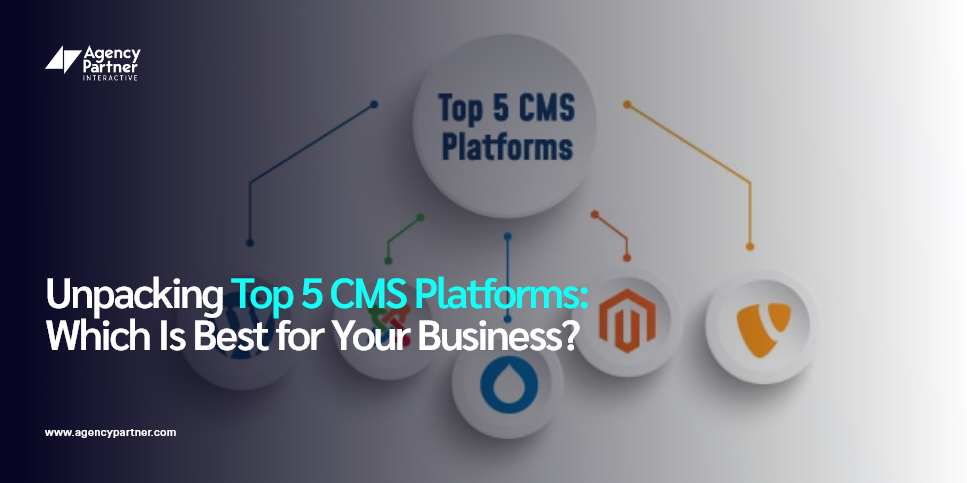
    Unpacking Top 5 CMS Platforms: Which Is Best for Your Business?

    In the digital era, choosing the right Content Management System (CMS) is crucial for any business aiming to thrive online. A CMS not only simplifies content creation but also enhances your online presence.   

    At Agency Partner Interactive, a leading digital marketing agency and web development agency, we understand the significance of selecting a CMS that aligns with your business needs. In this blog, we’ll explore the top 5 CMS platforms, equipped with the latest statistics, to help you make an informed decision.  

    What is a CMS?  

    A CMS, or Content Management System, is a software application that enables users to create, manage, and modify website content without specialized technical knowledge.   

    The ideal CMS for your business should offer ease of content creation, flexibility, and robust support. Regarding CMS platform selection, it’s essential to consider factors like scalability, user-friendliness, and customization options.  

    Top 5 CMS Platforms  

    Navigating the diverse landscape of CMS platforms for businesses can be challenging, but understanding the strengths and specialties of each can guide you to the perfect choice for your business.   

    Let’s delve into the top 5 CMS platforms in 2023, each with unique offerings tailored to different business needs, from user-friendly designs for beginners to advanced functionalities for large-scale operations. 

    1. Shopify 


    Shopify is best suited for businesses focused on e-commerce. Its user-friendly design and robust sales tools are perfect for entrepreneurs who want to set up an online store quickly without extensive technical expertise.   

    If your business revolves around online retail and you need a platform that easily handles everything from product listings to payments and shipping, Shopify is an excellent choice.  

    Shopify, a leader in e-commerce CMS, boasts over 1.75 million merchants and has a 32% market share in the U.S. e-commerce platform sector. Its user-friendly interface and comprehensive e-commerce tools make it ideal for businesses looking to establish or expand their online stores. Shopify is particularly beneficial for those requiring a reliable, scalable platform with strong online sales and marketing support.  

    2. WordPress 

    WordPress is incredibly versatile, making it ideal for a wide range of businesses, from small blogs to large corporate websites. Its strength lies in its extensive customization capabilities and vast plugins, which can cater to almost any business need. WordPress is a strong contender if you need a flexible platform that can grow and change with your business.  

    Powering 45.8% of all websites on the Internet as of 2023, WordPress’s open-source CMS nature offers versatility and a vast array of customization options through themes and plugins. It’s suitable for a wide range of businesses, from tiny blogs to large corporate websites, and is a popular choice for its extensive community support and SEO-friendly nature . 


    3. Magento 


    Magento is best for large-scale e-commerce businesses requiring high customization and scalability. Its advanced features are well-suited for enterprises with complex product inventories and those who need a robust platform to support rapid business growth.  
     

    Magento is likely the right choice if your business demands a powerful e-commerce solution with extensive customization capabilities.  

    Magento, the 8th most widely used e-commerce platform worldwide, powers 0.13% of all websites on the Internet. Ideal for large enterprises with complex online store requirements, Magento is known for its scalability and advanced features. Online stores built with Magento grow three times faster than those using other e-commerce technologies . 


    4. Wix 

    Wix is renowned for its simplicity and ease of use, making it an excellent choice for small businesses and individuals new to website creation. Its drag-and-drop interface and wide range of templates allow quick and easy website development without coding skills.   

    Wix is ideal for those who prioritize ease of use and quick setup in their content management system for businesses.  

    Wix, holding a 3.5% share of the CMS market as of 2023, is a testament to its popularity, especially among users who value simplicity and ease of design in a web design agency context.  


    5. OpenCart

    OpenCart is an open-source CMS tailored explicitly for e-commerce businesses. Known for its straightforward and user-friendly interface, OpenCart is ideal for small to medium-sized companies looking to establish an online store quickly.   

    It offers a range of features like multi-currency support, product reviews, and ratings, making it a comprehensive solution for online retailers.   

    While OpenCart is praised for its simplicity and range of features, it also provides flexibility for customization, which is highly beneficial for businesses with specific requirements. As a platform, it strikes a balance between user-friendliness and comprehensive e-commerce functionality.   

    As of 2023, OpenCart powers 237,812 live stores, showing its substantial presence in the e-commerce space. Notably, OpenCart stores experienced a remarkable 79% year-over-year growth in 2023 Q3 and a 14.3% increase quarter-over-quarter, highlighting its growing popularity and effectiveness as an e-commerce platform . 

    Choosing the Right CMS for Your Business 

    The best CMS for your business depends on your specific needs. Consider your business size, industry, technical expertise, and future growth plans. Whether you need a simple platform for content creation or a complex system for e-commerce, there’s a CMS out there that’s right for you.  

    Start by assessing the size of your company and industry, as these factors will heavily influence your CMS requirements. Additionally, consider the level of technical expertise available within your team, as some CMS platforms may require more technical skills than others.   

    Future growth plans are also critical; you need a CMS that can scale with your business, accommodating increasing traffic, content, and functionality needs. Whether you’re looking for a straightforward platform primarily for content creation or a more complex system capable of supporting a full-fledged e-commerce operation, a CMS fits the bill.   

    It’s about finding the best CMS platform where functionality, ease of use, and scalability intersect with your business goals and resources. 

    Choose Agency Partner Interactive for CMS Web Design Services 

    Selecting the right CMS is a crucial decision for your online presence. The top CMS platforms each offer unique features and benefits, and finding the one that perfectly aligns with your business goals and capabilities is critical to your success.  

    Deciding which Content Management System is the best fit for your brand is the first step. The next is to build your website tailored to your brand, ensuring responsiveness, optimizing for SEO, and more.  

    At Agency Partner Interactive, we offer web development services and comprehensive digital marketing services tailored to enhance and optimize your chosen CMS. Our team, equipped with over 100 years of collective experience and a track record of over 1800 successful website projects, excels in CMS web design and development.   

    Whether you need help deciding which CMS best suits your business needs, creating a site from scratch, updating it for the latest plugins and functionalities, or even maintaining your website, our web design and development agency can help. Our expertise and dedication to turning your vision to life have won us awards like Clutch Global 2023, Inc. Power Partner 2023, Top Web Development Agency by DesignRush, and more. 

    By partnering with us, you can access a team dedicated to maximizing your digital potential. Contact us for a free proposal and start transforming your digital strategy today! 

  • Seasonal Marketing 101: Quick Tips for Busy Business Owners

    Seasonal Marketing 101: Quick Tips for Busy Business Owners

    In today’s fast-paced business environment, understanding the nuances of seasonal marketing is more important than ever. Whether you’re looking to refine your existing marketing strategies or explore new avenues for growth, this blog aims to be your go-to resource.  

    With a blend of industry insights and easy-to-implement tactics, we’re here to give you practical seasonal marketing tips, ensuring your business stays ahead of the curve. Let’s dive into some quick marketing tips for business owners!  

    Understanding Seasonal Trends 

    The cornerstone of effective seasonal marketing lies in identifying key seasons and holidays. 2024 brings a calendar of opportunities, from traditional holidays to unique cultural events. Businesses can craft targeted campaigns that resonate with their audience by pinpointing these pivotal times.  

    At Agency Partner Interactive, our digital marketing agency expertise extends to helping clients identify and capitalize on these critical periods, ensuring they don’t take advantage of potential growth opportunities. 

    However, recognizing these moments is just the start. Analyzing past trends and predicting future ones is crucial in crafting successful seasonal marketing strategies. It involves reviewing what has worked and adjusting strategies to align with consumer behaviors and preferences.  

    This is where the digital marketing services offered by Agency Partner Interactive shine, as we utilize data and analytics to guide our clients toward informed, data-driven decisions. 

    Setting Seasonal Goals 

    Setting clear, specific, and measurable goals is the foundation of any successful marketing campaign. Whether you’re aiming to boost holiday sales, increase brand awareness during particular seasons, or capitalize on a local event, having concrete objectives is vital.  

    As a digital marketing agency, we emphasize the importance of aligning these goals with your overall business strategy, ensuring every marketing effort pushes your business toward its broader objectives. 

    Practical goal setting also includes establishing metrics to measure success. This is where web development services play a critical role, providing the tools and technologies to track progress and analyze results.  

    Whether through website traffic, conversion rates, or social media engagement, having tangible metrics allows for continuous improvement and adaptation of your marketing strategies. 

    Developing a Seasonal Marketing Calendar 

    A well-structured marketing calendar is essential for timely and effective campaign execution. It’s about planning your marketing activities around critical dates and seasons, ensuring you’re prepared to seize every opportunity.  

    Agency Partner Interactive assists clients in developing these calendars, integrating long-term campaigns and short-term tactics to maintain a consistent and impactful marketing presence throughout the year. 

    Flexibility is also a critical component of any marketing calendar. The ability to adapt to unforeseen changes in the market or consumer behavior can make a significant difference. This agility allows businesses to take advantage of unexpected opportunities or mitigate challenges.  

    It balances preparedness and adaptability, ensuring your marketing efforts are as effective as possible in an ever-changing landscape. 

    Creating Seasonal Promotions and Offers 

    Seasonal promotions and offers are powerful tools in your marketing arsenal. These tailored promotions can significantly enhance customer engagement and drive sales, especially during peak seasons.  We recommend designing promotions that appeal to your target audience and create a sense of urgency, encouraging immediate action.  

    For instance, exclusive holiday discounts or limited-time offers can effectively capture customer attention and boost short-term sales. Early rollout of promotions is key to engage and convert customers efficiently​. 

    Think beyond traditional discounts and consider bundling products, offering special loyalty rewards, or creating unique experiences that align with the season’s spirit. These strategies attract new customers and strengthen relationships with existing ones. These marketing tips are designed to spark creativity and help you create promotions that attract attention and drive tangible results.  

    Remember, the goal is to make your promotions stand out in a crowded marketplace, something a seasoned web design agency like Agency Partner Interactive can help you achieve. 

    Leveraging Social Media and Digital Marketing 

    Social media and digital marketing are indispensable in today’s business landscape, offering many seasonal marketing opportunities. Different social media platforms provide various ways to connect with your audience, and it’s essential to tailor your approach.  

    As a digital marketing agency, we encourage businesses to create engaging, platform-specific content that aligns with seasonal themes. This could include unique holiday-themed posts, interactive contests, or timely ads that capitalize on current trends. 

    Make the Most of the Holiday Hustle for Brand Awareness 

    The holiday season is a prime time for boosting brand awareness. Entrepreneurs can maximize their visibility by strategically boosting posts on platforms like Facebook and Instagram. These boosted posts can target specific demographics, ensuring your content reaches the right audience at the right time.  

    Additionally, investing in YouTube ads can be a game-changer. With millions of viewers tuning in, YouTube provides a vast platform to showcase your brand through creative and engaging video content. The key is to craft eye-catching ads that embody the season’s festive spirit, making them more relatable and compelling. 

    Digital marketing offers various tools and techniques to enhance your seasonal campaigns. From targeted advertising to email marketing campaigns, the possibilities are vast. With its comprehensive digital marketing services, Agency Partner Interactive can guide you in selecting the most effective strategies to reach your audience.  

    The key is to ensure your digital marketing efforts are cohesive, engaging, and aligned with your overall seasonal marketing strategies. By leveraging these platforms effectively, businesses can significantly increase their brand presence during the year’s busiest shopping period. 

    Localizing Your Marketing Efforts 

    Tailoring your marketing efforts to local events and cultural nuances can significantly amplify their effectiveness. Localized marketing strategies create a deeper connection with your audience as they resonate more with their immediate environment and experiences. As a web development services provider, we help businesses optimize their local SEO, making them more visible and relevant in local search results. 

    Engaging with local communities through events or sponsorships can also be a powerful way to enhance brand visibility and foster goodwill. These efforts demonstrate your business’s commitment to the community and provide unique marketing opportunities tied to local culture and events. It’s about being a part of the community conversation, which can set your business apart in a competitive market. 

    Evaluating and Adjusting Your Marketing Strategies 

    Every marketing strategy is complete with a robust evaluation and adjustment process. It’s crucial to track the performance of your seasonal campaigns, analyzing what worked and what didn’t. This evaluation provides valuable insights that can inform future marketing decisions.  

    At Agency Partner Interactive, we stress the importance of using analytics and feedback to continuously refine your marketing strategies, ensuring they remain practical and relevant. Adapting your strategy based on these evaluations is essential.  

    The market is constantly evolving, and so should your marketing efforts. Whether tweaking your social media approach, refining your email marketing campaigns, or adjusting your web design for a better user experience, being responsive to feedback and data is critical to maintaining a successful marketing presence. 

    Agency Partner Interactive: Your Solution to Seasonal Marketing Strategies 

    Mastering seasonal marketing requires creativity, strategy, and adaptability. At Agency Partner Interactive, we combine these elements to create customized marketing solutions that resonate with your brand and audience. Take, for example, one of our clients.  

    We significantly enhanced their online presence through our tailored SEO, content marketing, and social media marketing approach. Their traffic swelled to 20,797 users, an 158% increase year-over-year. Moreover, we achieved 2,038 conversions, an 104% increase YoY.  

    These numbers demonstrate our commitment to delivering results and our ability to turn marketing strategies into tangible business successes. 

    So remember, at Agency Partner Interactive, we’re more than just a digital marketing agency; we’re your partner in navigating the ever-evolving marketing landscape.  

    Let’s work together to make 2024 a year filled with impactful and rewarding marketing endeavors. Contact us today for a free consultation! 

    FAQs on Seasonal Marketing for Business Owners 

    Q1: What are some essential seasonal marketing tips for small business owners? 

    A1: Key tips include identifying crucial seasons and holidays relevant to your business, creating targeted promotions, and using social media to engage your audience. Adapting your strategies based on market trends and customer feedback is vital. 

    Q2: How can Agency Partner Interactive assist with my seasonal marketing strategies? 

    A2: As a digital marketing agency, Agency Partner Interactive offers various digital marketing services tailored to seasonal marketing. From developing customized marketing calendars to creating dynamic web and mobile app designs, we help businesses capitalize on seasonal trends effectively. 
    Q3: What role does web design play in seasonal marketing? 

    A3: A responsive web design agency can significantly enhance your seasonal marketing efforts by creating a website that resonates with seasonal themes, improves user experience, and effectively showcases your promotions and offers. 

    Q4: Can you provide quick marketing tips for business owners looking to boost holiday sales? 

    A4: Focus on creating unique offers and promotions that resonate with the holiday spirit. Utilize email marketing and social media advertising to reach a wider audience. Remember to optimize your website for seasonal traffic and ensure it’s mobile-friendly. 

    Q5: How influential are digital marketing services in executing seasonal marketing 101 strategies? 

    A5: Digital marketing services are crucial for effectively executing seasonal marketing strategies. They provide tools and techniques like SEO, targeted ads, and content marketing, essential for reaching and engaging your target audience during different seasons. 

    Q6: What are some innovative seasonal marketing strategies for 2024? 

    A6: Innovative strategies include leveraging emerging social media platforms, integrating augmented reality experiences in your campaigns, and using data analytics to personalize customer experiences. 

    Q7: Do you have any digital marketing tips for businesses new to seasonal marketing? 

    A7: Start with understanding your audience and what seasons matter most to them. Use digital marketing tools to analyze customer behavior and preferences. Invest in social media and content marketing to build a solid online presence. 


  • Local SEO for Elderly Care: Collaborating with Austin Web Designers for Better Visibility

    Local SEO for Elderly Care: Collaborating with Austin Web Designers for Better Visibility

    When you’re looking for elderly care services in Austin, the first place you go to search for one is the internet. With countless options available at the click of a button, having a well-designed website is essential to stand out in the crowded digital space.  

    With Austin’s aging population on the rise, there’s no time to waste. As more families seek reliable care options for their aging loved ones, you need to improve your elderly care marketing strategy to meet this growing demand effectively. One way to do that is by ranking on Search Engine Results Pages (SERPs) using Local SEO and a visually appealing elderly care website design. Let’s dive into specifics in this blog! 

    Importance of Local SEO in Elderly Care    

    Austin local SEO services are vital for elderly care companies to connect with the people who need them most—nearby residents. Being found on local search can be a lifeline for your business, ensuring that your services reach the families urgently needing what you offer. This targeted approach gains even more importance, considering that most senior living consumers—around 75%—are researching options on search engines. 

    Key Local SEO Strategies for Elderly Care in Austin  

    To effectively reach your local target audience, there are specific SEO tactics you’ll need to implement. Let’s explore some of the most critical ones below: 

    Keyword Research in Austin, TX  

    Keyword research lays the foundation for a solid local SEO strategy. Selecting the right local keywords for Austin is crucial for ranking highly in SERPs when your target audience searches within the area.  

    Examples of local keywords could include “Austin elderly care services,” “senior living in Austin,” or “Austin nursing homes.” Long-tail keywords like “affordable elderly care in Austin” or “best nursing homes near Austin” also effectively drive targeted traffic to your site.   

    Austin On-Page SEO   

    Enhancing metadata with localized keywords like “elderly care in Austin” can help search engines quickly identify your service areas. Headers with relevant localized keywords will signal to search engines what your content is about, improving your content’s local search visibility. 

    Content’s Role in Local SEO   

    Creating engaging and informative content is another essential aspect of your Local SEO strategy. Blog posts, articles, and even instructional videos related to elderly care can help your website rank higher in SERPs while providing valuable information to your target audience.  

    Google My Business (GMB)   

    Setting up your Google My Business (GMB) profile and optimizing it for local SEO is critical. The top Google local search result accounts for nearly a quarter of all clicks. This tool helps in local search discovery and provides potential customers with essential information such as your location, hours of operation, and reviews.  

    Another advantage of using GMB is the ability to post updates and promotions to your profile, which gives more reasons for potential customers to choose your service over competitors. 

    Online Reviews   

    Online reviews can influence your ranking in local search results. Positive reviews send signals to search engines that your service is trusted, which can significantly improve your local SEO.   

    Navigating Local SEO Algorithms  

    Understanding how search algorithms work can be a game-changer for your local SEO strategy, especially in Austin’s crowded market. These algorithms are designed to prioritize local businesses when the user’s location factors into the search query, making it crucial for reaching high-intent customers looking for businesses like yours in your area.  

    Role of Austin Web Designers in Boosting Your Local SEO Strategy  

    The role of web designers extends far beyond creating a visually pleasing website. Here’s how they enhance your site’s local SEO and user experience. 

    Responsive Design   

    Having a mobile-friendly website isn’t just optional; it’s a necessity. Considering that roughly 97% of online search users are looking for local businesses, ensuring your website is optimized for mobile becomes crucial.  

    Austin web designers can implement flexible grid layouts, responsive images, and CSS media queries to get there. With a responsive design, it ensures your site looks and works well on various devices, which is critical for local SEO rankings.  

    Local SEO-Driven Design   

    Austin web design agencies, like Agency Partner Interactive, can help you incorporate local SEO elements into your site. We can assist in further optimizing your content for Austin-specific searches, ensuring your services rank higher locally and organically, at no costs to you. These could include optimizing for local keywords, including meta tags and headers specific to Austin, or implementing schema markup for local businesses.   

    User Experience (UX)   

    Good UX involves intuitive navigation, fast load times, and mobile friendliness. These factors not only make your site more user-friendly but also improve engagement rates, which in turn enhances your local SEO efforts.  

    Why Collaborate with Austin Web Designers?   

    Forbes ranks Austin as one of the top 25 places to enjoy retirement. With its endless recreation options and close access to healthcare facilities, it’s no wonder retirees are coming to Austin. The growing popularity of the city as a retirement destination creates an expanding local market that’s too big to ignore. 

    Working with a web design company in Austin, Texas offers distinct advantages—they provide a unique understanding of the local market, offer custom solutions to meet the specific needs of elderly care services and maintain ongoing communication to make necessary adjustments. You can’t afford to fall behind in a state where the senior living market is booming.     

    Choosing an Austin Web Designer for your Elderly Care Services  

    Collaboration is key in both web design and local SEO services. With Agency Partner Interactive, we can build targeted strategies that meet your elderly care website design needs.  

    Our strategic approach to web design, local SEO services, and digital marketing services has led one of our clients to astonishing outcomes, including ranking 23,075 keywords, 888 of which landed in the top 1-3 positions of SERPS. Make sure to optimize your online presence with the best web design and SEO company in Austin and take advantage of this high-demand market.   

    Ready to get a flawlessly designed website optimized for maximum visibility, reach, and conversions? Schedule a consultation with us today, and let’s start your journey to digital dominance!   

    FAQs: Elderly Care Website Design and Local SEO Services 

    1. What is Local SEO, and why is it important for elderly care providers in Austin?

    Local SEO helps businesses promote their services to local customers when they’re looking for them online. For elderly care providers in Austin, it ensures that families seeking care services can find them easily when making location-specific searches. 

    1. How does a responsive web design impact my elderly care website’s visibility in search results?

    Responsive web design ensures that your website looks and performs well on all devices, especially mobile. Since search engines, like Google, prioritize mobile-friendly websites in their rankings, a responsive design can significantly improve your website’s visibility in search results. 

    1. Why should I collaborate with local Austin web designers for my elderly care website?

    Local Austin web designers have an in-depth understanding of the local market and its specific needs. They can offer tailored solutions that resonate with Austin’s community and trends, ensuring that your elderly care website stands out and effectively reaches its target audience. 

    1. How do online reviews influence my local SEO rankings for elderly care services?

    Positive online reviews signal search engines that your service is trusted and of high quality. The more positive reviews you accumulate, especially on platforms like Google My Business, the higher your chances of ranking well in local search results. 

    1. Can a web design agency help optimize my elderly care website for specific Austin-related searches?

    Yes, Austin website design companies like Agency Partner Interactive specialize in incorporating local SEO elements into your site. This includes optimizing for Austin-specific searches, using local keywords, and implementing web design optimization features that resonate with Austin residents. 

  • How to Choose the Right CMS Platform for Your Business

    How to Choose the Right CMS Platform for Your Business

    A content management system (CMS) is a software program that facilitates the creation, administration, and distribution of digital information across numerous platforms. It’s a must-have tool for organizations of all sizes since it simplifies content generation and administration, allowing you to present a consistent message to your audience.  

    According to a survey by WP Engine, 40% of consumers will leave a website if it takes more than three seconds to load. Choosing the right CMS can help improve website speed and prevent users from leaving your site. 

    Selecting the right CMS for your business is crucial because it can affect your website’s performance and your team’s workflow. This article provides a comprehensive guide to help you choose the best CMS for your business.  

    By the end of this article, you’ll have a better idea of selecting the best CMS for your company, whether a small start-up or a large corporation. 

    What is a CMS Platform? 

    A CMS or Content Management System platform is a software application that allows you to create, manage, and publish digital content. It provides a user-friendly interface and tools that allow users to create and edit web content without requiring technical knowledge or programming skills.  

    A CMS platform typically consists of two parts: a content management application that allows to create and manage content and a content delivery application that delivers the content to the website or other digital channels. CMS platforms manage many types of digital material, such as text, photos, videos, and audio files. 

    Factors to Consider When Choosing a CMS 

    Here’s what you should consider before selecting a platform that’s right for your business needs. 

    Ease of Use 

    The usability of a CMS is critical for content creators since it affects their ability to generate high-quality material effectively. A user-friendly interface and straightforward content management tools can let writers focus on the content rather than the CMS. 

    Customization Options 

    Customization options are essential because they allow businesses to tailor the CMS to their unique needs. With customization options, businesses can modify the CMS’s design, functionality, and user experience to match their brand and business goals. 

    Customization options are particularly crucial for businesses that require specific features or have unique design requirements that may not be available in a standard CMS. 

    Scalability 

    Scalability is crucial for businesses that plan to grow and expand over time. A scalable CMS can handle increasing traffic, larger volumes of content, and more complex functionality without sacrificing performance or stability. 

    Choosing a CMS that can scale with your business is essential to avoid the cost and disruption of migrating to a new CMS as your needs evolve. 

    What Are Popular CMS Platforms? 

    When choosing a CMS, there are several popular platforms to consider. This section will overview three popular CMS platforms: WordPress, Drupal, and Joomla. 

    WordPress 

    WordPress is one of the world’s most widely used CMSs, powering more than 40% of all websites on the internet. According to W3Techs, WordPress is used by 43.2% of all websites. Its user-friendly interface and an extensive library of plugins and themes, which make customization simple, are partly responsible for its popularity.  

    WordPress’s features 

    WordPress offers many features that make it an attractive option for businesses of all sizes. Some of its key features include: 

    • WordPress’s intuitive interface makes creating and managing content easy for all skill levels. 
    • With its hundreds of themes and plugins, WordPress can be customized to meet various corporate requirements. 
    • The design of WordPress is SEO-friendly, making it simple for businesses to optimize their website for search engines. 
    • WordPress offers several e-commerce plugins that allow businesses to sell products and services online. 

    Drupal 

    Drupal has over 1.5 million users and contributors in its community. Drupal is a highly customizable CMS used by many large organizations, including government agencies and universities. Its popularity is due in part to its scalability and security features. 

    Drupal’s features 

    Drupal offers many features that make it a powerful CMS option for businesses. Some of its key features include: 

    • Drupal offers extensive customization options through its robust API and theme system. 
    • Drupal’s caching and performance optimization features make it a fast and efficient CMS. 
    • Drupal has built-in security features and is known for its strong security track record. 
    • Drupal allows businesses to manage multiple websites from a single installation, making it an excellent option for businesses with a large online presence. 

    Joomla 

    Joomla has over 2 million active websites, and its community has over 800,000 registered users and contributors. Joomla is another popular CMS used by many businesses and organizations. Its popularity is partly due to its ease of use and strong community support. 

    Joomla’s features 

    Joomla offers many features that make it a powerful CMS option for businesses. Some of its key features include: 

    • Joomla’s intuitive interface makes creating and managing content easy for users. 
    • Joomla offers several themes and extensions that allow businesses to customize their website to match their brand. 
    • Joomla offers built-in support for multiple languages, making it an excellent option for businesses with a global presence. 
    • Joomla has a significant developer and user community that helps and contributes to its continuing development. 

    Comparison of the Three CMSs 

    When comparing WordPress, Drupal, and Joomla, it’s important to consider the specific needs of your business. While all three CMSs offer robust features and customization options, each has strengths and weaknesses. 

    WordPress is a wonderful option for businesses of all kinds, thanks to its extensive library of plugins and themes that allow it to be very configurable. Drupal is a good choice for companies with extensive customization and complicated requirements. At the same time, Joomla is a great choice for companies that need a user-friendly interface and multi-language support. 

    What Is Magento? WordPress vs. Squarespace 

    Magento is an open-source eCommerce platform that provides businesses with powerful features and customization options to create engaging and user-friendly online stores. Magento is designed for eCommerce, offering customizable templates and built-in features.  

    It also has advanced features for online sales, such as inventory management, payment processing, and customer management. Magento is a popular choice for businesses looking to build an online store with more advanced functionality than Squarespace provides for eCommerce. 

    When it comes to website building, choosing between Magento and Squarespace depends on your specific needs and goals. While Squarespace is a user-friendly platform for building a website with a modern design, Magento is a specialized platform for building an online store with advanced eCommerce features. Understanding the differences between these platforms can help you make an informed decision and choose the right platform for your business needs. 

    How to Choose the Right CMS for Your Business 

    To sum it up, a CMS is a software application for creating, managing, and publishing digital content. It provides a user-friendly interface and tools that allow users to create and edit web content without requiring technical knowledge or programming skills. Popular CMS platforms include WordPress, Drupal, and Joomla. 

    When choosing a CMS for your business, it’s important to consider your business goals, ease of use, customization options, and scalability. Businesses can also choose between custom and open source cms software applications whose source code is publicly available, allowing users to modify, customize, and distribute the software as they see fit., each with advantages and disadvantages. Ultimately, selecting the right CMS for your business is crucial for your online presence and overall success and requires careful consideration of your specific needs and resources. 

    Custom CMS Solutions for Your Unique Business Needs 

    We understand the crucial role CMS plays in the overall performance of your website. Our expertise ensures your website is optimized for a seamless user experience and maximum functionality.  

    At Agency Partner Interactive, we specialize in helping businesses select and implement the right CMS that aligns with their business goals and objectives. Whether you need SEO optimization, web development services, digital marketing services, or content creation, Agency Partner Interactive is the premier partner to help you achieve your goals. 

    We’ve enjoyed working with numerous clients across various industries, providing customized CMS solutions that significantly improve their website’s performance. For instance, after we helped one of our clients implement the right CMS, they saw an impressive 40% increase in website traffic and a 25% increase in conversion rates. 

    So, if you’re seeking a trustworthy web design agency to assist you in selecting and implementing the best CMS for your website, look no further than Agency Partner Interactive. Contact us today to learn how we can help you take your online presence to the next level! 

  • How to Develop a Unique Brand Identity for Your Audience

    How to Develop a Unique Brand Identity for Your Audience

    Brand identity is the invisible elements of a brand, such as its name, logo, design, and messaging, that work together to create a distinct and recognizable image for the brand. A reputable brand identity is crucial for businesses to stand out in today’s crowded market and connect with their target audience. In a survey conducted by HubSpot, 89% of marketers stated that brand awareness is their top goal. 

    This blog post will cover the essential steps to develop an exceptional brand identity that resonates with your audience. We will start by defining your brand and researching your audience, then move on to creating your visual identity and crafting your brand voice. 

    What Is Brand Identity, and Why Do We Need It? 

    Brand identity is the graphic and verbal elements representing a brand, including its name, logo, color scheme, typography, tone of voice, and overall design. It is how a company offers itself to its audience and how its customers perceive it. A reputable brand identity sets your business apart from competitors and helps you stand out in a crowded market. 

    It communicates your company’s values, personality, and mission, which can resonate with your audience and foster a sense of connection and loyalty. A compatible brand identity across all channels helps reinforce your brand’s message and builds brand recognition over time, increasing engagement and customer trust. 

    Examples of Brand Identity From 6 Successful Businesses 

    A strong brand identity is a critical element for any successful business. It sets your business apart from the competition and helps your audience relate to your brand more deeply. Here are a few examples of businesses with strong brand identities and what makes their branding so effective: 

    Apple 

    Apple’s brand identity centers on simplicity, innovation, and premium quality. Apple’s minimalist design philosophy emphasizes clean lines, intuitive interfaces, and a streamlined user experience. Its iconic logo, featuring a simple apple with a bite taken from it, is instantly recognizable worldwide. Apple’s brand identity is consistent across all its products and marketing materials, focusing on premium materials and attention to detail.  

    MAC cosmetics 

    MAC Cosmetics is known for its edgy, bold, and diverse makeup offerings. Its brand identity emphasizes creativity, inclusivity, and individuality, focusing on encouraging customers to express themselves through makeup. Its branding features bold typography and vivid colors, and it’s marketing often features models of all ages, ethnicities, and genders. 

    Nike 

    Nike’s brand identity is famous for its inspiration, athleticism, and performance. Nike’s iconic swoosh logo conveys a sense of motion and athleticism, and it’s branding often features inspirational messaging and high-energy visuals. Nike’s products are designed with performance in mind, using advanced materials and technology to help athletes achieve their goals.  

    Coca-Cola 

    Coca-Cola’s brand identity is centered around happiness, joy, and refreshment. Its classic red-and-white color scheme, iconic logo, and feel-good advertising campaigns all communicate these values to its audience. This branding has helped Coca-Cola become one of the world’s most beloved and recognizable brands. 

    Airbnb 

    Airbnb’s brand identity is focused on community, travel, and authenticity. It’s warm and welcoming branding, user-generated content, and personalized travel experiences all communicate these values to its audience. Airbnb’s branding is consistent across all its products and marketing materials, focusing on creating a sense of connection and community among its users. This branding has helped Airbnb become one of the significant and innovative businesses in the travel industry. 

    Tesla 

    Tesla’s brand is about innovation, sustainability, and luxury. Tesla’s sleek and futuristic product design, eco-friendly messaging, and high-end price point all communicate these values to its audience. Tesla’s branding is consistent across all its products and marketing materials, focusing on creating a sense of exclusivity and luxury. This branding has helped Tesla become one of the most successful and creative companies in the automotive industry. 

    Why Is Brand Identity Important? 

    A strong brand identity is critical for building a successful business. It helps you differentiate yourself in a crowded market, establish recognition and trust with your audience, and create an emotional connection that fosters loyalty and advocacy. 

    1. By clearly communicating your unique values, personality, and messaging, you can differentiate yourself from your competitors and create a distinct position in your industry. 
    2. A strong brand persona helps your business become easily recognizable to your target audience. Consistent branding across all channels, from your website to your social media to your sustainable packaging, builds brand recognition and makes it easier for customers to remember and identify your brand. 
    3. A unique brand identity can help build credibility and trust with your audience. By consistently delivering on your brand promise and living up to your values, you can make a loyal customer base and establish a positive reputation in your industry. 
    4. A positive brand identity can help create an emotional connection with your audience. By aligning your brand values and messaging with the values and goals of your target audience, you can make sense of a shared purpose and identity that resonates with your customers. 

    Easy Steps: How to Develop a Unique Brand Identity 

    Following these steps, you can create and maintain a solid and consistent brand identity that resonates with your audience. 

    Identify and develop your unique value proposition 

    Research and gather information and insights about your target audience, unique value proposition, and competitors in your industry or market. Identifying and effectively communicating your unique strengths and the value your brand brings to customers is essential for gaining a competitive advantage in the marketplace. 

    This research involves analyzing demographic and psychographic data about your audience, identifying your business’s unique selling proposition, and analyzing the strengths and weaknesses of your competitors. By understanding these factors, companies can create a reputable brand identity that resonates with their target audience and effectively communicates their unique value proposition.  

    Choose the right font for your brand  

    Design and development of a logo and a template create a brand’s visual presentation that reflects its values, personality, and unique selling proposition. A logo is typically the most recognizable element of a brand and serves as a visual representation of the brand’s identity. A logo template provides guidelines for using the logo across different mediums and channels, ensuring consistency and recognition. 

    Designing a logo involves several steps, including defining the brand’s values, personality, and unique selling proposition, choosing appropriate colors, typography, and graphics, and creating a memorable, recognizable, and reflective brand identity. The logo template includes guidelines for the size, placement, and color usage of the logo across various mediums, such as digital, print, and social media. 

    Define the tone and personality of your brand 

    Creating messaging and content that aligns with a brand’s values, personality, and visual identity and resonates with its target audience across various social media platforms. Social media language involves selecting an appropriate tone, voice, and communication style that reflects the brand’s identity and values. 

    You can start by identifying your target audience and its preferred social media platforms. Once identified, develop a social media strategy outlining each platform’s messaging, tone, and content. The language used on social media should be engaging, informative, relevant, consistent with your brand’s values and visual identity, hashtags, and emojis, and resonate with the target audience. 

    Avoid Common Branding Mistakes 

    Knowing what to avoid is essential to creating an authentic brand identity that resonates with today’s consumers. It helps businesses avoid potential mistakes or missteps that could damage their reputation and brand image. Here’s what you should avoid: 

    • Avoid using offensive language or imagery that could offend or alienate their target audience. 
    • Refrain from copying or replicating the branding or messaging of competitors, as this can create confusion and dilute the brand’s unique identity. 
    • Avoid inconsistent messaging or visual elements that can create confusion or a lack of recognition among customers. 
    • Do not take controversial political or social perspectives that do not align with the brand’s values. 
    • Avoid negative or divisive messaging that may alienate customers or create a negative image for the brand. 

    Setting Up Tools and Metrics to Track Your Brand Identity 

    Monitoring your brand means regularly checking and analyzing your messaging, visual identity, and overall reputation to ensure consistency and effectiveness. This involves monitoring various channels and platforms where your brand is present, such as social media, online reviews, and customer feedback, to identify any issues or inconsistencies. 

    Creating a Consistent Strategy That Aligns with Your Brand Identity 

    Developing key brand elements that speak to your audience involves creating a cohesive visual identity that reflects the brand’s values, personality, and messaging. Brand elements convey your message to audiences emotionally using visual elements instead of text, so this part of the branding process can take a considerable amount of time and resources. This typically includes four main components:  

    Color palette 

    Selecting your brand’s color palette or theme can impact how customers perceive your brand. The colors should be consistent across all channels and reflect your brand’s values and personality. According to Forbes, color improves brand recognition by up to 80%. 

    Font 

    Choosing a font consistent with the brand’s visual identity and messaging is essential. The font should be readable and easily read across different mediums, from digital to print. The font should also align with the brand’s personality, values, and messaging. 

    Logo 

    A logo is a brand’s visual presentation and should be memorable, recognizable, and reflective of the brand’s identity. It should align with the brand’s values and messaging and be consistent across all channels.  

    Templates 

    A template, or a brand guide, provides guidelines for using the brand’s visual elements across different mediums and channels, including color palette, font, and logo. This ensures consistency in the brand’s visual identity and messaging and helps create a recognizable brand. 

    Key Takeaways: How to Develop a Unique Brand Identity for Your Audience 

    A solid and unique brand identity is crucial for business success in today’s crowded market. This process involves researching your target audience, value proposition, and competition, designing a visual identity and messaging that communicates your values and personality, and avoiding common branding mistakes. 

    Modern consumers decide to purchase and support brands that feel authentic, transparent, and real. Regardless of how great your services and products are, you’ll need to develop your unique brand to stand out amongst an oversaturated landscape and captivate your audience’s attention. While these tips and best practices can get your creative juices flowing, it takes more than just picking colors and fonts to build a brand. That’s where Agency Partner Interactive comes in. 

    Developing a Unique Brand Identity with Agency Partner Interactive 

    Agency Partner Interactive is a Dallas digital marketing company transforming business into brands. We work with clients like you to develop a unique brand identity that resonates with your target market. Whether you need branding and logo design services to build your marketing collateral, a custom website tailored to your unique business personality, or digital marketing services to grow your online reach, our full-service agency has got you covered. Our team thoroughly researches your audience and designs a logo and template that captures your brand essence. 

    Our portfolio of more than 1500+ successful projects showcase our design and digital marketing services to create compelling brand identities that set our clients apart. Choose the top Dallas web design agency to create a unique brand identity, email marketing, content marketing, web design, and development or social media marketing that drives long-term success for your business. 

    Don’t settle for a generic brand identity – Let us create something that’s instantly recognizable and becomes top of mind for your customers.  

    Get a free personalized proposal for our Dallas branding services today! 

  • Mastering the Art of Lead Generation: Strategies for B2B Businesses

    Mastering the Art of Lead Generation: Strategies for B2B Businesses

    Lead generation refers to identifying and attracting potential customers for a business’s products or services. Lead generation aims to convert these potential customers, or leads, into actual paying customers. 

    By identifying and targeting the right leads, and B2B lead generation strategies, businesses can improve their sales conversion rates, increase their customer base, and ultimately grow their business. 

    Lead generation can take many forms, including advertising, content marketing, email marketing, and social media marketing. The key is identifying the most effective strategies for engaging and reaching your target audience and continually optimizing and refining these strategies based on data and feedback. 

    Understanding Your Target Audience 

    Identifying your target audience is a critical step in an effective lead generation which involves defining the specific group of people or businesses most likely to be interested in your product or service. This can be based on demographics, geographic location, industry, job title, etc. 

    When you’ve determined your target audience, it is crucial to understand their pain points and needs which involves gathering information about their challenges, goals, and priorities and identifying how your product or service can address them. 

    Optimizing Your Website for Lead Generation 

    Designing a website with lead generation in mind is important for optimizing your online presence and converting website visitors into leads. Here are some tips for creating a website that is optimized for lead generation: 

    • Ensure your website is easy to navigate and that visitors can quickly find the information they’re looking for, which can help lower bounce rates and increase engagement. 
    • Landing pages are stand-alone pages designed to capture specific information from visitors, such as their contact details. They should be optimized for conversions, with a clear call-to-action and a compelling offer. 
    • Calls-to-action (CTAs) are buttons or links encouraging visitors to take a particular action, such as signing up for a free trial or downloading an eBook. They should be prominently placed on your website and designed to stand out. 
    • Forms are essential to lead generation but can also be a major source of friction for visitors. Optimize your forms using clear and concise language and keeping them short and simple without asking for too much information. 
    • Social proof, such as customer reviews or testimonials, can help develop trust and credibility with your target audience. 
    • Incorporate social proof throughout your website to help convert more visitors into leads. 

    By designing your website with lead generation in mind and using tactics, like landing pages, CTAs, and social proof, you can improve your conversion rates and generate more high-quality leads for your business. 

    Leveraging Social Media for Lead Generation 

    Social media can be a strong tool for lead generation, but it is important to approach it strategically and clearly understand your target audience. Here are some key tips for leveraging social media for lead generation: 

    • Not all social media platforms are created equal, and different platforms may be more effective for reaching different audiences. Research your target audience and identify the social media platforms where they are most active. 
    • Social media content should be informative, engaging, and relevant to your target audience. Share blog posts, infographics, videos, and other content that provides value to your audience and encourages engagement. 
    • Social media advertising can be a very effective way to drive leads and conversions. Use targeted advertising to reach your potential audience and promote your lead magnets, webinars, or other offers. 
    • Social media is the best way to build relationships with potential customers and engage with your audience authentically. Respond to comments and messages promptly, share user-generated content, and participate in industry discussions and events. 
    • It’s important to track your social media metrics and measure the effectiveness of your lead-generation efforts. Use tools like Google Analytics and social media analytics platforms to track your website traffic, engagement, and conversion rates. 

    Email Marketing for Lead Generation 

    Email marketing may be a successful lead-generating strategy, allowing businesses to reach potential clients directly and develop long-term relationships. Here are some key tips for leveraging email marketing for lead generation: 

    • Building a high-quality subscriber list is the first step in efficient email marketing. Use lead magnets, landing pages, and other tactics to encourage users to sign up for your email list. 
    • Your email campaigns should be informative, engaging, and customized to the needs and interests of your target audience. Use personalization, segmentation, and other tactics to ensure your emails are highly relevant to each recipient. 
    • Marketing automation tools allow you to automate your email campaigns and other marketing efforts, making reaching and engaging with your target audience easier. Use automation to send targeted emails based on user behavior, such as abandoned cart emails or follow-up emails after a webinar or website visit. 
    • To maximize the efficiency of your email campaigns, it is important to test and optimize them over time. Use A/B testing to test different subject lines, email formats, and calls-to-action, and use analytics tools to measure the effectiveness of your campaigns. 

    Leveraging Content Marketing for Lead Generation 

    Content marketing is a powerful strategy to help businesses generate leads, engage with their audience, and establish themselves as thought leaders. To effectively leverage content marketing for lead generation, there are three key steps to follow: 

    • Your content needs to speak directly to your target audience to attract leads. Start by understanding your audience’s pain points, interests, and challenges, and then create content that addresses those needs. Use various formats like blog videos, infographics, and social media posts to keep your content fresh and engaging. 
    • Once you have created your content, getting it in front of your target audience is important. Share your content on social media, like Facebook, Instagram, LinkedIn, email newsletters, and other relevant channels where your audience is most active. You can also consider using paid advertising, such as Google Ads or social media ads, to reach a wider audience. 
    • You must track your performance metrics to ensure your content marketing efforts generate leads. Use Google Analytics to track website traffic, engagement rates, and lead conversions. This will help you identify which posts are performing well and which areas need improvement. 

    Lead Scoring and Nurturing 

    Lead scoring and nurturing are critical components of an effective lead generation strategy. Lead scoring is assigning a value to a lead based on their behavior, demographics, and other factors that indicate their likelihood to become a customer. 

     Here are the steps to successfully implement lead scoring and nurturing: 

    • You can use a combination of quantitative and qualitative criteria, such as website visits, email openings, job titles, company sizes, and engagement levels, to determine the lead score. This allows you to prioritize leads and focus your sales and marketing efforts on the leads most likely to convert. 
    • Once you have identified high-priority leads through lead scoring, you can nurture them through targeted campaigns. Lead nurturing involves providing relevant and valuable content to leads over time to build trust and keep them engaged. 
    • This can include personalized emails, social media interactions, webinars, and other forms of communication. By nurturing leads, you increase their likelihood of converting into customers. 
    • You must analyze your data and adjust your strategy to improve your effective lead-generation techniques continuously. Look at metrics such as lead conversion rate, customer acquisition cost, and revenue generated to assess the effectiveness of your lead scoring and nurturing campaigns. Use this information to refine your approach and identify new growth opportunities. 

    Key Takeaways for Mastering the Art of Lead Generation 

    Mastering the art of lead generation is crucial for the success of any B2B business. You can effectively generate and convert leads into loyal customers by understanding your target audience, using multiple channels to reach them, producing quality content, and building strong relationships. 

    However, lead generation is an ongoing process that requires constant testing, measuring, and adjusting strategies to stay ahead of the competition. Your business can achieve sustainable growth and profitability through effective lead generation with the right mindset, tools, tactics, and by partnering with a B2B digital marketing agency. 

    Therefore, staying up to date with B2B trends and best practices in lead generation, and continuously experimenting with new strategies to optimize your results is recommended. With perseverance and a commitment to excellence, you can become a master at lead generation and take your B2B business to another level. 

    Agency Partner Interactive: Your Key to Unlocking B2B Lead Generation 

    Do you want to keep ahead of the competition regarding B2B lead generation? Choose Agency Partner Interactive as your digital growth partner. We’ll help you unlock the power of digital marketing and drive real business results for your bottom line. 

    Agency Partner Interactive is the best lead generation for B2B companies; we’re all about helping B2B businesses master the art of lead generation through our expert digital marketing strategies. Our team of internet marketing specialists knows exactly what it takes to reach and engage your ideal audience, driving more qualified leads and conversions like never before. 

    Whether you’re looking to boost your brand’s online presence, improve your website’s performance, or launch targeted campaigns that get results, our digital marketing and lead generation services have got you covered. So why wait? Get in touch with Agency Partner Interactive and start generating more leads, calls, and sales today! 

  • The Power of Emotional Branding: How to Build Strong Emotional Connections with Customers

    The Power of Emotional Branding: How to Build Strong Emotional Connections with Customers

    Emotional branding helps businesses stand out from competitors and establish meaningful connections with customers. Today’s market is more competitive than ever, making this tactic more effective.
    Emotional branding builds an emotional connection between a brand and its customers by appealing to their emotions, feelings, and values.
    Emotional branding has great power, and this blog will explain why. Additionally, we will look at how you can create strong emotional connections with their customers.

    Why Is Emotional Branding Important? 

    Emotional branding is essential for businesses. It helps to create an emotional connection and loyalty between customers and the brand. This leads to increased customer retention and improved customer satisfaction.

    A brand can stand out from competitors by creating positive emotions and personal connections with customers, leading to long-term success. Emotional branding also helps companies create a distinctive personality for their brand, making it more recognizable and memorable.

    Top Strategies to Build Strong Emotional Connections with Customers 

    Companies can use various emotional branding strategies to create an emotional connection with customers. Here are four popular strategies:

    Brand personality 

    Developing a brand personality is one way to create an emotional connection with customers. A brand personality is a set of human characteristics associated with a brand. These characteristics can include features such as friendliness, reliability, and innovation. By creating a distinct personality for their brand, companies can make it more relatable and appealing to customers.

    Storytelling 

    Another way to create an emotional connection with customers is through storytelling. Stories are a powerful tool for evoking emotions and creating a personal connection with customers. By telling stories highlighting the brand’s values, mission, and history, companies can make their brand more memorable and meaningful to customers. brand emotional connection and loyalty

    Visual branding 

    Visual branding is another important element of emotional branding. Colors, fonts, and imagery can all produce specific emotions and help to create a strong emotional connection with customers. For example, blue can evoke trust and reliability, while red can produce passion and excitement.

    Experiential branding 

    Experiential branding involves creating unique and memorable experiences for customers. By creating experiences that produce positive emotions, companies can build a strong emotional connection with their customers.

    A company may use various tactics to engage customers. For instance, you can organize a pop-up store or an event to give your customers an immersive brand experience and create a positive emotional connection.

    Using these emotional marketing strategies, companies can create a strong emotional connection with their customers and differentiate themselves from competitors.

    Examples of Successful Emotional Branding 

    Here are three examples of companies that have successfully implemented emotional branding strategies:

    Apple 

    Apple is a renowned example of a business utilizing emotional branding to construct a strong customer bond. This strategy has been highly successful for the company. Apple’s branding focuses on simplicity, elegance, and innovation, which creates a sense of exclusivity and luxury.

    Apple’s marketing campaigns often feature emotionally charged visuals and messages, such as its “Think Different” campaign. Apple has built a loyal customer base by creating a unique and emotionally appealing brand identity and differentiating itself from competitors.

    Nike 

    Nike is another company that has successfully used emotional branding to build a strong connection with customers. Nike’s branding is focused on inspiring and empowering athletes, which creates a strong emotional connection with its target audience.

    Nike’s “Just Do It” campaign is an excellent example of emotional branding, encouraging customers to push themselves and achieve their goals. Nike has become one of the world’s most successful sports apparel companies. They achieved this by creating a brand that resonates emotionally with customers.

    Coca-Cola 

    Coca-Cola is a classic example of a company that has successfully used emotional branding for decades. Coca-Cola’s branding is focused on happiness and togetherness, which creates a sense of nostalgia and emotional attachment.

    Coca-Cola’s marketing campaigns often feature emotionally-charged messages and visuals, such as its famous “Share a Coke” campaign. Coca-Cola has become one of the most recognizable brands in the world. They achieved this by crafting a brand that produces positive emotions and builds personal customer connections.

    Airbnb 

    Airbnb is another example of a company that has successfully used emotional branding to build a strong connection with its customers. Airbnb’s branding is focused on the idea of belonging and connecting people from different cultures and backgrounds.

    Airbnb utilizes emotionally charged messages and visuals in their marketing campaigns. These emphasize the unique experiences their customers can have when using the platform.

    Airbnb has become one of the world’s most popular and successful online hospitality companies. They achieved this by creating a brand that evokes positive emotions and connects with customers personally.

    Measuring the Effectiveness of Emotional Branding 

    Measuring the effectiveness of emotional branding can be challenging, as it involves measuring intangible factors such as emotions and perceptions. However, here are three metrics that companies can use to measure the effectiveness of their emotional branding efforts:

    Brand loyalty 

    Brand loyalty is a key indicator of the effectiveness of branding emotion. Customers who have a strong emotional connection to a brand are more likely to remain loyal to it over time. Companies can measure brand emotional connection and loyalty by tracking repeat purchases, customer retention rates, and customer satisfaction scores. Utilizing affinity marketing to establish brand loyalty through shared values and interests with your target audience.

    Customer lifetime Value 

    Customer lifetime value is another metric that can be used to measure the effectiveness of emotional branding. When customers have a strong emotional connection to a brand, they will probably repeat purchases and refer the brand to others. Companies can measure customer lifetime value by tracking the revenue generated by each customer over time.

    Customer referrals 

    Customer referrals are a powerful indicator of the effectiveness of emotional marketing strategies. Customers who have a strong emotional connection to a brand are likelier to recommend it to others. Companies can measure customer referrals by tracking the number of referrals generated by each customer and the overall number of referrals.

    Social media engagement 

    Social media engagement is another metric that companies can use to measure the effectiveness of their emotional branding efforts. Social media allows companies to connect with customers more personally, and emotional branding can lead to higher engagement and interaction.

    Companies can measure social media engagement in several ways. They can track the likes, comments and shares on their posts. Additionally, they can monitor the number of followers and brand mentions.

    Conclusion 

    Emotional marketing is a powerful tool companies can use to build strong emotional connections with customers. Companies can increase brand loyalty, customer lifetime value, and customer referrals by understanding the psychology of their customers. This can be done by creating a brand that resonates emotionally.

    Emotional branding has clear benefits. It can boost sales, enhance customer satisfaction, and build a strong reputation for the brand.

    Companies prioritize emotional branding in their marketing. This increases the chances of building a loyal customer base. Additionally, it improves the chances of achieving long-term success.

    Why Understanding the Customer Is essential 

    To understand emotional connection building, it is crucial to understand the psychology of customers. Customers make decisions based on both rational and emotional factors.

    Rational factors, such as price, quality, and functionality, are important when deciding. However, emotions also have a significant influence. Customers often rely on emotions such as trust, empathy, and loyalty to make purchasing decisions.

    Unlock the Power of Promotional Strategies with Agency Partner Interactive 

    At Agency Partner Interactive, we offer promotional services to help our clients form emotional connections with their customers.

    Additionally, our services help clients build a strong brand presence. We use content marketing to help our clients achieve success by creating valuable, relevant, and engaging content. This enables them to become thought leaders in their industry and build trust with their audience.

    Our digital marketing services help clients connect with their customers personally and create a strong emotional connection. We also offer influencer marketing services that leverage the power of influencers to build trust with the target audience.

    If you’re looking to tell your brand story in a way that connects with your audience on a deeper level, get in touch with us at Agency Partner Interactive for your free consultation!

  • What to Expect When Outsourcing Digital Marketing Services

    What to Expect When Outsourcing Digital Marketing Services

    Outsourcing your digital marketing services is a smart move for any business looking to improve its marketing efforts. By doing so, you can expect to receive expert knowledge and experience from professionals in the field. According to Statista, 44% of companies outsource their SEO, while 34% outsource their content marketing. 

    Choosing the right agency can be challenging, especially with the increasing number of digital agencies available. We suggest careful consideration to find a trustworthy and competent internet marketing agency. This will help you manage your online presence more efficiently. Ultimately, this will lead to increased return on investment (ROI). 

    Determine Your Business Needs and Budget When Outsourcing Digital Marketing Services 

    Before beginning your search for a digital marketing firm, define your goals.
    Think about what you want to accomplish with your online presence. This will help you choose an agency that aligns with your specific needs.
    Defining your business goals and objectives when outsourcing digital marketing is essential. Assess your budget and prioritize the services you require. Research potential agencies to choose the best fit for your needs and budget.
    You can make an informed decision when outsourcing digital marketing services, leading to increased efficiency and ROI for your business. 

    What Qualities Makes a Digital Marketing Company Standout? 

    Outsourcing digital marketing services can be beneficial for businesses. They can choose to work with a third-party agency or a freelancer.
    This will help them to improve their online marketing efforts. However, finding the best digital marketing agency can be challenging.
    We believe a great digital marketing firm has several key characteristics that make it stand out. Here are some of the features of a great digital marketing company: 

    Experience and expertise  

    Marketing team augmentation can help you access extra expertise and resources. This can improve your marketing strategies and help you reach your business goals more efficiently. A digital marketing agency with an experienced team of professionals offers a wide range of services. These include search engine optimization SEO, email marketing, social media marketing, PPC, social media management, and content marketing. 

    Proven track record 

    A proven track record is a documented history of success or achievement in a particular field or industry. A company with a proven track record has a successful history in digital marketing. They have delivered successful marketing campaigns for their clients.
    A proven track record may include case studies, feedback, awards, or other forms of recognition for their work. Choose a digital marketing firm with a proven track record. This assures businesses that the company has a history of delivering results.
    A digital marketing agency must have a successful history. This can be seen in their case studies, reviews, and client feedback. 

    Aligns with your company’s culture 

    Find a digital marketing firm that aligns with your company’s culture, principles, and personality. Business owners often overlook this factor, but it is one of the most important when choosing an agency partner.
    Working with a digital marketing company that shares your values and works with a similar mindset is essential. They act as an extension of your company. 

    Strategic approach 

    An excellent digital marketing firm takes a strategic approach to digital marketing customized to each client’s needs. They should deeply understand the client’s business and target audience and develop a comprehensive strategy to achieve their goals. 

    Communication and transparency  

    An exceptional digital marketing company values communication and transparency with its clients. They should be easily accessible, provide regular progress updates, and clearly explain their strategies and tactics. 

    Cutting-edge tools and techniques  

    A great digital marketing firm stays up to date with the latest tools and techniques in digital marketing. They should be familiar with the latest trends and technologies and use them to their client’s advantage. 

    Ability to adapt  

    An ideal digital marketing agency must be flexible and adaptable. It must be able to redirect its strategy quickly if needed. This is done to respond to changes in market or client needs. 

    By finding a digital marketing company with these qualities, businesses can achieve their marketing goals and increase their ROI. 

    Key Takeaways: Outsourcing Digital Marketing Services 

    Outsourcing digital marketing services involves hiring a third-party agency or freelancer to manage a business’s online marketing efforts. Businesses that outsource digital marketing services can benefit from specialized expertise. 
    These professionals have experience in different areas of online marketing, such as SEO, PPC, social media, and content marketing.
    Outsourcing can be cost-effective for businesses without the resources for a full-time marketing team. They can pay for services only when needed.
    Outsourcing saves time for business owners. They can use this time to focus on other business aspects. Meanwhile, a digital marketing agency can manage its online marketing efforts. 

    Transform Your Business with Leading Digital Marketing Services 

    Marketing partners are valuable supporters for businesses looking to enhance their marketing strategies and drive growth through collaborative efforts. Selecting the right digital marketing agency can make all the difference in your business’s success. At Agency Partner Interactive, we work to understand your business needs and goals. 

    Our digital marketing agency uses cutting-edge strategies and technologies to help businesses grow and maintain a competitive edge. We prioritize providing exceptional service and take the time to ensure our strategies are customized to meet our client’s unique needs. 

    Our team has years of experience in digital marketing and website design. We are qualified to help businesses reach their marketing objectives. 

    We are a result-driven agency that values transparent communication and reporting. We maintain open and honest communication with our clients. This helps us work together to achieve desired outcomes. We also ensure our clients receive a return on their investment (ROI). 

    Our marketing service provider can benefit businesses of all sizes. We take a customized approach to help drive traffic, increase conversions, and boost your online presence. Contact us today for a consultation and see how we can take your business to the next level! 

  • Buyer Personas vs. Target Audience

    Buyer Personas vs. Target Audience

    Do you currently clearly understand your target audience or buyer personas? If so, how have they helped you better understand your customers? Buyer personas and target audience are two common approaches to identifying and understanding your customers’ behavior. According to HubSpot, 44% of marketers’ biggest challenge is understanding their target audience.   

    The buyer persona creates a detailed profile of an individual buyer with their aims, goals, challenges, and preferences. The target audience focuses on the broad characteristics of your ideal target market, such as interests, age, demographics, and behaviors.   

    By developing buyer personas, you can better understand your customer’s needs and motivations and create more personalized and effective marketing strategies. However, target audience analysis is still important for understanding broad trends and behaviors that may impact your marketing efforts.   

    What Is the Buyer Persona? 

    Buyer personas focus more on an ideal customer based on data and insights gathered from research and analysis. They are designed to provide a detailed profile of a typical customer and their behaviors, preferences, motivations, and challenges.  

    Improved marketing strategies 

    Buyer personas help businesses better understand their customers and create more targeted and effective marketing strategies. Identifying a target market and customizing your products or services to meet their needs and preferences is essential for business success. 

    Better customer experience  

    Businesses can improve customer experience and build stronger relationships with their buyers. This can be done by creating personalized content and messaging that addresses the buyer persona’s needs and interests.  

    Enhanced sales performance  

    Buyer personas can help to approach each customer, improving their ability to engage and convert customers.  

    What is Target Audience?  

    A target audience is a group of people a business aims to reach with its products or services and can be identified based on many factors. Another HubSpot report showed that 70% of businesses identifying the right target audience improved their overall marketing effectiveness. 

    These include gender, age, location, income level, interests, and other psychographic characteristics.  

    The benefits of identifying a target audience include the following:  

    More effective marketing   

    Understanding who their customers are helps businesses create better marketing strategies. These campaigns are more focused and have a greater impact. They are customized to the customers’ needs and interests.  

    Higher conversion rates   

    Businesses can boost their chances of converting leads into customers by customizing their messaging and marketing strategy to the target audience.  

    Cost savings  

    Targeting a specific audience is beneficial for businesses. It allows them to target their marketing resources and budget to the most profitable segments, which reduces wasted efforts and costs.  

    What Are the Differences Between Buyer Personas and Target Audiences?  

    The key differences between buyer personas and target audience are:  

    Scope  

    A target audience is a group of organizations and people a business wants to reach with its products or services. At the same time, a buyer persona is a specific and detailed representation of an ideal customer within that target audience.  

    Level of Detail   

    Buyer personas are more detailed than general target audiences. They fully understand an ideal customer’s preferences, behaviors, and motivations.  

    Application   

    Buyer personas are often used for content creation, messaging development, and sales prospecting. 

    The target audience is more commonly used for broader marketing strategy and targeting.  

    How to Create Buyer Personas    

    Here are some easy steps to create a buyer persona:  

    Conduct market research   

    Collect customer data through interviews, surveys, and social media analytics. Look for patterns in demographic and psychographic information, their buying behavior, and motivations.  

    Identify common characteristics   

    Search for demographic patterns like gender, age, location, education, and income. Also, look for psychographic ways, including interests, values, and lifestyle.   

    Create personas  

    Include their name, age, location, job title, hobbies, interests, values, goals, and information about their buying behavior and preferences. 

    Refine and test   

    Refine your personas based on feedback from your customer and team. Test your personas by creating content and messaging that speaks to each persona and tracking the results. 

    How to Identify a Target Audience: 

    Businesses can create buyer personas by following these steps. This allows them to identify a target audience that could benefit from their products or services. Here are some steps to find out your target audience. 

    • Clearly define your product or service and identify its unique selling proposition (USP). 
    • Identify the needs that your product or service meets and the problems they solves.
    • Research to identify groups of people who have those needs and problems. Look for psychographic and demographic data, buying behavior, attitudes, and preferences.
    • Analyze the data collected to identify segments and patterns and most likely to benefit from your product or service.
    • Use the collected data to develop detailed buyer personas representing your target audience.
    • Refine your target audience based on feedback from your team and customers. Test your targeting by creating campaigns that speak to your target audience and tracking the results.

    Buyer Personas vs. Customer Segmentation 

    Buyer personas and customer segmentation are both important marketing tools. Customer segmentation groups customers based on shared characteristics. In contrast, buyer personas provide detailed profiles of ideal customers. These profiles include information about their challenges, goals, and motivations. 

    Bottom Line: Buyer Personas vs. Target Audience  

    Buyer personas and target audiences play essential roles in marketing. A target audience is people with similar characteristics that a company aims to reach through marketing efforts. On the other hand, a buyer persona is a detailed profile of a company’s ideal customer based on research and data. Buyer persona development involves creating detailed profiles of your ideal customers. 

    Research and analysis help to understand customer needs, behaviors, and preferences. Also, you can customize marketing and sales strategies by using this information. 

    Boost Your Business Growth with the Best Digital Marketing Agency 

    We at Agency Partner Interactive specialize in digital marketing services to help businesses reach their full potential through effective online strategies. One of the key aspects of successful marketing is understanding your audience. We’re here to help you understand the difference between buyer personas and target audiences, and how to use them to form compelling digital marketing campaigns to get more customers and improve sales. 

    As the best digital marketing and web design agency, we can help you create buyer personas and target audience profiles customized to your business goals and objectives. Schedule a free consultation to learn how we can help your business succeed! 

  • How to Conduct Keyword Research for Effective SEO

    How to Conduct Keyword Research for Effective SEO

    To maximize the chance of getting your website on the first page of Google search engine results page (SERPs), you’ll need to identify the right keywords to target. Finding the exact terms and phrases users use to search for goods, services, or information is known as keyword research. 

    With over 200 ranking factors in Google’s algorithm, identifying those keywords and using them within your content can seem daunting. In this article, we’ll discuss how to conduct SEO keyword research to help you develop an effective strategy to drive organic traffic and online visibility for your business. 

    What Is Keyword Research, and Why Is It Important for SEO? 

    SEO research helps to optimize websites for better search engine visibility. The keyword is the term or query your users search on Google to find the product or service they’re looking for. For the user to find the most relevant answer to their question or fulfill their search intent on your page, you’ll need to relate the relevance of those keywords to your website and its particular pages.  

    Keyword research also involves categorizing search queries according to the buyer’s journey. Such as, if your user doesn’t know about your product and they want to learn more, or the buyer has enough knowledge and is ready to purchase now, the keywords you use play a crucial role in determining whether those buyers will visit your page, so make sure to use relevant and appropriate keywords for SEO in your article. 

    Keyword Reasearch Tips for Beginners 

    Following this strategy can attract more audiences to your website. We’ve broken down the SEO keyword research process into a few easy steps to help you get started. 

    Make a list of relevant topics for your website 

    To kickstart this process, brainstorm the relevant topics to your niche or website regarding the generic bucket. Depending on how many topics you consider appropriate for your website, you can come up with 15 to 20 ideas. If you’re blogging daily, then you probably already have some topics you think your audience will be interested in. If your brand focuses on health and fitness, you can consider these niches topics: 

    • Nutrition plans for better gut health
    • Movement training techniques to reduce back pain
    • Best yoga poses for weight loss
    • Best dietary supplements for men over 50
    • High fiber protein diet recipes

    Think of synonyms your target audience might use 

    You can list synonyms and phrases your targeted audience may use along with the specific keywords you already have to create a more effective strategy. Taking a look at your organic traffic results can also help determine which keywords were the most effective in reaching your target audience. Remember that this is not your final keyword list, but will give you a better idea of what and how people are searching. 

    Analyzing search volume & trends to find the right keywords 

    Keyword targeting is an essential part of any successful SEO strategy. It involves researching and selecting the best keywords to target to rank higher in search engine results. The right keywords can help websites maximize organic traffic and increase their visibility on search engines. It requires combining technical knowledge and creative thinking to identify keywords that will bring maximum value to a business’s website. 

    You can use certain tools, like Ahrefs, Semrush, Keyword Planner, Moz, and Ubersuggest,  to select keywords with high search volume and less competition in organic searches. These tools can help you find the exact keywords for your target audience and can even provide you with more precise information, like the search volume of a specific keyword.   

    Long-tail keywords have less competition, making it much simpler to rank them and achieve higher conversion rates. However, long-tail keywords have lower search volumes, and it can be challenging to rank for them. When identified and used appropriately, long-tail, short-tail, and variations (synonyms) keywords give you a holistic strategy to increase reliable web traffic.  

    Analyze how to rank in your industry 

    Big brands have captured the market and are already ranking on Google. Analyze how the SERP environment has been set. If you’re trying to compete with an industry leader, you should add long-tail keywords to your list to try and level the playing field. Another method is analyzing your competitor’s content and keyword performance. If they’re publishing similar content, this is the best time for you to leverage your unique strengths and outrank them with your quality and consistent content updates. 

    Identify your user’s search intent 

    It’s essential to enter your keywords into a search engine and analyze which page currently has high rankings. This helps you analyze the content offered on those pages and determine why they are successful. Suppose your users want to know about something, and you offer them an irrelevant product instead of what they expected. In that case, they might visit your website but leave quickly, negatively impacting your ranking and user experience. On the other hand, if the user is ready to buy and you provide them with a relevant product page, you’re much more likely to make a sale.   

    It’s a good idea to take note of the buyer intent for each keyword phrase in a spreadsheet or establish a routine for yourself or your team to check the intent behind a keyword before creating content that incorporates it. 

    Strategies for Crafting Compelling and Engaging Content 

    Crafting compelling and engaging content is crucial to have a content list to keep your audience engaged, build brand awareness, and ultimately drive conversions. A well-crafted content list can ensure that your website is constantly updated with fresh and engaging content. Your list should include various content types, such as blog posts, articles, infographics, videos which can also help you make your content more impactful and engaging. 

    SEO Research: Key Takeaways 

    Keyword research is essential to understanding user intent and connecting users to your website. Remember that website keyword analysis and keyword research are the basis for an effective SEO strategy. The primary reason for any website is for its pages to be valuable, readable, and solve users’ queries, so ensure every page on your website is SEO optimized and contains relevant keywords. Keeping keyword analysis in mind and updating your website with high quality content pages keeps your audience engaged.   

    At Agency Partner Interactive, we understand that effective SEO and high-quality content go hand-in-hand when executing any successful online marketing strategy. As a full-service digital agency, we’re proud to offer top-notch content writing services and proven SEO techniques to help you achieve your business goals. 

    An SEO Agency Dedicated to Your Success 

    Agency Partner Interactive is an expert on search engine optimization. We’ve helped businesses spanning multiple industries grow their online presence to drive more traffic and higher-quality leads with no advertising costs. 

    On average, our clients see as much as a 430% increase in website traffic and a 113% increase in the top 3 keyword rankings. While SEO is a long game, our customers achieve results in as fast as 3 months, giving them a fantastic ROI that increases month over month. 

    With Agency Partner Interactive, you can rest assured that you’re getting the best possible solutions for your business, delivered on time and within budget. Let us help you take your online presence to the next level with premier digital solutions tailored to your unique needs. Schedule a free consultation today! 

  • What Are Buyer Personas, and How Do I Create One?

    What Are Buyer Personas, and How Do I Create One?

    A buyer persona is a marketing strategy that helps companies better understand their target audience. Buyers’ personas represent an ideal customer that businesses can use to understand their target audience and cater to their needs. These personas are based on research and analysis of customer data and behavior, allowing companies to create a detailed profile of their typical customer. A buyer persona typically includes a name, photo, and detailed information about the customer’s background, goals, challenges, and interests.  

    Creating a buyer persona involves understanding the buyer’s decision-making process, preferences, and behavior, which helps businesses customize their marketing and sales strategies to attract and retain more of those customers. Keep reading to learn everything you need to know about the benefits of buyer personas and how to create them! 

    Why Do We Use Buyer Personas? 

    The primary reason to use buyer or audience personas is to understand your target audience better. By creating these personas, you can see what your audience wants, what encourages them to purchase, how they interact with your brand, their challenges, etc. 

    Marketing or buyer personas are detailed representations of a brand’s ideal customers. By creating accurate buyer personas, marketers can effectively customize their messaging and content to their target audience’s specific needs and preferences. This helps to create a clear picture of the customer’s needs, customer segmentation, behavior, and point of view. This information is then used to develop targeted marketing strategies for the intended audience.  

    Since getting to know each and every one of your customers is nearly impossible, creating a buyer persona that encompasses segments of your market helps you put their needs ahead of your own, leading to more effective marketing campaigns, ultimately boosting conversions and a higher return on investment. In short, marketing personas allow brands to understand and connect with their customers on a more personal level, resulting in more successful marketing efforts. 

    What Are the Benefits of Creating a Buyer Persona? 

    Buyer personas are fictional representations of your ideal customers based on research and data about your target audience. They can help businesses better understand their target audience, develop more effective marketing and sales strategies, and improve customer satisfaction.  

    Improved customer engagement 

    Buyer personas provide insights into your customers’ needs, preferences, and wants. By understanding what motivates them, you can customize your messaging, products, and services to enhance their experience and exceed expectations. 

    Better marketing campaigns  

    With buyer personas, you can create targeted marketing campaigns that speak directly to your ideal customers. This can improve the effectiveness of your marketing efforts and increase engagement with your target audience. 

    Enhanced product development 

    Buyer personas can help you identify issues in your current product offerings and develop new products that better meet the needs of your target audience. 

    Effective sales strategies  

    By understanding your customer, you can develop more effective sales strategies that resonate with your target audience. 

    Improved customer satisfaction  

    By tailoring your products and services to align with your customers’ needs, you can improve customer satisfaction and loyalty, generating repeat business and revenue. 

    Easy Steps to Create a Buyer Persona 

    Persona development paves the way for a successful marketing strategy. Now that we’ve covered the benefits, let’s dive into some practical steps to help you craft a fictional buyer persona for your real customer: 

    Define your target audience  

    Collect information about your target audience through social media surveys, interviews, and website analytics. Offer incentives like discounts or credits to gain more information about their age, plans, challenges, preferences, behaviors, and more. Start broad and narrow down on specific details to help you build a comprehensive buyer persona that truly represents your ideal customer segment.  

    Find similarities 

    Look for patterns and similarities in the data you have accumulated. Identify common attitudes, behaviors, values, etc., to help you narrow down each persona’s attributes. Your goal is to understand the needs, expectations, and stages of the customer journey so you can craft strategies catering to those attributes. 

    Give your persona a name and picture  

    Give your persona a name and picture. Attaching a name and photo representing your fictional customer humanizes your buyer persona and makes it more relatable. Your marketing and sales team can better associate your target audience with a “real” customer and helps you to keep your target audience in mind when crafting and developing sales and marketing strategies. 

    Use your persona to guide your marketing strategy  

    Use your persona to guide your marketing strategy, content creation, and messaging. Customize your marketing efforts to your target audience’s specific needs and interests with the information gathered for each persona. Based on their preferred communication methods, spending habits, and various stages of their customer journey, you can create a holistic strategy with your customer’s specific needs in mind. 

    Continuously update your persona  

    Stay current on demographic analysis and update your persona as you gather more information about your target consumer, behavior, and trends to ensure that your persona remains accurate and relevant. Ensuring your buyer personas are regularly reviewed and updated allows you to remain enables you to retain existing customers and attract prospects.  

    Following these steps gives you a basic outline for creating buyer personas for your business. While they should be as detailed as possible, the main goal for creating a persona is to help you empathize with your customer base and meet their needs throughout their buying journey. 

    Best Practices for Creating Buyer Personas 

    • Use various sources, including customer surveys, social media, and website analytics, to gather data on your target audience. 
    • Ensure the data you collect is relevant to your business and marketing goals. Avoid including irrelevant information. 
    • Don’t rely on assumptions or stereotypes when creating your buyer personas. Instead, rely on data to inform your understanding of your audience. 
    • Incorporate quotes from real customers to add authenticity and personality to your buyer personas. 
    • Depending on the complexity of your target audience, you may need to create multiple buyer personas to reflect different segments of your audience accurately. 
    • Regularly review and update your buyer personas to ensure they reflect changes in your audience over time. 
    • Test your buyer personas by using them to inform marketing strategies and track the results. Adjust your personas as needed based on your findings.

    Buyer Personas: Key Takeaways 

    Buyer personas are critical for businesses looking to understand and connect with their target audience. By identifying key characteristics and motivations of potential customers, businesses can customize their marketing strategies and messaging to relate with their audience and ultimately drive more conversions.  

    To create an effective buyer persona, it’s important to conduct thorough research, gather data, and consider your target audience’s unique needs and behaviors. An accurate and detailed buyer persona helps businesses improve their marketing efforts and ultimately achieve greater success. 

    Create a Winning Marketing Strategy with Agency Partner Interactive 

    With the right buyer personas in place, you can ensure that your promotional effort resonates with your targeted audience. Whether you’re running social media ads, email campaigns, or other forms of digital marketing, having a deep understanding of your target consumer can help you create compelling campaigns that drive actual results for your business. At Agency Partner Interactive, we specialize in helping businesses like yours maximize their reach and visibility through our bespoke digital marketing services.  

    Our digital marketing specialists are skilled in various internet strategies, including search engine optimization (SEO), digital marketing tips, pay-per-click (PPC) advertising, social media marketing, email marketing, and more. We understand that every company is unique, so we work closely with you to understand your business drivers before leveraging technology and internet marketing solutions to achieve ROI-driven results. 

    Schedule a free consultation to discuss your business needs today! 

  • Finding the Perfect Fit: How to Choose a Digital Marketing Agency in San Antonio

    Finding the Perfect Fit: How to Choose a Digital Marketing Agency in San Antonio

    Choosing the right digital marketing agency in San Antonio can be daunting. The search for a trustworthy and competent internet marketing company to manage your online presence has grown increasingly complex due to the uptick in the number of digital agencies in recent years. 

    With so many firms vying for your business, knowing where to start and how to find the perfect fit can be difficult. But with the right approach and a clear understanding of what you’re looking for, you can find a marketing agency to help you achieve your brand goals and drive growth for your business. In this blog, we’ll explore the key factors to consider when choosing a digital marketing agency in San Antonio and provide practical tips for finding the agency that’s right for you. 

    Finding the Best Digital Marketing Firm for Your San Antonio Business 

    A simple “digital marketing agency near me” search can lead you down a rabbit hole with many digital service providers promising you the world. The right agency will help you scale your business and revenue, while the wrong one can put your brand reputation and bottom line at risk. Here’s what you should keep in mind to maximize your digital marketing agency’s potential: 

    Determine your business needs and budget 

    The first step in choosing a digital marketing firm is defining what you hope to achieve. Whether you want to create a custom website, increase online visibility, drive more sales, or build a stronger brand, being able to describe your business needs will lead to better conversations with prospects. 

    You should also know your budget and what you’re willing to spend each month or per project. There’s no set price for digital marketing services. A good internet marketing company should be able to work with a reasonable budget and set your expectations correspondingly. 

    What Makes a Great Digital Marketing Company? 

    Here are the steps to finding the best digital marketing agency near you: 

    Check out their website 

    Internet marketers understand the importance of a well-designed website, especially ones that offer web design and development services. How can they create a high-quality product for you if they can’t successfully execute their own? Review their site to see if it’s on par with your expectations. 

    Transparency 

    A lack of transparency is one of the biggest red flags many San Antonio business owners overlook. The agency’s website should have an address, bio, client list, and portfolio. You should also be able to quickly find the company’s values, processes, and services. If you can’t, look elsewhere. 

    Credibility 

    An effective digital agency should have established its credibility and experience. Read the client testimonials on their website and verified reviews from sites like Clutch and Glassdoor.  

    They should also have up-to-date LinkedIn and social media profiles with quality content. These aspects demonstrate the quality of their digital marketing services and what it’s like to work with them. 

    Ask to see their latest project and results 

    While many digital marketing agencies claim to have everything you need, many fall short because they can’t provide the results to back it up.  

    Ask for client references and case studies proving their value and how they’ve helped others achieve success. 

    Many industry-specific digital marketing companies use a one-size-fits-all approach, repurposing the same strategies for different businesses. A good agency can evaluate your industry, online presence, and competitors to formulate an effective strategy tailored to your goals. 

    Sometimes, it just takes a fresh set of eyes to revitalize a stagnant marketing strategy, so finding a digital agency that can think out of the box and offer innovative solutions is the key to staying ahead in an increasingly digital world. 

    Aligned with your core values 

    Consider your company’s culture, principles, and personality to find one that aligns. Business owners overlook this aspect, but it’s one of the most important factors when bringing in an agency partner. 

    Why? Because collaborating with a digital marketing firm that shares your values and works in a similar mindset is essential, as they are an extension of your company. 

    Web services 

    Understanding web development technologies is a vital component of any marketing strategy. Your website is the foundation of your online presence and represents your brand, so your site must be built and hosted properly.

    Ask the project manager what experience they’ve had with developing, hosting, and maintaining websites in the past. If they have extensive expertise with all three, they’ll have a holistic view of digital marketing and will be a quality partner to work with. 

    How to Choose the Right Marketing Agency: Key Takeaways 

    Once you’ve narrowed your list of prospective digital marketing agencies in San Antonio, think about what you truly want from this partnership. At the end of the day, what really matters is: can they do the job, and do you like working with them?  

    Considering these questions will save you time and money, and you’ll see more growth with an honest, transparent internet marketing agency dedicated to your success. 

    You should find a partner to grow with, not just a digital marketing service provider. 

    San Antonio Digital Marketing Agency 

    Choosing a digital marketing agency that’s right for your business can help you achieve growth and stay ahead in an increasingly online world. At Agency Partner Interactive, we work to understand your business drivers before leveraging the newest technologies and innovative marketing strategies to unlock exponential value for your brand.  

    As a data-driven agency, our transparent communication and reporting ensure all our clients achieve measurable results and ROI. Our digital marketing experts help optimize everything from SEO to web design. Get in touch with our Dallas digital marketing office for a consultation today! 

    Our Digital Marketing Services 

    Search engine optimization (SEO) marketing 

    Social media marketing 

    Paid search advertising 

    Content marketing 

    SMS marketing 

    eCommerce marketing 

    Web design & development 

  • 8 Effective Cyber Monday Marketing Strategies

    8 Effective Cyber Monday Marketing Strategies

    Cyber Monday is the biggest online shopping day of the year, and it’s no secret that it’s a massive opportunity for brands to get more sales. But if you want to take advantage of this opportunity, you need to know how to market your products effectively. Here are eight strategies that will help you boost sales on Cyber Monday. 

    1. Create Email Campaigns to Build Expectations

    Email marketing is the most effective way to reach your customers during Black Friday and Cyber Monday. Emails can be used to promote exclusive offers, new products, services, or new content you’re launching on those days. 

    An email campaign will help you build up expectations among your subscribers so that when they receive the actual emails, they know what to expect and are eager to take advantage of the promotions. In addition, sending out an email reminder about your sale offers allows you to reach out directly to people who might have missed the first round of advertising. 

    1. Create a Sense of Urgency

    Urgency, in marketing terms, means you want to encourage people to act immediately. You’re not just hoping your customers will buy. You’re also hoping that they’ll do so quickly. To create this feeling of urgency, here are two strategies: 

    • Include a countdown timer on your website or product page that counts down until the sale ends. This makes people feel like time is running out and encourages them to act fast before products sell out or prices increase. 
    • Use words like “only” and “final” when describing discounts or special offers during Cyber Monday sales. Using these terms makes shoppers think they’re missing out by not making a purchase.
    1. Improve Your Subject Lines

    You should also make sure to create subject lines that are relevant to your content. That way, you’ll increase the likelihood that people will open your emails and engage. 

    Make sure your subject line is short, sweet, and easy to read. If a subject line is too long, people may not even read it before clicking “delete.” 

    You should also ensure that your email’s title is engaging and interesting so that recipients find value in opening and reading it to the end. Make use of keywords when writing these titles, so they’re easy for Google search engines to index them properly. 

    1. Advertise Early

    If you’re smart, you’ll start advertising your Cyber Monday deals as soon as possible. You should have already created some pre-Cyber Monday buzz by this point, and a countdown timer will help keep the hype going (you can even tie in the countdown timer to your email marketing). Advertise on social media like Twitter and Facebook, but also on specialty sites too like Reddit or niche blogs—just make sure it’s relevant! 

    1. Highlight Benefits

    To make your product stand out, highlight the benefits of your product. This can be done by using benefit-oriented language, testimonials, case studies, and images that show your product’s benefits. Using benefit-oriented language is one way to emphasize what sets you apart from your competitors.  

    Testimonials are another way to showcase how well a product works for other customers before getting into too many details yourself. Use quotes from customers who have purchased your products so others know what they can expect. 

    1. Run Exclusive Offers

    Customers who see you running exclusive offers are more likely to contact you. Exclusive deals create a sense of urgency and get them excited about your brand. They also make customers feel like they’re part of an elite group—and when people feel special, they’re more willing to spend money. 

    But how can you offer something truly unique? You can hold a contest on social media or give out one-of-a-kind items as prizes for new members who sign up for your mailing list.  

    1. Create Anticipation

    Promoting a limited-time offer during the holidays is a great way to create anticipation. If you’re hosting a sale on your website or in-store, promote it heavily on social media and in emails. This will help you generate buzz and encourage customers to visit you sooner rather than later so they don’t miss out! 

    Another way you can create anticipation is by using pop-up messages on your site or app. You can use these alerts as part of your email newsletter or marketing campaign or even include them when users browse products on your site/app. 

    1. Use social media

    Social media is a great place to market on Cyber Monday. The best way to use social media is by creating ads and targeting specific audiences. You can also use influencers to help promote deals and get the word out about your Cyber Monday specials. 

    Creating a community around your brand is another great strategy that can help build brand awareness, increase traffic to your website and ultimately increase sales during Cyber Monday sales season. 

    An Award-Winning eCommerce Agency 

    By following these strategies, you can take advantage of the biggest shopping day of the year and ensure your eCommerce campaign is successful. You’ll also be able to continue driving sales throughout the holiday season and beyond.  

    Agency Partner Interactive helps businesses of all sizes and industries drive traffic, conversions, and sales at scale. Contact our digital marketing experts today to start your Cyber Monday campaign strategy! 

  • Reel Marketing for Beginners – How to Promote Your Business with Reels Marketing

    Expert Tips For Reel Marketing for Beginners – How to Promote Your Business with Reels Marketing

    There’s no denying that video is one of the most powerful marketing tools today. It conveys more information in a shorter amount of time, and it appeals to people on an emotional level that text cannot. Instagram Reels leverages this to create videos targeting consumers based on their needs and interests. If you have a product or service your customers are interested in but don’t know about, consider using videos as a part of your marketing strategy! 

    Stay Ahead of the Competition 

    Instagram Reels is a new way to share your story with customers and prospects. It’s an effective medium for showcasing your company’s culture, values, and people, engaging with them in a unique and personal way. By giving your customers a face to the label through Reels Marketing, you can stay ahead of your competitors.  

    If you’re new to Reels Marketing or unsure if video works with your business, you’re not alone. Getting creative in a space you’re unfamiliar with can be daunting, but it’s necessary for today’s digital market. Fortunately, Agency Partner Interactive has worked with brands of all sizes and industries to create effective social media campaigns that boost brand awareness and drive conversions. Contact us today to get started! 

    Expand Your Reach 

    Social media marketing is an excellent, cost-effective way for small business owners to promote their services. When done correctly, you can reach a large market of potential customers without increasing overhead.  

    The most important aspect of Reels Marketing is to create relevant, engaging, and unique video content. While there aren’t many rules and regulations about what you can post, brainstorming ideas and executing them in a way that’s consistent with your brand is crucial. Some of the most effective types of Reels Marketing include: 

    • Funny content
    • Interactive content (polls, games, etc.)
    • Authentic/”Behind the Scenes” content
    • Relatable content
    • Content that reflects your brand values
    • Trendy content
    • Nostalgic content

    Foster Trust 

    Your content must be authentic and genuine. No one buys from a company that doesn’t feel trustworthy, so ensure you’re sending the right message. 

    Reels are an excellent way to promote your company and engage with potential customers because they allow you to tell your story. Sharing your experiences, struggles, and success stories allows the viewers to connect with you on a personal level. Customers that relate to your brand will be more likely to engage and convert.  

    Have Fun with Your Viewers 

    When it comes to video, humor is your best friend. People love watching funny videos, and you can use this to your advantage by making your content entertaining and relatable. 

    If there’s something about your company culture that makes it unique from other companies out there, show it off! Those aspects through videos benefit businesses no matter what industry they’re in because consumers want originality when buying products/services from companies. 

    Educate Your Audience 

    Instagram is filled with entertaining reels. But what about those that want to learn something new? That’s where you can fill the gap. 

    Educational Reels can be about your industry, products, and services. Inform your audience about what products you offer, their specifications, and how they benefit your target audience.  

    Feature Your Employees 

    When you think about it, your employees are your best ambassadors. They know what it’s like to work for you, and they can speak to the quality of their experience. So why not put them in front of the camera? 

    Sharing employee stories are effective ways that will help build trust with potential clients and customers. These stories could be as simple as saying why they love to work for your company, a day in the life, or behind-the-scenes content.  

    Competitions and Giveaways 

    Giving away prizes and coupons is a great way to get people excited about your brand. People love free stuff, especially if it’s something they want, so giving away gifts will make them more likely to share and engage with your content. 

    A giveaway is a great way to increase your follower count, build trust, and generate excitement for what might come next!
     

    Time to Get Real About Instagram Reels Marketing 

    Reels Marketing presents a unique opportunity to show off your brand personality, build trust, and engage with customers on their level. They are also cost-effective and easy to create. With an effective strategy, they are extremely valuable for businesses of all sizes.  

    The digital marketing experts at Agency Partner Interactive have experience with Reels and content marketing campaigns for companies of multiple industries and budget sizes. Whether you’re new to this content medium or looking to revamp your strategy, our strategists can help. Schedule your free consultation today!

  • Is Email Marketing Good For Small Businesses?

    Is Email Marketing Good For Small Businesses?

    Expert Tips For Is Email Marketing Good For Small Businesses?

    Email marketing allows you to target your most valuable customer segments with a personalized message. You can build relationships with them, keeping them up to date on your product launches, upcoming promotions, and events. And if your brand has been around for a while, an email campaign can help you reach out to long-lost customers and rekindle that spark of love they once had for your business.

    As a digital marketing agency, we have found that the best way to take advantage of email marketing today is by being honest, transparent, and open with your customers. We’ve also found that unsolicited or generic emails don’t work. They are losing ground. Email marketing still works because it’s personal and relevant content that engages the customer in a way that makes them feel like they’re receiving “special” information from you, not from every company on the internet.

    You can easily create newsletters and send them out, but you need to focus on getting people to subscribe if you want your emails to be opened, read, and acted upon. Here are some ways that will help you do this.

    Make it easy for customers to subscribe to your newsletter. Don’t try to make it too fancy or add too many steps. Include a simple form with an email sign-up that customers can fill out in just a few seconds. A good tip is to add the email address field as the first item on your contact page and include it in all emails you send, so that customers are reminded how easy it is to sign up.

    To establish some trust with your readers, you should let them know what they’re signing up for. If the content is different than what they were led to expect, they’ll lose trust in your brand.

    Here are the top benefits of email marketing for small businesses.

    Build strong customer relationships

    Do you feel like it’s impossible to reach out directly to every customer? They can help! Reach out to them and let them know the latest that’s happening in your business. They’ll love being kept in the loop, and they can even tell their friends about what they see, or maybe even pass their email address along to someone else who needs your services.

    Your newsletter is the perfect opportunity to reach out, share information and news about your business, and ask for feedback at the same time.

    Develop your own unique brand

    Building a strong, recognizable brand is important for any business. Building on a solid foundation of customer relationships can help you improve your brand’s reputation and provide more value to your customers. Strong brands empower employees to share their knowledge about the company with potential customers, creating a positive impression in their minds every time they think about using your product or service.

    Become an expert with expert content

    You know a lot about your industry, and most of your customers know you as the expert in your field. But there are some people who don’t know much about what you do, or at least they haven’t heard of you. One way to reach these potentially new customers is by developing content that helps you come across as authoritative in your area of business.

    Email marketing isn’t just about sending coupons and sale information. You can use email to give customers content that’s fun, useful, and informative. You can even create videos and send them days before your monthly sale begins—giving customers plenty of time to shop early.

    Email marketing is efficient with your time and budget

    Email marketing allows you to reach your customers directly and inexpensively. The key is to build a relationship with those who matter most – your community! Building relationships will give you the opportunity to show your appreciation for their loyalty.

    Direct mail campaigns can be very expensive, especially those that rely on a significant sales force. But we all know that time is far more valuable than money, so you need to consider the time it will take to reach your audience through direct mail as well. If you can’t spare the time to visit several target people and if physical flyers could possibly harm your credibility, email marketing might be the better option for you!

    While TV commercials and radio ads can get your message out there, they take time and effort to create. And what do you do when you’re done recording? You’ve lost precious minutes of your day that could have been spent focusing on your business. Email marketing is the most efficient solution to reach your audience, with a small budget, and with little time.

    How to measure email marketing success in small business

    Small business marketers need to measure their success rates to identify more effective marketing strategies. There are several metrics to measure email marketing success; some get better results than others, depending on the type of business you run.

    You want to make sure all your emails are at least opened, given that they were read it’s best to add in some additional metrics that would give an indication of whether your recipients enjoyed reading the content. These metrics will help you plan future newsletters and email marketing campaigns so you can grow your list and get more revenue out of your efforts.

    If you want your newsletters to get read, you’ll need to ensure that they display well on mobile phones. Image-heavy email campaigns have lower click rates and higher unsubscribe rates than text-only email marketing. Image-heavy emails take an average of 6 seconds longer to load in users’ inboxes, which makes people impatient and more likely to give up loading the email completely. If a user must wait more than ten seconds for an email to load, their chances of opening it decrease tremendously.

    Does it really matter?

    You’re probably wondering whether email marketing is worth it for your business. We’ve got the answer: Yes! Email marketing matters to small businesses and can launch you ahead of the competition. It can open new markets, bring in new customer bases, and help build strong, long-term customer relationships.

    With email marketing, you can deliver engaging newsletter content directly to your customer base—without the hassle of printing paper or buying postage. It’s a simple and cost-effective way to stay in touch with customers and reach out to new ones.

    Let our digital marketing experts be your guide as you grow your business. We’re here to help you attract valuable customers, drive sales, and increase leads. Ready to optimize your business with an award-winning media Outbound Marketing Agency? Submit a request today!

  • Agency Partner Interactive LLC Ranked As Top 20 SEO Company in Texas

    Agency Partner Interactive LLC Ranked As Top 20 SEO Company in Texas

    DALLAS — August 19, 2021 — Agency Partner Interactive has been recognized as a Top 20 SEO Agency in Texas here in 2021 by DesignRush.

    DesignRush is a B2B marketplace that connects brands with professional full-service agencies, web design companies, digital marketing firms, and top technology companies.

    Their platform lists over 9,300 agencies from over 50 different countries and is consulted by thousands of decision-makers looking to start a project.

    “It’s an honor for our agency to be recognized for our work to help businesses show up on Page 1 by utilizing our SEO expertise. This is especially notable since we are in such a competitive market,” said Adam Rizzieri, Chief Marketing Officer at Agency Partner.

    Agency Partner Interactive has continued to grow its presence in Texas and North America. During this time, the Agency Partner team has focused on hiring subject matter experts and account managers to improve the quality of service on both the web design and digital marketing sides of the company. Despite the occasional growing pain, the agency has maintained a stellar 5.0 out of five stars on Google My Business’ review network.

    Agency Partner Interactive helps growth-focused businesses achieve ROI-driven strategies by providing bespoke technology and marketing expertise.

  • Agency Partner Interactive LLC Granted a 5-Star Rating On Clutch for Digital Services.

    Agency Partner Interactive LLC Granted a 5-Star Rating On Clutch for Digital Services.


    Nowadays, digital growth is an essential business metric that organizations need to keep track of, and understandably so. As more and more people rely on digital means to discover goods and services, businesses would be missing out on potential clientele if they didn’t incorporate digital marketing trends into their outreach strategy.

    A team of experienced digital marketing and development professionals, Agency Partner Interactive LLC helps businesses navigate the age of digital transformation seamlessly. Our mission is to understand our clients’ brands and leverage technology to bolster their revenue generation.

    As we get to know your business and apply the best marketing strategies for your brand, we feel honored whenever we receive a new 5-star review on Clutch. clutch-rating-reviews

    To give you a clearer picture of why feedback on Clutch is essential for us, Clutch is B2B ratings and reviews platform based in Washington, DC. They evaluate technology service and solutions companies based on the quality of work, thought leadership, and client reviews. A rapidly expanding startup, Clutch has become the go-to resource in the agency space. Their review process is reliable and transparent, and we’re grateful to those of our clients who have taken the time to provide feedback.

    Clutch’s sister site, The Manifest, also provides business tips, news, and company lists to market researchers, helping them in their decision-making process.

    In our most recent Clutch review, our year-long partnership with Trinity Hardwood Distributors was perfectly explained by their Marketing Manager, Jacqueline Jamie:

    “We needed an up-to-date website for our customers, so we hired Agency Partners Interactive. I found Agency Partner Interactive on Google and chose to work with them because they offered the best price among other agencies.”

    The project’s scope involved developing and designing their website and breathing life into the site through content creation. 

    The results have been overwhelmingly positive, and we’re glad to see Trinity Hardwood Distributors delighted with the project’s results.

    “We’ve noticed an increase in our website traffic. The online forums that they implemented on our website have helped us generate leads online. It was nice to work with Agency Partner Interactive because they had a team of diverse cultures. It made them stand out from other agencies.”

    We’re always looking forward to helping businesses grow digitally. So talk to us today and get a free quote.