Austin encircles possibilities—where technology meets creativity, it’s a city that embraces growth and innovation. As the capital of Texas, Austin is not just a political hub but a booming center for digital innovation and creativity, attracting tech companies and startups alike. In this vibrant city, choosing the right digital marketing agency can significantly boost your online presence and, consequently, your business success. In this context, Agency Partner Interactive stands out by offering tailored strategies and insights that align perfectly with your business needs.
Understanding Your Needs: The First Step in Your Search
The foundation of any successful marketing strategy is a clear understanding of your business objectives. Are you looking to increase traffic, enhance brand awareness, or boost online sales? Each goal requires a different approach and strategy, and defining these early in your search will help you find an agency that specializes in delivering specific marketing services. Best Austin Marketing Agency works closely with you to pinpoint your goals and crafts strategies that align directly with your business aspirations.
The Spectrum of Services
Digital marketing agencies provide a comprehensive range of services that cover every aspect of online marketing. From search engine optimization (SEO) and pay-per-click (PPC) advertising to social media campaigns and content creation, these services are designed to increase visibility and engage directly with your target audience. Digital Marketing Companies Austin offer customized services, whether it’s driving local traffic through Austin SEO services or broadening your reach with nationwide PPC campaigns.
Experience Matters
When selecting a digital marketing agency, their track record can provide you with valuable insights into their expertise and effectiveness. An established agency with a robust portfolio and client testimonials offers a reassuring indicator of their capability to deliver results.
Diverse Portfolio: Look for an agency that has successfully managed campaigns across various industries. This diversity demonstrates adaptability and a broad understanding of different market dynamics.
Client Testimonials and References: Positive feedback from past clients is a strong endorsement of an agency’s reliability and quality of service. Don’t hesitate to ask for references or direct testimonials that you can verify.
Award-Winning Campaigns: Recognition in the form of awards or certifications from reputed industry bodies can further validate an agency’s standing and expertise in the field of digital marketing.
Culture Fit
The synergy between your company’s values and the chosen agency’s culture is pivotal for a successful collaboration. A harmonious relationship not only facilitates smoother interactions but also ensures more productive and effective marketing efforts. Here are some key considerations:
Shared Values: Ensure that the agency’s core values resonate with your own. This alignment can enhance teamwork and the overall success of marketing initiatives.
Innovative Thinking: Look for a culture that prioritizes innovation and creative solutions, which are essential for staying competitive in a rapidly evolving digital landscape.
Customer-Centric Approach: The agency should prioritize your needs and goals, demonstrating a commitment to achieving your business objectives rather than just delivering generic solutions.
Transparency in Operations: Open communication and transparency in processes and reporting ensure that you are always informed and confident in the strategies being implemented.
Long-Term Partnership Mentality: Choose an agency that seeks to understand and grow with your business over time, rather than treating the relationship as a short-term transaction.
Size and Scalability
The size of the agency should complement the size of your business and its ambitions. Whether you’re a small local business or a large corporation, the agency you choose should be able to scale its services to meet your growing needs. A digital marketing agency offers the flexibility and resources to scale our services up or down based on your requirements, ensuring that you always have the right level of support.
Local vs. National
Choosing between a local and a national digital marketing agency hinge on your business’s scope and target market. A local agency specializing in Austin web design and marketing will possess an intimate understanding of the local market and consumer behavior, which can be crucial for businesses aiming to establish a strong local presence. These agencies are typically more attuned to the unique cultural and economic dynamics of the region, providing tailored strategies that resonate deeply with the local audience.
On the other hand, if your business goals extend beyond the local landscape, a national agency can offer broader capabilities and resources. These agencies are well-equipped to handle large-scale campaigns and have the expertise to navigate various market environments, making them ideal for businesses aiming to reach a national or diverse audience. They can leverage their wider network and experience to ensure your brand achieves a significant impact across multiple regions.
The Creative Edge
In the competitive field of digital marketing, creativity and innovation set top agencies apart. These agencies excel at devising unique and compelling strategies that capture and retain audience attention. They embrace out-of-the-box thinking and push conventional boundaries, ensuring that your brand stands out in a crowded marketplace. By utilizing cutting-edge technologies and engaging storytelling, they connect your brand with consumers more meaningfully. This approach fosters deeper emotional connections, enhances brand loyalty, and drives conversions. In a world flooded with marketing messages, a creative edge is crucial for making a lasting impact.
Technology and Tools
In an era dominated by technology, the use of advanced tools and platforms is critical for executing effective marketing strategies. Top agencies employ state-of-the-art tools to track data, analyze trends, and manage campaigns efficiently. This capability allows them to react quickly to market changes and continuously optimize your campaigns, ensuring optimal results. Emphasizing technological proficiency helps in making data-driven decisions that can significantly enhance the effectiveness of your marketing efforts.
Transparency and Communication
Effective communication and transparency are the backbone of any successful agency-client relationship. Agencies that prioritize open lines of communication and regular updates keep you well-informed about the progress of your campaigns. Such openness builds trust and confidence, which are crucial for a long-term partnership and consistent success in all marketing endeavors.
Budgeting for Success
Understanding and planning for the financial investment in digital marketing is crucial. Top agencies offer transparent pricing structures that align with your budget and expectations. They discuss all costs upfront to avoid hidden fees and work within your financial constraints to maximize your return on investment, ensuring that every dollar spent is an investment towards achieving your marketing goals.
The Selection Process
Choosing the right digital marketing agency involves careful consideration and comparison of potential partners. It’s advisable to create a shortlist based on agency expertise, industry experience, and their ability to meet your specific needs. Initial consultations are crucial as they provide insights into the agency’s approach and determine if they are a good fit for your business. This step is essential in selecting a partner who will effectively contribute to your marketing success.
Making the Decision and Moving Forward
Deciding on the right digital marketing agency is a turning point for your business. With the right partner, you can confidently enhance your online presence and achieve significant growth. Agency Partner Interactive is committed to being that partner, helping you navigate the complexities of digital marketing with ease and expertise.
To further aid in your decision-making process, we offer additional resources and guidance. Explore more about Agency Partner Interactive and discover why we are considered one of the top digital marketing companies in Austin. Our dedicated team is ready to help you achieve your marketing goals with innovative strategies and exceptional services.
Google Multitask Unified Model, aka Google MUM, represents a game-changing technological leap in search technology, poised to reshape how users interact with search engines. In this comprehensive blow, we will explore all the key aspects of Google MUM along with its implications for search engine optimization, not only that but how businesses can prepare for this whole new era of search. So, let’s dive in!
What is Google MUM?
Before we get into the details, it’s necessary to understand and develop basic comprehension of what Google Multitask Unified Model actually is. It is a revolution in the world of search technology that aims to understand and process information across different modalities. Those modalities include text, images, and videos to provide more relevant and detailed and accurate search results. This response to a major leap forward from the traditional search algorithms which primarily rely on text-based queries.
If we shed light on the need or the purpose of Google MUM, then we can say that it is designed to improve the search experience by understanding the context and intent behind user queries more effectively. It is smart enough to analyze and process information from various sources in parallel, allowing for more nuanced and precise search results.
Importance of Google MUM for Search Engine Optimization
For SEO professionals, Google Multitask Unified Model represents a new frontier that requires a shift in strategy. Optimizing content for Google MUM means focusing on creating comprehensive, multimodal content that addresses user intent and provides a seamless search experience.
In addition to content optimization, SEO professionals must also pay attention to the technical aspects of their websites, such as site speed and mobile-friendliness, to ensure a positive user experience. Moreover, Google MUM’s emphasis on understanding user intent highlights the importance of conducting thorough keyword research to identify and target relevant long-tail keywords.
Furthermore, SEO professionals can benefit from Google MUM’s capabilities to enhance their content marketing strategies by creating more engaging and interactive content that resonates with their target audience. Overall, embracing Google Multitask Unified Model can lead to improved search rankings, increased organic traffic, and a stronger online presence for businesses.
If you are wondering how Google MUM is different from BERT, lets find out. While BERT focuses on understanding the context of individual words in a search query, Google MUM takes it a step further by understanding the context across multiple modalities. This allows it to provide more comprehensive and accurate search results.
Impact of Google MUM on Users
For users, the implementation of Google’s Multitask Unified Model (MUM) translates into a significantly enhanced search experience, characterized by faster access to more relevant search results. This improvement is rooted in MUM’s advanced ability to understand and integrate multiple content types—such as text, images, and videos—into its search algorithms, allowing for a deeper and more comprehensive understanding of user queries.
Consequently, this leads to more accurately targeted information, which not only meets but anticipates the user’s intent. The result is a noticeable increase in the satisfaction and efficiency of online searches, as users spend less time sifting through irrelevant results and more time engaging with content that directly addresses their needs and questions. This streamlining of the search process enriches the user’s interaction with the digital world, making it quicker and more productive.
Key Features of Google Multitask Unified Model
Google MUM incorporates several groundbreaking features that revolutionize the search experience. Its advanced capabilities enable it to understand and process information from multiple modalities, such as text, images, and videos, providing users with more diverse and relevant search results.
1- Multimodal Capabilities
Starting off with Google MUM’s ability to understand and process information from multiple modalities, such as text, images, and videos. This allows it to offer more relevant and detailed search results.
2- Large-scale Understanding
Next up we have, large scale understanding capability of Google MUM. what it refers to is how effectively it is trained to process information from a wide range of sources. This allows Google Multitask Unified Model to understand the world from a different perspective and enables it to provide the desired results.
3- Continuous Learning
Google MUM is designed to continuously learn and improve over time. This means that it can adapt to changes in user behavior and preferences, ensuring that it remains effective and relevant.
Benefits of Google MUM for Users
1- Enhanced Search Experience
Google Multitask Unified Model ability to understand and process information from multiple modalities means that users can expect to see more relevant and comprehensive search results. This can lead to a more satisfying search experience overall.
2- More Relevant Results
By understanding the context and intent behind user queries more effectively, Google MUM can provide more relevant and accurate search results. This means that users are more likely to find what they’re looking for quickly and easily.
3- Improved Accessibility
Google MUM’s ability to process information from multiple modalities can also improve accessibility for users with disabilities. For example, it can provide more relevant image and video results for users who are visually impaired.
Impact of Google MUM on Search Engine Optimization
1- Changes in Keyword Strategy
With Google MUM’s emphasis on understanding user intent, SEO professionals may need to rethink their keyword strategy. Instead of focusing solely on individual keywords, they may need to focus more on creating content that addresses the broader context and intent behind user queries. The overall theme of the content needs to be in the spotlight instead of just the primary keyword.
2- Importance of Visual Content
Google MUM’s ability to process images and videos means that visual content is likely to become more important for SEO. Businesses may need to invest more in creating high-quality visual content to improve their visibility in search results.
3- Need for Comprehensive Content
Google MUM’s emphasis on understanding and processing information from multiple modalities means that comprehensive content is likely to perform better in search results. This means that businesses may need to create more in-depth and detailed content to rank well in Google MUM.
4- Emphasis on User Intent
Google MUM’s ability to understand user intent means that businesses will need to focus more on creating content that meets the needs and expectations of their target audience. This means that understanding the user journey and providing relevant and valuable content at each stage will be crucial for SEO success.
Challenges and Considerations with Google MUM
1- Privacy Concerns
Google MUM’s ability to understand and process information from multiple modalit
ies raises privacy concerns. For example, there are concerns about how Google MUM handles personal data and whether it respects user privacy.
2- Data Security
Another consideration with Google MUM is data security. Businesses will need to ensure that their data is secure and protected from unauthorized access, especially given Google MUM’s large-scale understanding capabilities.
3- Potential Bias in Search Results
There is also the potential for bias in Google MUM’s search results. For example, if Google MUM relies on biased or incomplete data, it could lead to biased search results that favor certain groups or perspectives over others.
Conclusion
Google MUM represents a substantial breakthrough in search technology that has the potential to revolutionize how users interact with search engines. By understanding and preparing for the impact of Google MUM, businesses can position themselves for success in this new era of search.
This blog delves into the transformative role of AI in PPC campaigns, illustrating how it can enhance ad performance and significantly increase your return on investment.
Understanding Smart PPC Campaigns
Artificial Intelligence (AI) is reshaping the PPC landscape by bringing human-like analysis and decision-making capabilities. By processing vast amounts of data at incredible speeds, AI helps identify effective PPC strategies, predict user behavior, and optimize campaigns.
Integrating AI into PPC translates into more targeted ads, better budget management, and innovative, data-driven decisions. This results in improved engagement, higher conversion rates, and a more substantial PPC ROI.
Enhancing PPC Campaigns with AI Strategies
AI-driven strategies are revolutionizing paid campaigns by optimizing keywords based on deep data analysis, enabling precise audience targeting, and implementing real-time bidding strategies. AI tools analyze search trends to pinpoint the most effective keywords, ensuring ads reach the right audience at the right time.
Additionally, AI’s ability to adjust bids based on conversion likelihood maximizes ad placement and budget efficiency. This holistic approach to PPC management streamlines the advertising process and significantly boosts campaign effectiveness.
Practical Steps to Implement AI for PPC Campaigns
Implementing AI in PPC campaigns begins with selecting AI tools that complement your existing strategies and platforms, focusing on features like data analysis and predictive analytics.
Gradual integration allows for a smoother transition, starting with one aspect, keyword optimization, and then expanding. Essential to this process is ensuring your team is well-versed in AI basics, balancing the automated insights provided by AI with human creativity and intuition to craft compelling PPC strategies.
Analyze and Optimize PPC with AI
AI’s role in PPC extends beyond setting up a paid campaign; it’s instrumental in analyzing and optimizing them. AI systems offer advanced campaign analysis, tracking user responses and conversion rates with remarkable precision.
This data is then used for predictive analytics, helping you anticipate market trends and consumer behaviors. Continuously optimizing campaigns using AI insights ensures that your PPC strategies evolve with changing dynamics, maintaining their effectiveness and efficiency over time.
Challenges and Solutions in AI-Driven PPC
While AI offers remarkable advantages for PPC campaigns, its implementation is challenging. These challenges range from technical complexities to ethical considerations, requiring careful attention and strategic solutions.
By understanding and addressing these challenges, businesses can fully leverage the benefits of AI in their PPC efforts.
AI technology is constantly evolving
AI technology is constantly evolving, with new advancements emerging rapidly. Staying abreast of these changes is challenging but essential to maintain a competitive edge in AI for PPC.
Solution: Engaging in continuous learning through workshops, conferences, and industry publications informs the team about AI trends and technologies. This proactive approach ensures that your PPC strategies remain relevant and practical.
AI is not perfect
The integration of AI into PPC involves understanding and adapting to its imperfections. While AI is a powerful tool, it is not without its flaws. Users of AI in PPC campaigns often encounter various quirks and errors. Recognizing and effectively managing these limitations is crucial.
Solution: The key to overcoming this challenge lies in educating your team about AI basics, including its potential errors and limitations. Regular training sessions should focus on AI’s capabilities and troubleshooting common issues.
Maintaining a comprehensive record of AI errors and their resolutions can be beneficial. This proactive approach ensures that all team members are prepared to handle AI’s imperfections, thereby improving your smart PPC campaigns’ overall performance and efficiency.
It’s difficult to balance AI and human insight
Finding the right balance between automated AI processes and human creativity and decision-making is a crucial challenge. While AI excels in data handling and analysis, the human element is vital for strategic thinking and creative input.
Solution: You can successfully balance AI and human insight by actively feeding AI systems with your insider knowledge. For instance, you can provide context, emotional intelligence, and creative flair to the data, which AI can use to refine its algorithms and outputs. This synergy of AI’s analytical prowess, human creativity, and strategic thinking can significantly enhance the effectiveness of PPC campaigns.
Elevating Your PPC Strategies with Agency Partner Interactive
As the digital world continues to evolve, AI will undoubtedly play an even more significant role in shaping the future of PPC advertising. At our digital marketing agency, Agency Partner Interactive, we deeply understand the digital marketing landscape, and our strategic approach enables us to deliver high-impact PPC campaigns for our clients consistently.
Consider the success story of one of our clients. With our expertise as a pay-per-click agency, they experienced a remarkable 169% increase in conversion rate and a 65% decrease in cost per lead, all within just six months. This is a testament to our ability to optimize PPC strategies and achieve substantial returns for our clients.
Our comprehensive digital marketing services, including content marketing, email marketing, and SEO, ensure a holistic approach to enhancing your online presence.
Are you ready to enhance your PPC strategies with our digital marketing services? Contact Agency Partner Interactive for a free consultation. Let us help you build effective PPC strategies for your brand to help you achieve your marketing goals.
Expert Tips For Is Facebook Marketing Still Relevant in 2024?
Undoubtedly, Facebook has been one of the most important digital marketing on Facebook over the last decade. But with changes to the Facebook algorithm updates and increasing competition from other social media networks, is Facebook still as relevant in 2024 as it was in 2012?
In this blog post, we’ll discuss whether Facebook is still a valuable marketing tool, its competitors concerning marketing viability, and how these platforms can help you reach your target audience. Let’s dive in!
What Happened to Facebook?
When it was first introduced, Facebook stood out as the premier platform for social media advertising. With the acquisition of well-known platforms like Instagram and WhatsApp, finding someone not engaged with Facebook’s network was unusual. However, a series of events began to change this.
First came controversies, followed by privacy breaches and intense government scrutiny. With this, Facebook made site updates that hindered businesses from effectively reaching consumers. This combination of factors caused a significant wave of negative publicity for Facebook, and as a result, the company’s reputation and appeal have been continuously eroding.
Despite the negative publicity and uprising of contemporary competitors, Facebook remains in some ways a great marketing platform for businesses to reach a specific target audience. Below, we’ll outline some of the pros and cons of Facebook marketing so you can determine whether it’s worth your investment.
What Are the Pros of Facebook Business Marketing?
In the constantly evolving world of social media, Facebook has uniquely positioned itself as a versatile and powerful tool for businesses. This platform’s adaptability and advanced Facebook audience targeting capabilities make it valuable for marketers looking to connect with their audience effectively.
As we explore Facebook marketing strategies and adapt to social media trends in 2024, we’ll uncover the multifaceted advantages that Facebook offers, revealing why it remains a top choice for businesses aiming to enhance their digital presence.
Demographic
Facebook is highly popular among the 35-44 age group, particularly older millennials who have continued to use the platform since its early days.
Globally, Facebook’s reach is extensive but varies by region. Only 10% of its users are from the United States or Canada. At the same time, Europe accounts for 446 million active users, and the Asia-Pacific region boasts over 1.2 billion monthly active users, highlighting its broad international appeal.
Additionally, the platform is notably popular among Hispanic individuals, with over 72% using Facebook, making it a dominant social media platform for this demographic.
These demographic shifts and patterns underscore Facebook’s evolving role in the digital landscape, reflecting changes in user preferences and behaviors across different age groups and regions.
Flexible and cost-effective
Facebook has a robust online advertising tool integrated into the platform itself. You can tailor your ads by demographic and interest more than other social media outlets.
Facebook marketing also offers more freedom in terms of budget constraints. You can run an ad campaign with a low budget and still expect to see results from it.
The typical cost for each click on Facebook ads, spanning various industries, is relatively low at $0.83, much lower than the average CPC for Google Ads. This means businesses can reach and convert website visitors more cheaply.
There is also more flexibility to adjust and redefine your ads to generate optimal returns by exposing them to the exact target audience that will most likely take action.
The rise of video marketing
Video marketing has emerged as a fundamental element in successful digital strategies, especially on platforms like Facebook. In recent years, the preference for video content has surged, with users increasingly engaging with video over other types of content.
In 2024, this trend continues to grow. Brands leverage Facebook’s video capabilities to capture user attention, tell compelling stories, and drive engagement. The platform presents a range of formats designed to meet diverse audience preferences, from short-form videos and stories to live broadcasts.
Furthermore, Facebook’s algorithms have evolved to prioritize video content, recognizing its high engagement rates. This shift means that video content often enjoys greater organic reach and engagement than other content types.
For businesses, this emphasizes the importance of incorporating video into their Facebook marketing strategies. By doing so, they can connect more effectively with their audience, enhance brand visibility, and drive meaningful interactions.
High user engagement in Facebook ads
Facebook ads demonstrate impressive user engagement, a critical factor in their effectiveness as a marketing tool. The average click-through rate (CTR) for these ads across various industries is 1.51%, a significant figure in digital advertising. This percentage suggests that many viewers find Facebook ads engaging enough to click on them.
Such a high engagement rate indicates Facebook’s ability to capture user attention effectively, making the platform a valuable resource for businesses aiming to boost their online marketing strategies. The success of Facebook ads in engaging users can be attributed to the platform’s sophisticated targeting options and the creative freedom it offers advertisers.
What Are the Cons of Facebook Business Marketing?
Now, let’s explore some of the reasons why Facebook marketing might not be the best fit for your business.
Demographic
If your target audience falls below the 30+ age group, Facebook marketing may not be the most direct channel for your ad campaigns. The platform has seen a significant decline in its younger user demographic, with only about 33% of teenagers having an active Facebook account, down from 71% in 2014-2015.
Daily usage among teens is relatively low, with only 19% using Facebook daily. In such cases, platforms like YouTube, TikTok, and Instagram could offer more exposure and relevance for marketing your business.
However, Facebook might still be worthwhile if your strategy includes targeting the parents or grandparents of your younger audience. In such scenarios, creating content that these older demographics find appealing and are likely to share with their younger family members is essential.
The content should be crafted to encourage sharing with and discussion among the younger audience, leveraging the platform’s broader reach among older users.
This approach can be a clever way of indirectly reaching your intended younger audience through their family connections. Recognizing these demographic shifts, a digital marketing agency like Agency Partner Interactive can help you curate content that resonates with your chosen audience.
Platform-specific requirements
In 2024, Facebook’s approach to content visibility and organic reach for businesses emphasizes generating meaningful interactions. Content that encourages conversation and engagement, like compelling videos and images, tends to be prioritized by the algorithm. Additionally,
The authenticity and quality of content are fundamental to influencing user interactions.
Timeliness is also essential, as the algorithm favors newer posts.
Relevancy is crucial, with Facebook assigning a relevancy score to each post, impacting its visibility.
Mobile optimization is essential due to the high number of mobile users, including ensuring suitable media dimensions and quick loading times.
Interaction with the audience, like responding to comments, enhances post visibility, as does posting during peak audience activity times.
Personalized communication also plays a role in improving content performance on the platform.
If your business isn’t meeting these criteria, you might have a lower chance of success on Facebook’s platform compared to alternative channels
The Future of Facebook Advertising & Trends
As we evaluate the Facebook Marketing trends in 2024, it’s crucial to understand the evolving dynamics of the platform. Despite facing challenges, Facebook continues to innovate, adapting to the changing digital landscape. This adaptability is critical to understanding the future of Facebook advertising.
Rise of micro-influencers
In 2024, Facebook advertising is seeing a shift towards micro-influencers. Although these influencers have smaller followings, they often hold significant sway within their specific niches.
They offer higher engagement rates and can be more cost-effective than macro-influencers, making them a strategic choice for businesses looking to build credibility and sales through influencer partnerships.
AI-powered Facebook messenger experiences
AI technology is being increasingly utilized in Facebook marketing. Chatbots integrated through Facebook Messenger are becoming more sophisticated, enabling businesses to enhance customer engagement, support, and lead generation.
Adopting AI in chat support can handle a significant portion of customer interactions, freeing up resources for more complex tasks.
Ecommerce integration on Facebook
Facebook’s evolution into an e-commerce platform will continue in 2024. The platform has been enhancing its ecommerce features, making it easier for users to discover, view, and purchase products directly through Facebook.
This merge of social media with online shopping is crucial for ecommerce brands, emphasizing the importance of having a well-organized Facebook Shop and utilizing shoppable ads and product-led campaigns.
Get Started on Your Social Media Plan with Agency Partner Interactive
There isn’t a straightforward answer to the question: is Facebook marketing still relevant in 2024?
When developing your marketing strategy with a Dallas web design agency or an internet marketing agency, it’s important to define your target audience, the type of content you want to create, and your ad spend budget. This is the key to generating brand exposure and engaging with your audience in the most impactful and relevant way.
As a digital marketing agency and web development agency, we offer social media marketing services to help you craft powerful digital marketing strategies. We’ve successfully helped a business PPC campaign by boosting conversion rates up to a staggering 169% and reduced costs per lead by 65% — all within a three-month period.
Our expert social media marketing team will help you develop a powerful marketing strategy to expand your reach and engage with your target audience to help accelerate your business growth.
To stay ahead in digital marketing, it’s essential to embrace change. The SEO landscape is no exception, continuously reshaping with technological advancements.
One of the recent groundbreaking developments is the introduction of generative AI, a tool redefining the norms of SEO strategies and practices. As a leading digital marketing agency, Agency Partner Interactive is at the forefront of integrating these advancements, ensuring that our SEO services are future-ready.
What is Generative AI?
What exactly is generative AI? In simple terms, it refers to artificial intelligence systems that can generate content, predictions, and decisions based on the data they are fed. This technology has seen rapid adoption across various sectors, revolutionizing how tasks are approached and completed.
In the context of SEO, generative AI is becoming a game-changer. The capacity to analyze and interpret large volumes of data and generate content at an unprecedented pace sets the stage for a new era in SEO techniques. From automating mundane tasks to offering advanced SEO strategies, generative AI is reshaping how digital marketing agencies approach SEO.
Generative AI’s Impact on SEO Trends 2024
The integration of generative AI into SEO practices represents a fundamental shift in how we address search algorithm updates and strategize our approaches in the evolving landscape of SEO. As we look at the future of SEO technology, it’s clear that AI is playing a pivotal role.
One of the most notable impacts is the personalization of search results. AI algorithms are becoming more complex, capable, and efficient in their functions, allowing for more tailored and relevant user search experiences. This level of customization was once a distant dream but is now becoming a reality, thanks to SEO algorithmic advancements.
In addition, generative AI offers automated SEO insights, enabling us to refine our strategies precisely. This enhances our campaigns’ effectiveness and ensures that our clients get the best ROI on their SEO budget in 2024. With these technologies, local SEO services can also be optimized, ensuring businesses rank higher in their specific locales.
Benefits of Generative AI in SEO
Generative AI is a powerful tool that’s reshaping SEO as we know it. One of the key benefits is its ability to revolutionize content creation. By leveraging AI, we can generate high-quality, SEO-friendly content more efficiently, allowing for a higher volume of work without sacrificing quality.
This is particularly beneficial for digital marketing agencies like Agency Partner Interactive, where content creation is a significant part of our SEO services.
Another area where generative AI shines is in keyword research and SEO analytics. AI can uncover valuable insights by analyzing data patterns and user behaviors, leading to more advanced SEO strategies. This means anticipating SEO trends in 2024 and beyond, placing our clients ahead of the curve.
Challenges and Considerations
While the advantages of generative AI in SEO are clear, it’s also important to navigate its challenges responsibly. One such challenge is ensuring the quality and uniqueness of AI-generated content.
As search engines become more competent, they can distinguish between content that offers genuine value and content created solely for ranking purposes. This necessitates balancing AI-assisted content creation and human oversight to maintain authenticity and relevance.
Moreover, staying updated is crucial with the rapid pace of SEO algorithmic advancements. For businesses and digital marketing agencies, this means continuously adapting and learning to use AI tools effectively while adhering to ethical standards and search engine guidelines.
Preparing for the AI-Driven SEO Era
So, how can small and enterprise-level businesses looking to make their mark in the digital world prepare for this AI-driven era in SEO? First, it’s essential to understand that AI is not a substitute but a tool for human creativity and efficiency.
Incorporating AI into your SEO techniques means you can focus on more strategic aspects, like understanding your audience and refining your brand message.
At Agency Partner Interactive, we believe in leveraging AI to provide personalized SEO services and reduce turnaround time while balancing cost and quality. Personalization in search results is more crucial than ever, and AI helps achieve this by understanding user intent more deeply.
Moreover, keeping up-to-date with the most recent developments in SEO trends and algorithm updates is critical. Engaging with a knowledgeable digital marketing agency that stays abreast of these changes can be a significant asset.
Stay Ahead with Agency Partner Interactive
As we journey through the constantly changing world of digital marketing, it’s clear that integrating generative AI into SEO is a significant evolution. This technological advancement has opened new avenues for advanced SEO strategies, making it essential for businesses to adapt to stay competitive.
Embracing these innovative methods, we at Agency Partner Interactive have demonstrated our expertise by working with a Dallas-based auto repair company. They approached us to increase their online visibility and reach.
By employing our tailored SEO services, we successfully elevated their online presence from zero to over 2,000 organic users per month, ranking them for more than 2,200 keywords in just six months. This highlights our ability to deliver tangible results, showcasing the impact of our strategic approach to SEO.
Are you ready to explore the potential of generative AI in your SEO strategy? As a digital marketing agency dedicated to staying ahead of the curve, we’re committed to helping your business thrive in the digital age.
Contact us today to discover how we can assist you in leveraging the capabilities of generative AI for your SEO needs!
FAQs: Generative AI and Its Role in SEO
What is Generative AI, and How Does It Relate to SEO Evolution?
Generative AI refers to using artificial intelligence to generate content, insights, and decisions. In the context of SEO evolution with generative AI, it’s about leveraging these capabilities to enhance SEO strategies and adapt to search algorithm updates.
How Does Generative AI Impact Search Algorithm Updates?
Generative AI helps adapt to search algorithm updates by providing more nuanced and sophisticated SEO strategies. It enables the creation of content and insights that are more aligned with the latest search engine algorithms.
What’s the Future of SEO Technology with Generative AI?
The future of SEO technology is closely intertwined with generative AI. This includes more advanced SEO strategies, predictive analytics, and a deeper understanding of search trends and user behaviors.
Can Generative AI Help in Predicting SEO Trends 2024?
Yes, generative AI can be crucial in predicting and preparing for SEO trends in 2024. It offers automated SEO insights that can forecast upcoming changes and trends in SEO.
How Does Generative AI Personalize Search Results?
Generative AI contributes to personalization in search results by analyzing user data and preferences. This leads to more targeted and relevant search results tailored to individual users.
What Are Some SEO Algorithmic Advancements Enabled by Generative AI?
SEO algorithmic advancements include improved keyword analysis, content relevancy, user intent interpretation, and predictive insights on search engine behaviors.
What Services Does Agency Partner Interactive Offer in This Context?
Agency Partner Interactive offers various services that leverage generative AI, including advanced SEO strategies, local SEO services, and overall digital marketing agency expertise.
Should Businesses Allocate a Specific SEO Budget in 2024 for AI-Driven Strategies?
While the specific SEO budget in 2024 will vary for each business, allocating funds towards AI-driven SEO strategies can be highly beneficial in staying competitive and maximizing ROI.
How Can Local SEO Services Benefit From Generative AI?
Local SEO services can benefit from generative AI by gaining more precise local insights, tailoring content for local audiences, and enhancing visibility in local search results.
What Makes Agency Partner Interactive Unique in Digital Marketing with AI?
Agency Partner Interactive is a digital marketing agency that adopts the latest SEO techniques and integrates generative AI to provide cutting-edge, personalized SEO services.
In the digital era, choosing the right Content Management System (CMS) is crucial for any business aiming to thrive online. A CMS not only simplifies content creation but also enhances your online presence.
At Agency Partner Interactive, a leading digital marketing agency and web development agency, we understand the significance of selecting a CMS that aligns with your business needs. In this blog, we’ll explore the top 5 CMS platforms, equipped with the latest statistics, to help you make an informed decision.
What is a CMS?
A CMS, or Content Management System, is a software application that enables users to create, manage, and modify website content without specialized technical knowledge.
The ideal CMS for your business should offer ease of content creation, flexibility, and robust support. Regarding CMS platform selection, it’s essential to consider factors like scalability, user-friendliness, and customization options.
Top 5 CMS Platforms
Navigating the diverse landscape of CMS platforms for businesses can be challenging, but understanding the strengths and specialties of each can guide you to the perfect choice for your business.
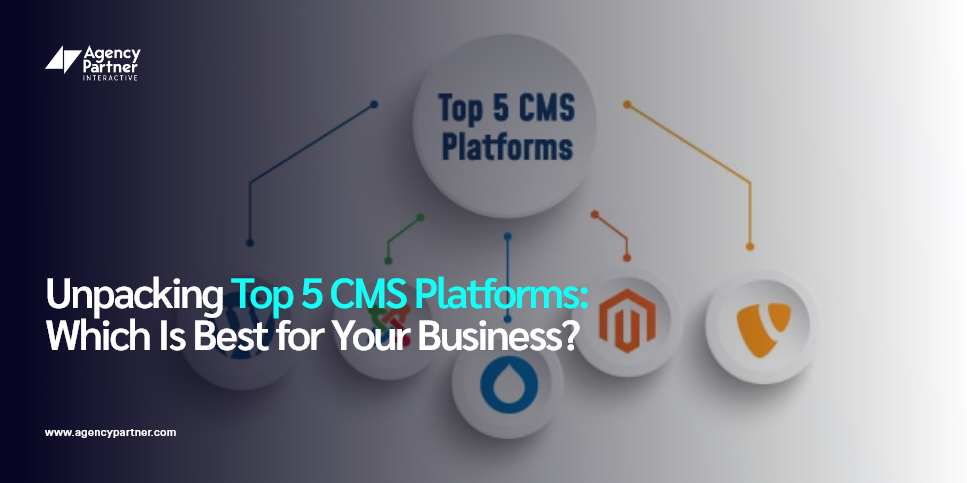
Let’s delve into the top 5 CMS platforms in 2023, each with unique offerings tailored to different business needs, from user-friendly designs for beginners to advanced functionalities for large-scale operations.
1. Shopify
Shopify is best suited for businesses focused on e-commerce. Its user-friendly design and robust sales tools are perfect for entrepreneurs who want to set up an online store quickly without extensive technical expertise.
If your business revolves around online retail and you need a platform that easily handles everything from product listings to payments and shipping, Shopify is an excellent choice.
Shopify, a leader in e-commerce CMS, boasts over 1.75 million merchants and has a 32% market share in the U.S. e-commerce platform sector. Its user-friendly interface and comprehensive e-commerce tools make it ideal for businesses looking to establish or expand their online stores. Shopify is particularly beneficial for those requiring a reliable, scalable platform with strong online sales and marketing support.
2. WordPress
WordPress is incredibly versatile, making it ideal for a wide range of businesses, from small blogs to large corporate websites. Its strength lies in its extensive customization capabilities and vast plugins, which can cater to almost any business need. WordPress is a strong contender if you need a flexible platform that can grow and change with your business.
Powering 45.8% of all websites on the Internet as of 2023, WordPress’s open-source CMS nature offers versatility and a vast array of customization options through themes and plugins. It’s suitable for a wide range of businesses, from tiny blogs to large corporate websites, and is a popular choice for its extensive community support and SEO-friendly nature .
3. Magento
Magento is best for large-scale e-commerce businesses requiring high customization and scalability. Its advanced features are well-suited for enterprises with complex product inventories and those who need a robust platform to support rapid business growth.
Magento is likely the right choice if your business demands a powerful e-commerce solution with extensive customization capabilities.
Magento, the 8th most widely used e-commerce platform worldwide, powers 0.13% of all websites on the Internet. Ideal for large enterprises with complex online store requirements, Magento is known for its scalability and advanced features. Online stores built with Magento grow three times faster than those using other e-commerce technologies .
4. Wix
Wix is renowned for its simplicity and ease of use, making it an excellent choice for small businesses and individuals new to website creation. Its drag-and-drop interface and wide range of templates allow quick and easy website development without coding skills.
Wix is ideal for those who prioritize ease of use and quick setup in their content management system for businesses.
Wix, holding a 3.5% share of the CMS market as of 2023, is a testament to its popularity, especially among users who value simplicity and ease of design in a web design agency context.
5. OpenCart
OpenCart is an open-source CMS tailored explicitly for e-commerce businesses. Known for its straightforward and user-friendly interface, OpenCart is ideal for small to medium-sized companies looking to establish an online store quickly.
It offers a range of features like multi-currency support, product reviews, and ratings, making it a comprehensive solution for online retailers.
While OpenCart is praised for its simplicity and range of features, it also provides flexibility for customization, which is highly beneficial for businesses with specific requirements. As a platform, it strikes a balance between user-friendliness and comprehensive e-commerce functionality.
The best CMS for your business depends on your specific needs. Consider your business size, industry, technical expertise, and future growth plans. Whether you need a simple platform for content creation or a complex system for e-commerce, there’s a CMS out there that’s right for you.
Start by assessing the size of your company and industry, as these factors will heavily influence your CMS requirements. Additionally, consider the level of technical expertise available within your team, as some CMS platforms may require more technical skills than others.
Future growth plans are also critical; you need a CMS that can scale with your business, accommodating increasing traffic, content, and functionality needs. Whether you’re looking for a straightforward platform primarily for content creation or a more complex system capable of supporting a full-fledged e-commerce operation, a CMS fits the bill.
It’s about finding the best CMS platform where functionality, ease of use, and scalability intersect with your business goals and resources.
Choose Agency Partner Interactive for CMS Web Design Services
Selecting the right CMS is a crucial decision for your online presence. The top CMS platforms each offer unique features and benefits, and finding the one that perfectly aligns with your business goals and capabilities is critical to your success.
Deciding which Content Management System is the best fit for your brand is the first step. The next is to build your website tailored to your brand, ensuring responsiveness, optimizing for SEO, and more.
At Agency Partner Interactive, we offer web development services and comprehensive digital marketing services tailored to enhance and optimize your chosen CMS. Our team, equipped with over 100 years of collective experience and a track record of over 1800 successful website projects, excels in CMS web design and development.
Whether you need help deciding which CMS best suits your business needs, creating a site from scratch, updating it for the latest plugins and functionalities, or even maintaining your website, our web design and development agency can help. Our expertise and dedication to turning your vision to life have won us awards like Clutch Global 2023, Inc. Power Partner 2023, Top Web Development Agency by DesignRush, and more.
By partnering with us, you can access a team dedicated to maximizing your digital potential. Contact us for a free proposal and start transforming your digital strategy today!
In competitive digital marketing, leveraging the best marketing tactics is essential for businesses looking to thrive without overspending. Inbound marketing, focusing on attracting customers through relevant and helpful content, emerges as a powerful strategy.
According to ZipDo, inbound marketing generates 54% more leads and offers a cost reduction of 62% per lead compared to traditional outbound marketing techniques.
At Agency Partner Interactive, a leading digital marketing agency, we understand the value of inbound marketing in significantly lowering customer acquisition costs. This approach aligns with modern consumer behavior and ensures that every marketing dollar is spent wisely. Let’s explore the top 5 inbound marketing tactics that can transform your marketing strategy.
1. Content Marketing: The Key to Engagement and Conversion
Content marketing stands at the forefront of effective inbound marketing tactics. It’s not about bombarding your audience with content but delivering value that resonates with them.
As a content marketing services agency, we’ve seen how a well-crafted content strategy can attract, engage, and convert audiences. Whether through informative blog posts, engaging videos, or insightful infographics, the aim is to provide content that answers questions, solves problems, and genuinely helps your audience.
This approach establishes trust and improves SEO, leading to higher organic traffic and lower customer acquisition costs. Additionally, content marketing is a continuous journey – consistently creating and sharing valuable insights, solidifying your brand as a thought leader in your industry.
2. SEO Optimization: Being Found Matters
For your content to have an impact, it must be found; this is where SEO optimization plays a crucial role.
Integrating SEO into your web development services ensures that your website and content rank high in search results, making it easier for potential customers to find you. As a web designing agency, Agency Partner Interactive emphasizes the importance of a well-structured, SEO-optimized website.
This means using the right keywords, optimizing meta tags, and ensuring your website is mobile-friendly. Remember, a website that ranks well is more likely to attract quality traffic, and quality traffic means a higher chance of conversion at a lower acquisition cost.
3. Social Media Engagement: Building Relationships with Your Audience
Social media is an excellent tool for building and nurturing relationships with your audience. Consistent posting is important, but cultivating meaningful interactions is even more crucial. Engage with your audience by responding to comments, sharing relevant information, and creating content encouraging dialogue.
This level of engagement helps in building a loyal community around your brand. A solid social media presence enhances brand visibility and credibility, critical components of an effective marketing strategy.
As a mobile app development company, we understand the impact of social media in reaching out to a mobile-savvy audience, thereby creating more opportunities for engagement and lowering the customer acquisition cost.
4. Email Marketing: Personalized Communication at Scale
Email marketing, often underrated, is a potent inbound marketing tool. It’s about connecting with your customers through personalized, relevant content. As a marketing service provider, we stress the importance of segmenting your audience and tailoring your messages to their needs and interests.
This approach leads to higher open and click-through rates, driving conversions at a lower cost. Moreover, email marketing is not just about selling but building relationships and staying top of mind. Regular newsletters, updates on your latest blog posts, or personalized offers can keep your audience engaged and connected to your brand.
The key is consistency and relevance, ensuring your emails provide value that keeps your audience looking forward to more.
5. Analytics and Feedback: Continuous Improvement and Adaptation
Inbound marketing is an ever-evolving field, and continuous improvement is vital. Utilizing analytics tools allows you to track the performance of your strategies and make data-driven decisions. As a digital marketing agency, we use analytics to understand which tactics are working and which need refinement.
For instance, monitoring which type of content generates the most engagement or which email campaigns have the highest conversion rates can provide insights into your audience’s preferences. This feedback loop is crucial for adapting and optimizing your marketing strategies over time, ensuring you get the most out of your efforts with reduced acquisition costs.
Agency Partner Interactive: Your Go-To for Winning Inbound Marketing Strategies
When executed effectively, inbound marketing can significantly lower customer acquisition costs while building a loyal customer base. At Agency Partner Interactive, we excel in implementing marketing tactics, aligning them with your business goals to maximize impact.
Through strategic marketing tactics, we achieved remarkable results. We helped one of our clients rank 23,075 keywords, with 888 in the top 1-3 positions, leading to a 450% year-over-year growth in total keyword rankings. This success story is a testament to our expertise in marketing tips and tactics and our commitment to delivering results.
Whether you’re looking for web development services, web designing agency expertise, or a comprehensive digital marketing strategy, Agency Partner Interactive is your premier marketing services agency. We understand the nuances of digital marketing and are dedicated to transforming your marketing challenges into success stories.
Contact us today for a free consultation and see how we can help lower customer acquisition costs through effective inbound marketing strategies!
In today’s fast-paced business environment, understanding the nuances of seasonal marketing is more important than ever. Whether you’re looking to refine your existing marketing strategies or explore new avenues for growth, this blog aims to be your go-to resource.
With a blend of industry insights and easy-to-implement tactics, we’re here to give you practical seasonal marketing tips, ensuring your business stays ahead of the curve. Let’s dive into some quick marketing tips for business owners!
Understanding Seasonal Trends
The cornerstone of effective seasonal marketing lies in identifying key seasons and holidays. 2024 brings a calendar of opportunities, from traditional holidays to unique cultural events. Businesses can craft targeted campaigns that resonate with their audience by pinpointing these pivotal times.
At Agency Partner Interactive, our digital marketing agency expertise extends to helping clients identify and capitalize on these critical periods, ensuring they don’t take advantage of potential growth opportunities.
However, recognizing these moments is just the start. Analyzing past trends and predicting future ones is crucial in crafting successful seasonal marketing strategies. It involves reviewing what has worked and adjusting strategies to align with consumer behaviors and preferences.
This is where the digital marketing services offered by Agency Partner Interactive shine, as we utilize data and analytics to guide our clients toward informed, data-driven decisions.
Setting Seasonal Goals
Setting clear, specific, and measurable goals is the foundation of any successful marketing campaign. Whether you’re aiming to boost holiday sales, increase brand awareness during particular seasons, or capitalize on a local event, having concrete objectives is vital.
As a digital marketing agency, we emphasize the importance of aligning these goals with your overall business strategy, ensuring every marketing effort pushes your business toward its broader objectives.
Practical goal setting also includes establishing metrics to measure success. This is where web development services play a critical role, providing the tools and technologies to track progress and analyze results.
Whether through website traffic, conversion rates, or social media engagement, having tangible metrics allows for continuous improvement and adaptation of your marketing strategies.
Developing a Seasonal Marketing Calendar
A well-structured marketing calendar is essential for timely and effective campaign execution. It’s about planning your marketing activities around critical dates and seasons, ensuring you’re prepared to seize every opportunity.
Agency Partner Interactive assists clients in developing these calendars, integrating long-term campaigns and short-term tactics to maintain a consistent and impactful marketing presence throughout the year.
Flexibility is also a critical component of any marketing calendar. The ability to adapt to unforeseen changes in the market or consumer behavior can make a significant difference. This agility allows businesses to take advantage of unexpected opportunities or mitigate challenges.
It balances preparedness and adaptability, ensuring your marketing efforts are as effective as possible in an ever-changing landscape.
Creating Seasonal Promotions and Offers
Seasonal promotions and offers are powerful tools in your marketing arsenal. These tailored promotions can significantly enhance customer engagement and drive sales, especially during peak seasons. We recommend designing promotions that appeal to your target audience and create a sense of urgency, encouraging immediate action.
For instance, exclusive holiday discounts or limited-time offers can effectively capture customer attention and boost short-term sales. Early rollout of promotions is key to engage and convert customers efficiently.
Think beyond traditional discounts and consider bundling products, offering special loyalty rewards, or creating unique experiences that align with the season’s spirit. These strategies attract new customers and strengthen relationships with existing ones. These marketing tips are designed to spark creativity and help you create promotions that attract attention and drive tangible results.
Remember, the goal is to make your promotions stand out in a crowded marketplace, something a seasoned web design agency like Agency Partner Interactive can help you achieve.
Leveraging Social Media and Digital Marketing
Social media and digital marketing are indispensable in today’s business landscape, offering many seasonal marketing opportunities. Different social media platforms provide various ways to connect with your audience, and it’s essential to tailor your approach.
As a digital marketing agency, we encourage businesses to create engaging, platform-specific content that aligns with seasonal themes. This could include unique holiday-themed posts, interactive contests, or timely ads that capitalize on current trends.
Make the Most of the Holiday Hustle for Brand Awareness
The holiday season is a prime time for boosting brand awareness. Entrepreneurs can maximize their visibility by strategically boosting posts on platforms like Facebook and Instagram. These boosted posts can target specific demographics, ensuring your content reaches the right audience at the right time.
Additionally, investing in YouTube ads can be a game-changer. With millions of viewers tuning in, YouTube provides a vast platform to showcase your brand through creative and engaging video content. The key is to craft eye-catching ads that embody the season’s festive spirit, making them more relatable and compelling.
Digital marketing offers various tools and techniques to enhance your seasonal campaigns. From targeted advertising to email marketing campaigns, the possibilities are vast. With its comprehensive digital marketing services, Agency Partner Interactive can guide you in selecting the most effective strategies to reach your audience.
The key is to ensure your digital marketing efforts are cohesive, engaging, and aligned with your overall seasonal marketing strategies. By leveraging these platforms effectively, businesses can significantly increase their brand presence during the year’s busiest shopping period.
Localizing Your Marketing Efforts
Tailoring your marketing efforts to local events and cultural nuances can significantly amplify their effectiveness. Localized marketing strategies create a deeper connection with your audience as they resonate more with their immediate environment and experiences. As a web development services provider, we help businesses optimize their local SEO, making them more visible and relevant in local search results.
Engaging with local communities through events or sponsorships can also be a powerful way to enhance brand visibility and foster goodwill. These efforts demonstrate your business’s commitment to the community and provide unique marketing opportunities tied to local culture and events. It’s about being a part of the community conversation, which can set your business apart in a competitive market.
Evaluating and Adjusting Your Marketing Strategies
Every marketing strategy is complete with a robust evaluation and adjustment process. It’s crucial to track the performance of your seasonal campaigns, analyzing what worked and what didn’t. This evaluation provides valuable insights that can inform future marketing decisions.
At Agency Partner Interactive, we stress the importance of using analytics and feedback to continuously refine your marketing strategies, ensuring they remain practical and relevant. Adapting your strategy based on these evaluations is essential.
The market is constantly evolving, and so should your marketing efforts. Whether tweaking your social media approach, refining your email marketing campaigns, or adjusting your web design for a better user experience, being responsive to feedback and data is critical to maintaining a successful marketing presence.
Agency Partner Interactive: Your Solution to Seasonal Marketing Strategies
Mastering seasonal marketing requires creativity, strategy, and adaptability. At Agency Partner Interactive, we combine these elements to create customized marketing solutions that resonate with your brand and audience. Take, for example, one of our clients.
We significantly enhanced their online presence through our tailored SEO, content marketing, and social media marketing approach. Their traffic swelled to 20,797 users, an 158% increase year-over-year. Moreover, we achieved 2,038 conversions, an 104% increase YoY.
These numbers demonstrate our commitment to delivering results and our ability to turn marketing strategies into tangible business successes.
So remember, at Agency Partner Interactive, we’re more than just a digital marketing agency; we’re your partner in navigating the ever-evolving marketing landscape.
Let’s work together to make 2024 a year filled with impactful and rewarding marketing endeavors. Contact us today for a free consultation!
FAQs on Seasonal Marketing for Business Owners
Q1: What are some essential seasonal marketing tips for small business owners?
A1: Key tips include identifying crucial seasons and holidays relevant to your business, creating targeted promotions, and using social media to engage your audience. Adapting your strategies based on market trends and customer feedback is vital.
Q2: How can Agency Partner Interactive assist with my seasonal marketing strategies?
A2: As a digital marketing agency, Agency Partner Interactive offers various digital marketing services tailored to seasonal marketing. From developing customized marketing calendars to creating dynamic web and mobile app designs, we help businesses capitalize on seasonal trends effectively.
Q3: What role does web design play in seasonal marketing?
A3: A responsive web design agency can significantly enhance your seasonal marketing efforts by creating a website that resonates with seasonal themes, improves user experience, and effectively showcases your promotions and offers.
Q4: Can you provide quick marketing tips for business owners looking to boost holiday sales?
A4: Focus on creating unique offers and promotions that resonate with the holiday spirit. Utilize email marketing and social media advertising to reach a wider audience. Remember to optimize your website for seasonal traffic and ensure it’s mobile-friendly.
Q5: How influential are digital marketing services in executing seasonal marketing 101 strategies?
A5: Digital marketing services are crucial for effectively executing seasonal marketing strategies. They provide tools and techniques like SEO, targeted ads, and content marketing, essential for reaching and engaging your target audience during different seasons.
Q6: What are some innovative seasonal marketing strategies for 2024?
A6: Innovative strategies include leveraging emerging social media platforms, integrating augmented reality experiences in your campaigns, and using data analytics to personalize customer experiences.
Q7: Do you have any digital marketing tips for businesses new to seasonal marketing?
A7: Start with understanding your audience and what seasons matter most to them. Use digital marketing tools to analyze customer behavior and preferences. Invest in social media and content marketing to build a solid online presence.
Search engine optimization (or SEO) keeps changing in our digital world. One of the latest buzzwords is Google’s Position Zero, a feature highly discussed within the Google Search Engine Results Page (SERP) realm. Let’s dive into what it is, the pros and cons, when you should use it, and how you can aim to get your content there.
Understanding Position Zero
Achieving an impressive online presence in the digital realm means staying updated on emerging trends. Position Zero offers brands an exclusive opportunity to display their content atop Google’s SERP. However, this spot has its advantages and disadvantages. Therefore, understanding its ins and outs is vital for anyone using Position Zero to strengthen their online presence.
What is Position Zero?
Position Zero, commonly known as the “Featured Snippet,” occupies a unique spot at the top of Google search results. It’s designed to provide users with relevant and quick information in various formats, be it direct answers, lists, tables, or even videos, without needing them to click on a website. Initially, content that secured the Position Zero spot would also feature in the main Google SERP results, offering websites a double advantage. However, this changed in 2020 when Google decided that content showcased in Position Zero wouldn’t appear again in the primary search results – a process they labeled “deduplication.”
What Are the Different Types of Featured Snippets?
To better understand Position Zero, it’s essential to recognize the different formats in which content can appear. Here are the main types of featured snippets on Google:
Extract or Paragraph Snippet: This is often a brief paragraph providing a quick answer to a user’s question.
Numbered Lists: Commonly seen for “How to” questions, these present step-by-step answers or sequences.
Bullet-point Lists: Ideal for showcasing “best of” recommendations or summarizing multiple points without a specific order.
Table: For searches that require numerical data or comparisons, tables might be the chosen format for Position Zero.
People Also Ask: This dropdown list offers related questions that users frequently ask alongside the initial query.
Video Responses: For “How To” questions, YouTube videos might appear in Position Zero to visually guide users.
What Are the Advantages?
There’s a reason why so many people want to get their content in Position Zero. Being right at the top can lead to more clicks and more people visiting your website. It makes your brand stand out and look like the SEO experts in your domain and a leader in your industry.
When users use Google’s voice search, it often cites sources such as “According to Agency Partner Interactive…” and then reads the answer. This helps people know where the information is coming from and makes them curious to click for more details. This can establish brand authority and brand awareness. Another advantage is that changes in Google’s algorithms won’t easily move you from there once you get to Position Zero.
What Are the Disadvantages?
Position Zero has its drawbacks. If your content is in Position Zero, it won’t also show in the main search results. Only a few searches on Google (only about 19%) show a featured snippet. Even when it does appear, many people still click on the regular results below. And sometimes, having your content in Position Zero can decrease your website visits.
Why? Because people get all the information they need from the answer box and don’t click on the link to your website. This means fewer visitors and possibly fewer sales or sign-ups. That’s why you should aim for Position Zero only when your brand goals align with its intent. If both align, use the right strategies to claim that top spot.
What Are the Best Strategies to Rank and Optimize for Position Zero?
1. Create Content for Featured Snippets
When you’re writing, focus on questions people might ask. Look at the current snippets and consider how to provide even better answers. Organize your content in a question-and-answer style and follow Google’s guidelines, especially when using schema markup.
2. Leverage Original Images
Images are more than just visual aids; they can play a pivotal role in determining if your content gets featured in Featured Snippets. Using original photos or custom-made graphics tailored to amplify the user experience is recommended, which can give you an edge in securing Position Zero.
While stock images are an option, it’s essential to recognize that those images might be widely used across various sites. If you opt for them, meticulous optimization becomes even more critical, as you’ll likely be competing against others using the same visuals. Prioritize genuine, high-quality imagery to stand out and enhance your chances of capturing that coveted top spot.
3. Use Appropriate Content Style and Format
When you answer questions, keep your answers clear and to the point. Use lists or steps to organize your information. If you’re aiming for a paragraph snippet, keep it short and sweet.
4. Use SEO Tactics Specific to Featured Snippets
Make sure your URLs, meta titles, and descriptions are spot on. When using pictures, use descriptive alt text. Build quality links to your content and use schema markup. Always consider what the person searching wants to know and ensure your content delivers.
5. Enhance Relevance and Authority
Use related keywords in your content and intelligently group them. Add pictures, videos, or other multimedia to improve your content. Your primary keywords should appear in your URL and headlines—link to other relevant pages on your site and trusted sites on the web.
6. Always Stay Up to Date
The internet is constantly changing, and so should your content. Always keep your content fresh and up to date. Quality backlinks from other websites can also help boost your content in Google’s eyes.
Transform Your SEO Journey with Agency Partner Interactive
Getting to Position Zero on Google can significantly increase visibility for your brand. Remember the steps we talked about and put them into action. With some work and innovative strategies, you can see the benefits of being in that top spot. As a leading digital marketing agency, we have helped our clients reap the rewards of such efforts, witnessing a remarkable 430% surge in website traffic and an impressive 113% rise in top 3 keyword rankings.
Agency Partner Interactive is dedicated to being the premier partner for growth-focused brands looking to achieve their full potential. We blend innovative digital marketing expertise with the latest SEO techniques to ensure our clients reach the top of Google SERPS and stay there. Looking to drive more organic traffic, qualified leads, conversions, and revenue?
Don’t wait! Schedule a free consultation today, and let’s craft a custom SEO strategy to boost your online presence to new heights and achieve your long-term goals.
In today’s digital realm, where TikTok rules and streaming platforms abound, the typical consumer is on the hunt for content that’s snappy, relatable, and easy to digest. To remain at the forefront, businesses have to evolve, matching pace with the dynamic demands of their audience. The age-old strategies featuring plain text and static images are becoming relics. The modern toolkit for businesses is incomplete without one key weapon: videos.
The Transformative Power of Video in Digital Marketing
Video content is now the pulsating heart of digital marketing. This year alone, a staggering 82% of all generated content is expected to be video based. That’s a quantum leap from 2017, showcasing a 15-fold increase! If your brand hasn’t embraced this trend, you’re potentially missing out on a surge of engagement and conversion opportunities.
Hard-Hitting Industry Statistics
Video marketing isn’t just a fleeting trend; it’s the future. A slew of statistics reinforces its indispensability:
80% of users prefer watching a video to reading written text.
An impressive 72% of social media users prefer video content compared to any other format.
Benefits of Videos for Social Media and Email Marketing
Higher Engagement Rates: Our neurons light up in response to visual content. With their captivating nature, videos glue viewers to the screen, translating to higher share rates. Platforms like Google and Facebook interpret this as a signal of high-quality content.
Enhanced Storytelling: Video surpasses the barriers set by traditional marketing. It allows brands to weave unforgettable narratives, building profound emotional ties. This is the secret sauce to bolstering customer loyalty and nurturing leads, setting the stage for future conversions.
Boosted Conversions: Data doesn’t lie. Videos consistently amplify click-through rates and propel sales or specific actions. A more engaged audience is more receptive to your calls to action.
Engagement & Brand Awareness: In the vast sea of daily emails and social posts, an eye-catching video is your beacon. It commands attention, ensuring your brand remains top-of-mind.
Why Your Videos Deserve a Spot in Your Strategy
1. Algorithm Prioritization:
The Mechanics: Most modern social platforms employ algorithms that prioritize content likely to engage users. Videos, given their engaging nature, often fit this criterion perfectly. This means that posts with videos are more likely to appear in a user’s feed than static content.
Engagement Metrics: Videos tend to accumulate higher engagement metrics such as shares, likes, and comments. These metrics further signal to platform algorithms that the content is valuable, increasing its reach.
2. Enhanced SEO:
Dwell Time Boost: When users spend more time on a particular page (often with engaging videos), it sends a positive signal to search engines, improving search rankings.
Rich Snippets: Video content on your website can enable rich snippets in search results. This can include a video thumbnail, increasing the click-through rate from the search engine results page.
Backlinks: High-quality, informative, or entertaining videos are more likely to be linked to by other websites, enhancing your backlink profile and, subsequently, your SEO.
3. Repurposing:
Maximize Content Lifespan: Once you’ve produced a video, elements of it can be extracted and used in other content formats. Think GIFs, images, quotes, and audio snippets. This allows one piece of content to be disseminated in various ways across different platforms.
Cross-Platform Compatibility: A video made for one platform (say, YouTube) can be edited and adapted for another (like Instagram or TikTok). This ensures maximum visibility without creating entirely new content.
4. Improved User Experience:
Visual Learning: A significant portion of the population is visual learners. Videos cater to this group, providing an efficient method of information transfer that text alone can’t achieve.
Interactivity: Modern videos can incorporate clickable links, embedded forms, and other interactive elements, providing an immersive experience and a direct path to action for viewers.
5. Mobile Friendliness:
Consumption Patterns: With a growing number of consumers accessing content via mobile devices, videos offer a format that’s easily consumable on smaller screens compared to lengthy text.
Platform Integration: Platforms like Instagram and Snapchat are mobile-first and video-centric. Leveraging video ensures you’re optimizing for these platforms’ primary mode of content delivery.
The Pressing Need for Video in Your Marketing Arsenal
Gone are the days when a stock image and a chunk of text held sway. The contemporary consumer’s palate has evolved. They’re after rich engagement, interactivity, and value – and videos deliver on these fronts. Here’s how you can deliver:
Integrating Videos in Your Email Marketing Campaign
Subject Line Optimization: Your subject line is the first impression. Hinting at video content like “[Video Inside]” can increase your open rates.
Embed vs. Link: Gauge your audience’s tech landscape. Choose between embedding videos or linking to ensure a smooth viewing experience.
CTA Crafting: Every video should drive a purpose. Bolster it with clear CTAs, guiding viewers on their next steps.
Social Media Strategy with Videos:
Choose the Right Platform: Customize content to resonate with platform-specific audiences. While LinkedIn users might gravitate towards in-depth content, TikTok and Instagram users typically thrive on snappy, engaging pieces.
Diverse Video Types: Live streams, testimonials, explainers – offer a video variety that’s appealing to everyone.
Promote Your Content: Extend your video reach with sponsored posts or ads, amplifying reach and interaction.
Key Takeaways: Boost Your Campaign with Videos
The era where video is the monarch of digital marketing, especially in the domains of email marketing and social media, is here. Brands seeking to invigorate their strategies, amplify engagement, and scale conversion peaks cannot afford to sideline videos.
Your Video Marketing Ally: Agency Partner Interactive
Embarking on the video journey can be overwhelming, but with Agency Partner Interactive by your side, it’s a breeze. We’ve mastered the art of strategically embedding videos into social media and email marketing blueprints.
Our bespoke social media strategies have propelled our clients to staggering heights, like a 3k+ surge in Facebook reach and over 100 product sales within the first 2 months of the social media campaign.
Eager to elevate your brand and unlock new growth with the best Dallas digital marketing agency? Connect with us to learn about our social media services, and let’s build your next winning campaign one video at a time.
In today’s hyper-competitive business landscape, achieving streamlined operations and maximum revenue is paramount. Enter RevOps optimization, a strategy that promises just that. But what is RevOps, and how can it catalyze your business growth? This blog post will dive into the key components of an effective RevOps strategy, how to build it, and how to implement it across your organization to achieve your revenue goals.
What is RevOps?
RevOps, or Revenue Operations, is a holistic approach, merging sales, marketing, and customer service under one strategic umbrella with a shared focus on revenue generation. When implemented correctly, it can lead to improved collaboration, increased efficiency, and, ultimately, business growth.
At its core, RevOps is an operational strategy that seeks to break down silos within organizations. Instead of viewing sales, marketing, and customer service as separate entities, RevOps combines them into a synchronized unit. It’s not just a change in structure but a shift in mindset: one that prioritizes the customer journey from awareness to retention.
The Importance of Revenue Operations for Your Business
Why is this holistic approach catching on? Because companies are recognizing the inefficiencies of isolated departments. When sales, marketing, and customer service operate in tandem, there’s a clearer understanding of the customer, leading to better targeting, smoother conversions, and enhanced post-sales services.
Key RevOps Statistics 2023
Companies that invest in RevOps report a 10-20% increase in sales productivity. They also noted that tighter alignment of go-to-market teams led to a 100% to 200% increase in digital marketing ROI (Boston Consulting Group).
Companies that implemented RevOps grew revenue 3x faster than those that didn’t (Forrester).
Organizations that used RevOps reported a 10-20% increase in sales productivity (Boston Consulting Group).
Because of RevOps, 21% of companies saw an improvement in alignment, particularly between sales and marketing teams. (Revenue.io)
Key Components of an Effective RevOps Strategy
Let’s delve into the core of RevOps and take a look at the foundational tenets that drive its success.
1. Integrative Organizational Alignment
RevOps optimization weaves all revenue-generating departments – sales, marketing, and customer service – under a single umbrella of purpose. No longer are teams bound by their specific roles. Instead, there’s a shared responsibility for revenue. This alignment means smoother communication, fewer hiccups, and a collective push toward shared milestones.
Aligned Objectives: Through RevOps, departments work in unison, using shared tools and processes, often in real-time. This alignment isn’t just about collaboration but about leveraging collective intelligence. It ensures that marketers understand sales teams’ pain points and that customer service is looped into feedback, driving product improvements.
Consolidated Platforms: Different departments leveraging diverse tools lead to fragmented operations and isolated data. RevOps introduces a singular platform, like an integrated CRM, enhancing teamwork and smooth data transitions.
Unified Approaches: Imagine your customer service and marketing department sending varied messages to the same audience. RevOps stitches these approaches together, assuring a harmonized and consistent communication strategy.
2. Prioritizing the Customer Journey
At its heart, RevOps seeks to refine and magnify the customer experience. The vision is to increase client satisfaction, build lasting trust, and extend the customer’s lifetime value through regular touchpoints.
Tailored Outreach: Utilizing RevOps paves the way for an aligned client database, facilitating customized marketing initiatives that amplify engagement and conversion rates.
Unified Client Support: By weaving RevOps services into your operations, all client-centric teams garner insights from comprehensive client interactions, ensuring more consistent and potent support.
Integrated Client Path: By bringing marketing, sales, and client success under the RevOps strategy, the customer’s path becomes fluid from the first interaction, enhancing loyalty and retention.
3. Data-Driven Decision Making
RevOps works on a unified data landscape, offering a panoramic view of the customer’s journey and organizational health to make data-driven decisions. Luckily, we live in an era that provides unprecedented access to data. From customer behavior on your website to feedback on social media, every touchpoint offers insights. In RevOps, these insights guide strategy.
Enhanced Predictions: A holistic data outlook is instrumental in sharpening sales predictions, which translates into optimal stock management and slashed expenses.
Customer Analytics: Capitalizing on RevOps to accumulate and dissect data from each customer touchpoint can unearth profound insights into client preferences, shaping a user-focused marketing approach.
Unified Evaluation: The power of RevOps lies in offering a composite performance dataset, equipping businesses to gauge their efficacy and adjust strategies dynamically.
4. Technology Stack & Automation
RevOps success hinges on the blend of robust technology frameworks and automation. These elements serve as the nexus, fostering streamlined operations and consistent growth.
Unified Infrastructure: At the heart of RevOps lies a consolidated technology stack. Picture an environment where sales, marketing, and customer service draw from a singular, harmonized system. This unification ensures seamless communication and data sharing, amplifying overall efficiency.
Smart Automation: Automation isn’t just about replicating manual tasks but enhancing them. Within a RevOps framework, automation tools ensure processes are reproduced and optimized. From automating lead nurturing to providing timely communication, it removes friction and accelerates the revenue lifecycle.
Adaptive Mechanisms: As the digital landscape evolves, so must the technology and automation strategies within RevOps. The strength of an infused technology stack is its ability to adapt — integrating new tools, refining automation strategies, and ensuring the organization stays ahead of the curve.
5. Optimizing Operations
RevOps optimizes operations by pruning inefficiencies and overlapping tasks. It thrives on refining procedures, ushering in automation, and maximizing technology to boost productivity.
Process Streamlining: Beyond mere alignment, charting processes is vital to RevOps. It’s essential to craft a solid offline strategy; then, as you start your RevOps strategy, the following automation can yield monumental time and cost dividends.
Maximizing Resources: RevOps can spotlight operational snags, granting the opportunity to reassign resources, smoothen processes, and slice down project timelines.
Reducing Overlaps: Recognizing and nullifying duplicated efforts translates into resource conservation, crafting a more streamlined workflow.
6. Continuous Evaluation & Iteration
Just like any strategy, RevOps isn’t something you can set and forget. It demands regular attention, monitoring, and adjustments in real time. By continuously evaluating performance and iterating strategies based on feedback and results, your businesses can stay agile and adaptive, increasing the effectiveness and efficiency of your revenue generation process.
Ongoing Analysis: Infusing Dallas RevOps services into your operations and initiating periodic reviews can foster a culture of perpetual growth, allowing strategies to be tweaked for amplified outcomes.
Feedback Mechanisms: Instituting feedback channels across all units under RevOps ensures that shared insights lead to collective growth and creativity.
Swift Adaptations: The tenets of RevOps empower organizations to swiftly modify their game plan in sync with market dynamics, ensuring that they remain at the pinnacle of their industry.
RevOps is a journey, not a destination. It emphasizes constant introspection, fostering a culture of relentless refinement and adaptability.
Steps to Implementing a Robust RevOps Strategy
Now, let’s turn these insights into action! Here’s a step-by-step guide to start building your RevOps strategy.
1. Assess the Current State
You wouldn’t start a journey without knowing your starting point. Dive deep into your existing processes. Understand where you’re efficient and where there’s room for improvement. Use this assessment as the foundation for your RevOps strategy. You can begin with a SWOT analysis to gain insights into your current operational model. Gather feedback from individual team members and foster a culture of open collaboration and idea sharing.
What challenges does your sales team face?
Is your marketing ROI declining on certain platforms?
These questions help with clarity and give you a sound foundation for mapping your RevOps strategy.
2. Set Clear Objectives
Define precise KPIs and revenue goals. Regardless of their department, every team member should understand these objectives and how their role feeds into them. The clearer and more precise your objectives are, the better your team members will understand how their role contributes to it.
One way to do this is by setting SMART (Specific, Measurable, Achievable, Relevant, Time-bound) goals.
Break down what you need to achieve instead of just aiming for generalizations. Instead of “increase sales,” an example of a SMART goal would be “achieve a 20% increase in sales from organic traffic in Q3.”
3. Assembling a Cross-Functional RevOps Team
RevOps thrives on diversity. By bringing together professionals from sales, marketing, and customer service, businesses can harness diverse perspectives, leading to richer strategies and more innovative solutions.
4. Leveraging the Right Technology
Choosing the right tools can make or break your RevOps efforts. Look for platforms that integrate well and cater specifically to your business’s needs. It’s not about having the latest tech but the most relevant and valuable for your business needs.
5. Regularly Review and Refinement
Markets evolve. Customers’ preferences change. A static plan won’t cut it. Regularly reviewing, monitoring, and auditing your strategy ensures your approach aligns with the market pulse.
6. Measuring Success in RevOps
Measuring success in RevOps goes beyond just revenue. Dive into metrics like churn rate, customer satisfaction scores, and average deal cycles. Each metric offers a unique perspective on performance, guiding decision-making.
Beyond this, focus on customer-centric metrics like Net Promoter Score (NPS) or Customer Satisfaction Score (CSAT). Monitor the sales funnel for drop-off points. Track the efficacy of marketing campaigns not just in engagement but in actual conversions.
Metrics for Monitoring RevOps Performance
Here are some metrics to monitor:
Customer Lifetime Value (CLV): Total revenue a customer can bring during their association with the business.
Customer Acquisition Cost (CAC): Total cost of acquiring a new customer.
Lead Conversion Rate: Percentage of leads that become paying customers.
Customer Churn Rate: The rate at which customers stop doing business with you.
Setting Your Organization Up for RevOps Success
Here are some best practices to ensure your company starts off on the right track.
Common Pitfalls to Avoid
While embracing RevOps promises a unified approach to driving revenue, there are common pitfalls that organizations should be wary of:
Lack of Communication: The essence of RevOps lies in collaboration. The process becomes disjointed without open communication channels among sales, marketing, and customer service.
Overloading with Technology: While technology is a cornerstone of RevOps, indiscriminately adding tools without a clear plan can create confusion and hamper efficiency.
Resistance to Change: Teams may resist the shift to RevOps, particularly if they feel their autonomy is threatened. Change management strategies are crucial to address these concerns.
Not Aligning KPIs: Metrics should reflect the goals of RevOps – holistic growth and customer satisfaction. Ensure that all teams know which metrics matter.
Change can be daunting, and with any organizational restructuring, challenges will arise. Beware of miscommunication, resistance to tech adoption, or misalignment of objectives. Being informed helps in crafting proactive solutions.
Tapping into Expertise
RevOps is complex, and it can be daunting at first. Collaborate with experts who’ve been there and done that. Their insights can be the difference between a good strategy and a great one.
Engage with Thought Leaders: Attend seminars, webinars, or workshops led by RevOps pioneers. They offer invaluable insights derived from real-world challenges and successes.
Hire or Consult Experts: Consider bringing in a RevOps expert or consulting with agencies like Agency Partner Interactive that specialize in the field and have implemented RevOps in their organization. They can help in tailoring a strategy specifically suited to your business needs.
Why Choose Agency Partner Interactive for RevOps Services
In today’s digital-first world, having a partner that understands your business and the digital landscape is crucial. Our expertise is not just theoretical; it’s battle-tested. We implement RevOps across our organization and operate with the same principles, bringing our experience and success to yours.
From groundbreaking digital marketing campaigns to innovative software solutions, our experience is vast and varied. Being a seasoned web design agency and digital marketing agency, we ensure your digital assets are optimized for both performance and revenue generation.
Tailored RevOps Solutions for Every Business
Every business is unique, and a one-size-fits-all approach rarely succeeds. We emphasize:
Custom Strategies: After thorough analysis, we craft RevOps strategies tailored to your business model, industry, and target audience.
Client Success: Over the years, we’ve helped hundreds of businesses achieve sustainable growth through data-driven marketing. From increasing lead generation by 150% for a tech startup to reducing sales cycle time for an eCommerce client, our tailored solutions deliver results.
Your Dallas RevOps Service Provider
Being a Dallas RevOps service provider, we bring the best of both worlds – global expertise with local insights. Our deep understanding of the Dallas market adds a layer of finesse to our strategies, ensuring they resonate with your target audience.
The promise of RevOps is undeniable – a cohesive, efficient, and revenue-maximizing strategy. It’s the future of business operations. As you embark on your RevOps journey, remember: it’s not just about change but evolution. And as always, Agency Partner Interactive is here to guide you every step of the way.
Looking to craft a winning RevOps strategy? Get in touch with Agency Partner Interactive today and unlock unparalleled growth.
More than high-quality content is required to attract and retain an online audience. With so much content on the internet, it’s easy for your content to get lost in the sea of information. That’s where content amplification comes in.
Content amplification refers to the various strategies and tactics that can be used to increase the reach and visibility of your content. According to HubSpot, 87% of marketers use email marketing to distribute content and maximize website traffic.
Blogs, social media posts, videos, and other forms of online content can be amplified using different techniques such as social media marketing, influencer outreach, email marketing, and paid advertising. By leveraging these strategies, businesses and individuals can maximize their web traffic and reach a wider audience.
The importance of content amplification in maximizing web traffic cannot be overstated. Without a solid amplification strategy, even the best content can go unnoticed. This blog will discuss various content amplification strategies to help you get your content in front of the right audience and drive more traffic to your website.
Understanding Your Audience
Before you amplify your content, it’s important to understand your audience. This involves identifying your target audience, creating buyer personas, and understanding their interests and behavior.
Determining your target audience
Identifying your target audience means defining the people you want to reach with your content. This could be based on demographics such as age, gender, income, and location or psychographics such as interests, values, and beliefs.
Creating buyer personas
Buyer personas are fictional representations of your potential customers. They are created based on research and data about your target audience. Buyer personas typically include demographics, goals, pain points, interests, and behavior. You may better understand your target audience by developing buyer personas, enabling you to provide content that appeals to them.
Knowing your audience’s interests and behavior
Knowing your target audience’s interests and behavior is key to creating content that resonates with them. This involves understanding their online behavior, such as what social media platforms they use, websites they visit, and keywords they search for. It also involves understanding their interests and pain points, which can be identified through surveys, social media listening, and other forms of research.
Content Creation for Amplification
Creating high-quality and engaging content is essential for content amplification. Here are some best tips for creating content that is optimized for amplification:
Creating high-quality and engaging content
High-quality content is informative, relevant, and valuable to your audience. It should be well-researched, easy to read, and visually appealing. Engaging content is also important, as it encourages your audience to interact with your content, share it with others, and return for more.
Creating content with shareability in mind
Creating content that is easy to share on social media can increase its reach and virality. This means including social media share buttons on your website, creating catchy headlines and compelling visuals, and writing easily digestible and shareable content.
Creating different types of content
You can reach a larger audience and keep your material interesting and new by producing several sorts of content. This can include:
Videos are highly engaging and can showcase products, explain complex topics, and share stories.
Infographics are simple to share on social media and have the potential to promote interaction. They are visual representations of facts and information.
Blog posts are a great way to share insights, opinions, and news about your industry or niche.
Analyzing and Measuring Results
Analyzing and measuring the results of your content amplification efforts is essential for optimizing your strategy and achieving your goals. Here are some tips for analyzing and measuring your results:
Setting goals and objectives
Setting specific, measurable, and realistic goals and objectives is important for measuring the success of your content amplification efforts. Your goals include increasing website traffic, growing your social media following, generating leads or conversions, or increasing brand awareness.
Measuring success with key performance indicators (KPIs)
KPIs are metrics that are used to assess the effectiveness of your content amplification efforts. Some common KPIs include website traffic, engagement rates on social media, conversion rates, and cost per click (CPC) for paid advertising.
Analyzing and adjusting your strategy based on results
Analyzing your results and adjusting your amplification strategy is key to improving effectiveness. This could involve experimenting with different social media platforms, adjusting your targeting for paid advertising, or trying out different types of content. You can optimize your content amplification efforts and achieve your goals by continually analyzing and adjusting your strategy based on your results.
7 Effective Content Amplification Channels to Drive Traffic to Your Website
Here are some content amplification channels that can help drive traffic to your website:
Social media
Sharing your content on social media platforms like Facebook, Twitter, LinkedIn, and Instagram can help you reach a massive audience and drive traffic to your website.
Influencer marketing
Partnering with influencers in your industry can help you reach their followers and drive traffic to your website.
Content syndication
Publishing your content on third-party websites can help you reach a new audience and drive traffic back to your website.
Email marketing
Sharing your content with your email subscribers can help drive traffic to your website and build customer loyalty.
Paid advertising
Investing in paid advertising channels like Google Ads or Facebook Ads can help you target your ideal audience and boost traffic to your website.
Guest blogging
Contributing guest posts to relevant industry blogs can help you reach a new audience and drive traffic back to your website.
Search engine optimization (SEO)
You can improve your SERP ranking and increase organic website traffic by optimizing your content for search engines.
Final Thoughts on the Best Content Amplification Strategies
Content amplification refers to the various strategies and tactics that can be used to increase the reach and visibility of online content, such as blogs, social media posts, videos, and other forms of content. It involves understanding the target audience, creating high-quality and engaging content, and leveraging different amplification strategies such as social media, influencer marketing, email marketing, and paid advertising to drive more traffic to a website.
The success of content amplification efforts can be measured using key performance indicators (KPIs), and the strategy can be adjusted based on the results to optimize its effectiveness. Content amplification is essential for maximizing web traffic and reaching a broader audience in today’s digital age.
Maximize Web Traffic with Agency Partner Interactive
Are you looking for the best digital marketing in Dallas? With so many digital agencies vying for your attention, it can be difficult to find the perfect partner to help you achieve your business goals.
At Agency Partner Interactive, we specialize in providing top-notch digital marketing services that help businesses grow. With over a decade of experience and a portfolio of successful projects, we have the knowledge, tools, and resources to boost your online presence.
As one of the top digital marketing agencies in Dallas, we offer various services to help businesses like yours build a reputable presence and drive scalable website traffic. Here are some our customizable services:
A content management system (CMS) is a software program that facilitates the creation, administration, and distribution of digital information across numerous platforms. It’s a must-have tool for organizations of all sizes since it simplifies content generation and administration, allowing you to present a consistent message to your audience.
According to a survey by WP Engine, 40%of consumers will leave a website if it takes more than three seconds to load. Choosing the right CMS can help improve website speed and prevent users from leaving your site.
Selecting the right CMS for your business is crucial because it can affect your website’s performance and your team’s workflow. This article provides a comprehensive guide to help you choose the best CMS for your business.
By the end of this article, you’ll have a better idea of selecting the best CMS for your company, whether a small start-up or a large corporation.
What is a CMS Platform?
A CMS or Content Management System platform is a software application that allows you to create, manage, and publish digital content. It provides a user-friendly interface and tools that allow users to create and edit web content without requiring technical knowledge or programming skills.
A CMS platform typically consists of two parts: a content management application that allows to create and manage content and a content delivery application that delivers the content to the website or other digital channels. CMS platforms manage many types of digital material, such as text, photos, videos, and audio files.
Factors to Consider When Choosing a CMS
Here’s what you should consider before selecting a platform that’s right for your business needs.
Ease of Use
The usability of a CMS is critical for content creators since it affects their ability to generate high-quality material effectively. A user-friendly interface and straightforward content management tools can let writers focus on the content rather than the CMS.
Customization Options
Customization options are essential because they allow businesses to tailor the CMS to their unique needs. With customization options, businesses can modify the CMS’s design, functionality, and user experience to match their brand and business goals.
Customization options are particularly crucial for businesses that require specific features or have unique design requirements that may not be available in a standard CMS.
Scalability
Scalability is crucial for businesses that plan to grow and expand over time. A scalable CMS can handle increasing traffic, larger volumes of content, and more complex functionality without sacrificing performance or stability.
Choosing a CMS that can scale with your business is essential to avoid the cost and disruption of migrating to a new CMS as your needs evolve.
What Are Popular CMS Platforms?
When choosing a CMS, there are several popular platforms to consider. This section will overview three popular CMS platforms: WordPress, Drupal, and Joomla.
WordPress
WordPress is one of the world’s most widely used CMSs, powering more than 40% of all websites on the internet. According to W3Techs, WordPress is used by 43.2% of all websites. Its user-friendly interface and an extensive library of plugins and themes, which make customization simple, are partly responsible for its popularity.
WordPress’s features
WordPress offers many features that make it an attractive option for businesses of all sizes. Some of its key features include:
WordPress’s intuitive interface makes creating and managing content easy for all skill levels.
With its hundreds of themes and plugins, WordPress can be customized to meet various corporate requirements.
The design of WordPress is SEO-friendly, making it simple for businesses to optimize their website for search engines.
WordPress offers several e-commerce plugins that allow businesses to sell products and services online.
Drupal
Drupal has over 1.5 millionusers and contributors in its community. Drupal is a highly customizable CMS used by many large organizations, including government agencies and universities. Its popularity is due in part to its scalability and security features.
Drupal’s features
Drupal offers many features that make it a powerful CMS option for businesses. Some of its key features include:
Drupal offers extensive customization options through its robust API and theme system.
Drupal’s caching and performance optimization features make it a fast and efficient CMS.
Drupal has built-in security features and is known for its strong security track record.
Drupal allows businesses to manage multiple websites from a single installation, making it an excellent option for businesses with a large online presence.
Joomla
Joomla has over2 million active websites, and its community has over 800,000 registered users and contributors. Joomla is another popular CMS used by many businesses and organizations. Its popularity is partly due to its ease of use and strong community support.
Joomla’s features
Joomla offers many features that make it a powerful CMS option for businesses. Some of its key features include:
Joomla’s intuitive interface makes creating and managing content easy for users.
Joomla offers several themes and extensions that allow businesses to customize their website to match their brand.
Joomla offers built-in support for multiple languages, making it an excellent option for businesses with a global presence.
Joomla has a significant developer and user community that helps and contributes to its continuing development.
Comparison of the Three CMSs
When comparing WordPress, Drupal, and Joomla, it’s important to consider the specific needs of your business. While all three CMSs offer robust features and customization options, each has strengths and weaknesses.
WordPress is a wonderful option for businesses of all kinds, thanks to its extensive library of plugins and themes that allow it to be very configurable. Drupal is a good choice for companies with extensive customization and complicated requirements. At the same time, Joomla is a great choice for companies that need a user-friendly interface and multi-language support.
What Is Magento? WordPress vs. Squarespace
Magento is an open-source eCommerce platform that provides businesses with powerful features and customization options to create engaging and user-friendly online stores. Magento is designed for eCommerce, offering customizable templates and built-in features.
It also has advanced features for online sales, such as inventory management, payment processing, and customer management. Magento is a popular choice for businesses looking to build an online store with more advanced functionality than Squarespace provides for eCommerce.
When it comes to website building, choosing between Magento and Squarespace depends on your specific needs and goals. While Squarespace is a user-friendly platform for building a website with a modern design, Magento is a specialized platform for building an online store with advanced eCommerce features. Understanding the differences between these platforms can help you make an informed decision and choose the right platform for your business needs.
How to Choose the Right CMS for Your Business
To sum it up, a CMS is a software application for creating, managing, and publishing digital content. It provides a user-friendly interface and tools that allow users to create and edit web content without requiring technical knowledge or programming skills. Popular CMS platforms include WordPress, Drupal, and Joomla.
When choosing a CMS for your business, it’s important to consider your business goals, ease of use, customization options, and scalability. Businesses can also choose between custom and open source cms software applications whose source code is publicly available, allowing users to modify, customize, and distribute the software as they see fit., each with advantages and disadvantages. Ultimately, selecting the right CMS for your business is crucial for your online presence and overall success and requires careful consideration of your specific needs and resources.
Custom CMS Solutions for Your Unique Business Needs
We understand the crucial role CMS plays in the overall performance of your website. Our expertise ensures your website is optimized for a seamless user experience and maximum functionality.
We’ve enjoyed working with numerous clients across various industries, providing customized CMS solutions that significantly improve their website’s performance. For instance, after we helped one of our clients implement the right CMS, they saw an impressive 40% increase in website traffic and a 25% increase in conversion rates.
Web accessibility is the design and development of websites and content easily accessible to all individuals, including those with disabilities and those who use assistive technologies, including visual, auditory, motor, and cognitive disabilities. In recent years, web accessibility has become increasingly important as technology becomes a savior in our daily lives and as the global population ages.
Many countries have introduced laws mandating web accessibility, and websites that are not accessible may face legal consequences. The benefits of implementing web accessibility include improving the user experience for all individuals and ensuring that websites are inclusive and accessible to everyone.
According to World Health Organization (WHO), over 1 billion people have some form of disability. That’s a significant percentage of the global population, highlighting the importance of creating accessible websites and web content.
Best practices for designing accessible websites include:
Using clear and descriptive text
Providing alternative text for images
Using headings and lists to organize content
Ensuring that websites are navigable with a keyboard
Current State of Web Accessibility in 2023
Web accessibility guidelines, like Web Content Accessibility Guidelines (WCAG), have been established to help web developers ensure their websites are accessible to all users, including those with disabilities. However, despite guidelines and regulations, many websites still have accessibility limitations that prevent individuals with disabilities from fully accessing and using the website. The biggest challenges web developers face in implementing accessibility include:
A need for more awareness and understanding
A need for prioritization
The time-consuming and costly nature of implementing accessibility
The constantly evolving nature of technology can make it challenging to keep up with accessibility best practices and standards. Developers must ensure that new technologies are accessible to everyone, including individuals with disabilities.
Latest Trends and Innovations in Web Accessibility
There have been a lot of innovations and trends in web accessibility that have helped to improve the user experience for individuals with disabilities. Some of the latest trends and innovations include:
Voice user interface
Voice user interface (VUI) technology has become popular with the rise of smart home devices such as Amazon Echo and Google Home. VUI can also improve web accessibility, allowing individuals with disabilities to navigate websites and access content using voice commands.
Instant Apps
Instant Apps are a mobile app technology developed by Google that allows users to access and use an app without downloading. Instant Apps are designed to offer a seamless experience to users who may not want to install an app or may need more storage space on their device.
Artificial intelligence in web accessibility
Artificial intelligence (AI) has significantly improved web accessibility by automatically generating alt text for images, providing real-time captioning and translation for video content, and even assisting individuals with cognitive disabilities in understanding complex information.
Virtual assistants and chatbots
Virtual assistants and chatbots can provide personalized and accessible support to individuals with disabilities, such as step-by-step instructions for completing tasks or answering questions in real-time.
Internet of Things (IoT) integration
IoT integration connects physical devices, sensors, appliances, and other objects with electronics, software, and connectivity to work together seamlessly and achieve a specific goal or objective. It enables organizations to collect and analyze data from various sources, automate processes, improve efficiency, reduce costs, and enhance customer experience.
User-centric design
User-centric design involves designing websites and web content with the user in mind, including individuals with disabilities. This approach prioritizes accessibility and usability, making it easier for individuals with disabilities to navigate and use the website.
Accessibility testing tools
There are now several accessibility testing tools available to web developers that can help identify and address accessibility barriers. These tools can save time and improve the overall accessibility of a website.
Benefits of Web Accessibility in 2023
There are several benefits to implementing web accessibility, including:
Improved user experience
Web accessibility improves the user experience for all individuals, including those with disabilities. By designing websites that are accessible and easy to use, businesses can increase customer satisfaction and loyalty.
Increased website traffic and customer engagement
Implementing web accessibility can also increase website traffic and customer engagement. By making websites accessible to individuals with disabilities, businesses can tap into a more extensive customer base and attract new customers who value accessibility.
Legal compliance
Many countries have introduced or strengthened laws mandating web accessibility, which means that websites that are not accessible may face legal consequences. By prioritizing accessibility, businesses can ensure compliance with these laws and avoid legal issues.
Corporate social responsibility
Implementing web accessibility is also a matter of corporate social responsibility. By designing websites that are accessible to all individuals, businesses can demonstrate their commitment to inclusivity and social responsibility.
Best Practices for Implementing Web Accessibility in 2023
There are several best practices for implementing web accessibility in 2023. These include
Correctly using HTML and CSS
Providing alternative text for images
Ensuring keyboard accessibility
Providing audio and video content captions
Making forms accessible
Designing for color blindness
Correctly Using HTML and CSS
Proper use of HTML and CSS includes using semantic HTML, organizing content with headings, and using CSS for layouts rather than tables.
Providing alternative text for images
Alt text allows individuals with visual impairments to understand the context of an image.
Keyboard accessibility
Ensuring keyboard accessibility enables individuals with motor impairments to navigate your website using the keyboard alone.
Audio and video content
Providing audio and video content makes it accessible to individuals with hearing and sight impairments. Making forms accessible ensures that all form fields are labeled and that error messages are clear and understandable.
Designing for color blindness
This involves using color combinations easily distinguishable for individuals with color vision deficiencies.
By implementing these best practices, businesses can make their websites more accessible and inclusive for all individuals, regardless of their abilities or disabilities.
UI/UX Design in 2023
What is UI/UX design, and why is it important in 2023?
UI, or user interface, is a digital product’s visual and interactive aspects along with the layout, colors, typography, icons, buttons, and other elements that users interact with to complete tasks within the product. Good UI design helps create a user-friendly interface that allows users to understand better.
UX, or user experience, refers to a user’s overall experience when interacting with a digital product, including everything from the user’s first impressions of the product to their final interaction and feedback. UX design involves understanding the user’s needs, goals, and behaviors and designing a product that meets those needs and provides a positive experience.
UI/UX 2023 design continues evolving and combining with new technologies and devices, such as augmented reality and wearable devices. As a result, designers must stay up-to-date with emerging trends and tools to create effective and engaging digital products that meet the needs of today’s users.
To Sum Up: Latest Trends and Innovations for a Better User Experience
Web accessibility is crucial in 2023 as the global population increasingly relies on the Internet for daily activities. Implementing web accessibility benefits businesses by increasing website traffic and customer engagement, ensuring legal compliance, and demonstrating corporate social responsibility. Latest trends and innovations in web accessibility, such as voice user interface, artificial intelligence, and user-centric design, are making the Internet more accessible and inclusive for all individuals.
However, challenges and barriers still exist, and web developers must prioritize accessibility in their design and development process using the best practices we outlined above.
Today’s web developers must prioritize accessibility and stay informed about the latest trends to make the Internet more accessible and inclusive.
Web Design Accessibility with Agency Partner Interactive
Agency Partner Interactive is Dallas’ top web development agency. Our team of experts has extensive experience in web accessibility and can help you create a website compliant with the latest accessibility standards.
We offer ongoing support and maintenance services to ensure that your website remains accessible over time. Whether you need help with website updates, UI/ UX trends, content changes, UI/ UX strategies, ongoing accessibility testing, and UI/UX tips, we’re here to help.
Our web design agency is proud to have completed over 1800 web projects championing accessibility, inclusion, and performance. Our team is passionate about what we do, and we feel proud to help your business succeed through effective strategies.
Is your website accessible to anyone at any time? Get in touch with us today to maximize your online presence and capture more of the market.
With the rise of online shopping, businesses increasingly realize the importance of a strong online presence to grow sales and customer base. Do you want to avoid generic ecommerce solutions that don’t fit your business needs? It’s time to explore the world of developing custom web!
According to Statista, retail eCommerce sales reached almost $5.2 trillion in 2023. This amount is anticipated to increase by 56% over the following years, reaching about 8.1 trillion dollars by 2026.
Developing a custom ecommerce web app is a powerful way for businesses to differentiate themselves from the competition and drive sales. This blog post will explore how to create bespoke eCommerce web sales, so let’s dive in.
Ways That a Custom eCommerce Web App Can Help Drive Sales:
Developing a custom eCommerce web app not only provides businesses with a range of benefits, but it can also positively impact sales. Here are some ways that a custom eCommerce web app can help drive sales.
Improved customer engagement and retention
A custom eCommerce web app can provide customers with a more engaging and personalized shopping experience, increasing customer loyalty and retention. Businesses can enhance customer satisfaction and encourage repeat purchases by tailoring the online shopping experience to match the customer’s preferences and needs.
Personalization and targeted marketing
A custom eCommerce web app can allow businesses to personalize marketing messages and product recommendations based on a customer’s browsing and purchase history. This targeted marketing approach can lead to higher conversion rates and increased sales.
Streamlined checkout process
A custom eCommerce web app can simplify the checkout process, making it faster and more efficient for customers to complete their purchases. By removing any barriers or friction points in the checkout process, businesses can increase the likelihood of a sale.
Enhanced search and product discovery
A custom eCommerce web app can provide customers with advanced search and filtering capabilities, making finding the products they are looking for easier. This enhanced search functionality can increase sales by helping customers discover new products they may be interested in purchasing.
Improved analytics and insights
A custom eCommerce web app can give businesses access to detailed analytics and insights into customer behavior, which can help them make data-driven decisions to optimize their Dallas ecommerce store and increase sales.
Easy Steps to Build a Custom eCommerce Website
Here are some easy steps to build a custom eCommerce website:
Identify your business needs
Understanding your business requirements is the first step in choosing the right technologies to support your operations, which involves identifying your business goals and objectives, pain points and challenges, required features and functionalities, a budget for investing in technology solutions, and your current technology infrastructure.
By considering these factors, you can determine the specific outcomes you want to achieve and select technology solutions that can address your business needs and help you achieve your objectives.
Consider your budget
Budget is an essential factor to consider when selecting technologies for your eCommerce website, as it affects the types of solutions you can afford.
Cost factors include software, hosting, payment processing, security, maintenance, and support costs. By identifying your budget and carefully weighing these cost factors, you can make informed decisions about the technologies that best support your eCommerce website and provide the most value for your investment.
Evaluate technology options
Various technologies are commonly used in eCommerce website development, including CMS, platforms, eCommerce store payment gateways, and hosting providers.
CMS options like WordPress, Drupal, and Joomla are user-friendly and customizable but may not be suitable for large-scale eCommerce websites. eCommerce platforms like Shopify, Magento, and WooCommerce are explicitly designed for online selling but may have limitations on customization and scalability.
Payment gateways provide secure payment processing for online transactions but can have high transaction fees and set-up costs. Hosting providers offer server space and infrastructure for your website but may require technical knowledge for server configuration and maintenance.
When evaluating these options, it’s important to consider scalability, security, customization, and associated costs to make the best decision for your eCommerce business.
Look to the future
When selecting technologies for your eCommerce website, it’s essential to consider future growth and changes.
Choosing scalable solutions, technologies that can easily integrate with other systems, and staying up-to-date with emerging technologies are all vital considerations that will help accommodate future growth, streamline business operations, and enable your eCommerce website to remain competitive and successful.
By anticipating future needs and selecting flexible technologies, you can ensure that your eCommerce website remains effective in the long term.
Key Takeaways
Developing a custom eCommerce web app can provide businesses with a range of benefits and can positively impact sales. A custom eCommerce web app can improve customer engagement and retention, provide personalized and targeted marketing, streamline the checkout process, enhance search and product discovery, and provide valuable analytics and insights into customer behavior.
Additionally, case studies have shown that businesses across various industries have experienced significant improvements in conversion rates and sales after launching a custom eCommerce web app.
Therefore, businesses must consider developing a custom eCommerce web app as a strategic investment to drive sales and stay competitive in today’s eCommerce landscape. Companies should prioritize tailoring their online shopping experience to match their customers’ preferences and needs and look for features and functionalities that can provide a unique and personalized experience.
Boost Your Sales with a Custom eCommerce Web App Agency
Developing a custom eCommerce web app is a worthwhile investment for businesses that want to stay ahead of the curve and maximize their potential for driving sales and growth in the long term.
As a digital marketing and web app development agency, we aim to help businesses succeed online by leveraging the power of custom eCommerce web applications.
Our custom web app agency experts create bespoke solutions tailored to your unique needs that can help drive sales, increase brand awareness, eCommerce marketing, and create a personalized customer experience.
Our more than 1800+ clients are happy with us, so do you want to be one of them? Contact us now to take your online business to the next level with our custom web development app solutions.
What’s up, Austin business owners! Looking for a way to get your business to the top of local search results in Austin? Being visible in local search results means more people will find your business when searching for your products or services, which can be a game changer in a competitive market. And let’s be honest, who doesn’t want more customers?
You might be wondering, “What is Austin’s local SEO?” Don’t worry; we got you covered. Local SEO (search engine optimization) is optimizing your website and online presence to increase visibility in local search results. It’s a powerful tool for businesses that want to attract more customers and dominate their local market. It’s all about making it easier for people to find your business when searching for things in your local area.
What Are Local Search Results?
Local search refers to searching for products, services, or businesses within a specific geographic location. When someone performs a local search, the search engine’s algorithm considers the user’s location and displays relevant results based on that location.
Local search differs from traditional SEO because it focuses on geography rather than general relevance. In other words, traditional SEO aims to optimize a website for specific keywords, regardless of where the searcher is located.
Local SEO aims to optimize a website for Austin so that it appears in search results for users in Austin. For example, local search results will show nearby coffee shops if someone searches for a “coffee shop” in Austin. Or if the user types “Local SEO Agency Austin,” so local search will show results nearby within the region.
Local search results often have unique features, such as a map showing the location of the business, customer reviews, and contact information. These features help users quickly find and evaluate businesses in their area.
Steps to Dominate Local Search Results
By taking these steps, you can dominate local search results in Austin and boost your business.
The first step to dominating local search results is to claim your Google My Business listing, which will help you appear in local search results when people search for businesses in Austin.
Once you’ve claimed your Google My Business listing, make sure it’s optimized, which means filling out all the relevant information, including your business hours, phone number, and address.
Having a strong website is crucial to dominating local search results. Make sure your website is mobile-friendly, has a fast load time, and includes relevant information about your business and services.
Getting listed in local directories can help improve your visibility in local search results.
Encourage customer reviews, because testimonials are important for building credibility and improving your local search rankings.
Make sure you’re using local keywords in your website content and on your Google My Business listing, which can help improve your visibility in local search results.
Social media can improve your local search rankings by driving traffic to your website and increasing engagement. Make sure you are active on social media and using relevant hashtags.
Local content can help improve your visibility in local search results. Consider creating blog posts or videos specific to Austin and its surrounding areas.
One effective strategy to dominate local search results in Austin and boost your business is by conducting thorough and targeted local keyword research. You can use variations of long tail keywords as well.
Why Is Local Search Important for Businesses?
Local search is critical for small and local businesses because it allows them to reach potential customers in Austin. Local search has become even more essential for companies that want to stay competitive and be seen by potential consumers due to the growth of mobile devices and voice search. Businesses that appear at the top of search engine results pages (SERPs) are more likely to be trusted by customers because they are thought to be more reliable and trustworthy. Positive reviews in local search results can help businesses increase their online reviews, and ratings can significantly influence a consumer’s decision-making process. Higher-rated businesses are more likely to draw new clients. Several studies have demonstrated the impact of local search on consumer behavior. For instance, according to Google, 46% of all searches have local intent, with 76% resulting in a visit to a physical store within 24 hours. Additionally, 28% of these visits result in a purchase.
Why Monitoring and Measuring Local Search Performance Is Essential?
Track your website’s conversions and see which pages drive the most traffic. If you’re only getting a few conversions, it may be time to improve your call-to-action or the user experience on your site. By regularly monitoring and measuring your local search performance, you can identify opportunities to improve your website and online presence, leading to more traffic, conversions, and revenue.
The Final Word on Dominating Local Search in Austin and Growing Your Business
Let’s wrap things up! Google local search optimization refers to optimizing a business’s online presence to improve its visibility in local search results. This is achieved through various local marketing strategies, such as claiming and optimizing a Google My Business profile, building a strong online reputation through customer reviews, using local keywords in website content, building local citations and backlinks, and monitoring and measuring local search performance through analytics tools. Local search optimization aims to attract more local customers in Austin to a business and improve its overall online presence.
Drive Business Growth with the Top Digital Marketing Solutions in Austin
Are you tired of being buried on the second page of Google results? Agency Partner Interactive can help! Our SEO company in Austin, TX helps growth-focused businesses like yours implement the strategies discussed in this blog to improve your local search performance and attract more customers to your business. If you need help optimizing your website for SEO or managing your Google My Business page for higher conversions, Agency Partner Interactive’s SEO experts are here to help as the best digital marketing agency in Austin.
With our proven strategies as an Austin SEO company, you can increase your online visibility, drive traffic to your website, and ultimately boost your sales and revenue.
SEO is a highly effective way to gain an advantage over your business competitors. For companies aiming to increase their visibility in the San Antonio area, SEO can be a valuable tool in improving website rankings and driving organic traffic.
Search Engine Optimization (SEO) involves optimizing a website to be easily recognizable by search engines and ranked higher on search results pages. This is achieved through strategic keyword research, content optimization, and link building.
By implementing these strategies, you can increase your ranking on major search engines. This article will explore the benefits of local SEO for businesses in San Antonio and its relevance in the local market.
What Are the Benefits of SEO in San Antonio?
Utilizing SEO strategies in San Antonio can offer numerous benefits to local businesses. An effective San Antonio local SEO can ensure your business is easily discoverable online, potentially increasing website traffic and sales. With SEO, your business can reach a wider audience and improve its visibility on search engine results in pages.
Targeting specific demographics in the area and establishing a connection with them can help build brand loyalty. Additionally, SEO allows businesses to customize content relevant to their target audience, leading to higher engagement. According to Hubspot, 72%of consumers who did a local search visited a store within five miles of their current location.
Given the many advantages of an SEO strategy, it’s highly recommended that local SEO for small businesses in San Antonio is a cost-effective and worthwhile investment. Here are some of the top benefits of local SEO for your business.
Improved visibility
Optimizing your website for Google through SEO can significantly improve its visibility to potential customers. As a result, your website can rank higher on SERP, leading to increased traffic, leads, and sales.
Cost-Effective
Compared to traditional marketing methods like print or television ads, SEO offers a more affordable way for businesses to promote themselves online. By investing in SEO, businesses can reap long-term benefits without making large upfront payments for advertising campaigns.
Boost brand recognition
Optimizing your brand recognition is another benefit of SEO for your San Antonio business. When your website appears at the top of search engine results, it increases your brand’s visibility and creates a positive impression among potential customers. They are more likely to trust your brand and perceive it as a reliable source for their needs. By optimizing your website’s content and improving its visibility on search engines, you can enhance your brand recognition and earn respect and loyalty of your target audience.
An SEO strategy specifically customized for San Antonio can significantly benefit local businesses by increasing their online visibility, attracting more customers, and improving their profitability.
This involves optimizing their website to search engine algorithms and producing optimized content for keywords relevant to their products or services.
By implementing an effective SEO strategy, businesses can ensure that their website appears among the top search engine results when potential customers look for relevant information. Businesses can also use SEO to establish customer trust by providing helpful information through blog posts and other content. Lastly, businesses can keep up with market trends and ensure they reach their target audience through SEO tactics.
How to Improve Your San Antonio SEO Strategy
Improving your search engine optimization in San Antonio is crucial for the success of your business’s marketing efforts. There are several steps you can take to achieve your intended results, such as optimizing your website’s content for search engines, improving website performance and speed, and using relevant local keywords. A strong social media presence is also important to connect with local audiences.
Partnering with other businesses or online directories for link-building can also boost visibility. By using a combination of effective techniques and strategies, businesses can successfully improve their San Antonio SEO.
Conduct an Audit of Your Website
A website audit evaluates and analyzes a website’s performance to identify any areas that need improvement. The audit aims to identify potential issues preventing the website from achieving its goals and provide recommendations.
By conducting a website audit, you can identify any weaknesses or problems with your website and take steps to improve its overall performance, user engagement, and conversion rates.
Check your website’s speed
Slow-loading websites can increase bounce rates and decrease user engagement. Use tools like Google Page Speed Insights and Geekflare website audit to analyze your website’s speed and identify improvement areas.
Evaluate your website’s design
Your website’s design should be visually appealing, easy to navigate, and mobile-responsive. Check if your website’s layout is consistent and if the color scheme is aesthetically pleasing.
Test your website’s functionality
Make sure all links, forms, and buttons are working correctly. Conduct a thorough check of your website’s navigation and ensure that users can easily find what they’re looking for.
Optimize your website’s content
Check if your website’s content is up-to-date, relevant, and engaging. Ensure your website’s metadata, including title tags, meta descriptions, and alt tags, are optimized for SEO.
Analyze your website’s traffic
Use tools like Google Analytics to analyze your website’s traffic and identify improvement areas. Look for trends in user behavior and identify areas where users are dropping off or not engaging.
Check your website’s security
Ensure your website is secure by checking for SSL certification, using strong passwords, and installing security plugins.
Evaluate your website’s accessibility
Make sure your website is accessible to users with disabilities using tools like WAVE and WebAIM to evaluate your website’s user friendliness.
Final Words: Benefits of Local SEO for San Antonio Businesses
Local SEO benefits for businesses in San Antonio cannot be overstated. With the popularity of mobile devices and local search queries, ensuring your business has a strong online presence and is optimized for local searches is more critical than ever.
Investing in local SEO is a cost-effective way for businesses in San Antonio to compete in the local marketplace and stay ahead of their competitors.
By leveraging the power of local search, businesses can effectively reach their target audience, build brand loyalty, and ultimately grow their business. Therefore, it is highly recommended for businesses in San Antonio incorporate local SEO into their overall marketing strategy for long-term success.
Get Your Business Noticed with the Best Agency
Are you struggling to stand out in San Antonio’s bustling business scene? With so many companies trying to compete for the same customers, it can be difficult to get noticed. That’s where we come in. At Agency Partner Interactive, we understand the importance of having a strong online presence in today’s digital age.
We provide high-quality local San Antonio SEO services to assist your company in getting recognized and attracting more consumers.
Local SEO is all about optimizing your website and online content to target specific local keywords and phrases relevant to your business.
By doing so, you can improve your search engine visibility and make it easier for potential customers in San Antonio to find you online, which can lead to more website traffic, increased brand awareness, and, ultimately, more sales.
At Agency Partner Interactive, the top Dallas based digital marketing agency, we take a personalized approach to local SEO. We collaborate closely with our clients to understand their unique needs and goals, and we develop customized strategies customized to their specific business.
Our SEO agency San Antonio experts have years of experience in the digital marketing industry. We stay up to date with the latest trends and best practices to ensure our clients achieve scalable results.
So why wait? If you’re looking to take your business to the next level in San Antonio, let Agency Partner Interactive help. Contact us today to get small business marketing tips and learn how we can help your business get noticed online and turn potential customers into regulars!
Digital marketing can be a highly effective way to reach your potential audience and grow your business. However, more than a digital presence is required to ensure success. To truly maximize the impact of your digital marketing efforts, it’s essential to focus on strategies that can boost your return on investment (ROI).
This article will explore five key strategies for improving your digital marketing ROI, from optimizing your website to leveraging social media. Whether you’re a small business owner or a marketing professional, these tips can help you maximize your digital marketing budget and drive meaningful results for your brand. Let’s get started!
Define Your Target Audience
Defining your target audience is crucial for creating an effective marketing strategy. Knowing who your ideal customers are allows you to customize your messaging and outreach efforts, increasing your chances of converting leads into sales.
To define your target audience, you can research the market to gather insights on demographics, psychographics, and behavior. You can also create customer personas, including demographic information and psychographic data such as interests, values, motivations, and challenges.
Develop a Strong Content Strategy
Content is the foundation of most online campaigns that can help you establish your brand identity, build relationships with your audience, drive traffic to your website, and generate leads and sales. According to HubSpot, businesses prioritizing blogging are 13x more likely to see a positive ROI.
To develop a strong content strategy, it’s essential to focus on quality over quantity. You want to create content that provides value to your audience and helps them solve their problems or achieve their goals. You can build credibility and trust with your targeted audience, leading to long-term success.
Creating a content calendar can also be a valuable tool for ensuring that you’re consistently producing high-quality content. This calendar should include the topics you want to cover, the types of content you plan to create (e.g., blog posts, videos, infographics), and the publishing schedule for each piece of content. By planning for the future, you can ensure that your content is timely, relevant, and consistent, which can help you build a loyal following. This can include posting your content on social media, reaching out to influencers in your industry, and optimizing your content for search engines.
Use Multiple Digital Channels
Using multiple digital channels is vital to boosting your digital marketing ROI. By utilizing different platforms and channels, you can reach a larger audience and increase the chances of converting leads into customers.
Use social media to promote your brand and engage with followers while investing in paid search advertising to drive traffic to your website. You can also incorporate email marketing into your strategy to boost leads and build customer relationships over time.
By diversifying your digital marketing efforts, you can gain valuable insights into which channels are most effective for your specific business and target audience. This can assist you in optimizing your campaigns and allocating your marketing budget more effectively, ultimately leading to a higher ROI.
Leverage Data and Analytics
Data and analytics provide valuable insights into consumer behavior and preferences. By doing so, businesses can create more targeted and effective marketing campaigns, leading to higher conversion rates, increased revenue, and improved customer satisfaction.
Here are some tips for leveraging data and analytics in your digital marketing efforts:
Set up tracking
Before you can analyze your campaigns, you need to ensure that you have proper tracking in place. This involves setting up tools like Google Analytics to track website traffic, conversion rates, and other vital metrics.
Define your goals
Evaluate what you want to achieve with your digital marketing campaigns and set specific, measurable goals. This will help you determine which metrics to track and analyze.
Analyze your data
Use the data you collect to gain insights into your audience, their behavior, and what drives conversions. Look for patterns and trends to identify areas for improvement and optimization.
Test and iterate
Use the insights you gain from analyzing your data to make campaign changes and improvements. Test different approaches and tactics to see what works best for your audience.
Use data to personalize your marketing
Use data to create more personalized marketing messages and experiences for your audience. By leveraging consumer behavior and preferences data, you can make more relevant and engaging campaigns more likely to resonate with your audience.
Continuously Test and Refine Your Approach
Testing and refining your digital marketing approach is essential because it allows you to identify what works and doesn’t in your campaigns. You can continually test and refine your strategy to optimize your campaigns for better performance and results.
Conduct A/B testing
A/B testing involves creating two versions of a campaign element, such as an ad or a landing page, and testing them against each other to see which performs better, which allows you to identify what resonates with your audience and make data-driven decisions about your campaigns.
Analyze your results
Use analytics tools to track and analyze the results of your tests. Look for patterns and trends to identify areas for improvement and optimization.
Continuously refine your approach
Use the insights you gain from your testing to make changes and improvements to your campaigns. Test different approaches and tactics to see what works best for your audience.
Monitor your campaigns
Keep a close eye on your campaigns and monitor their performance regularly. Adjust as needed to ensure that your campaigns continue to perform well.
Stay up to date with industry trends
Digital marketing constantly evolves, so staying current with the updated trends and best practices is essential. Stay informed about new technologies and techniques that can help you improve your campaigns.
Wrapping up: 5 Key Strategies for Boosting Your Digital Marketing ROI
Implementing these strategies can help you achieve better results from your digital marketing efforts, including increased traffic, higher conversion rates, and improved revenue. Remember to set clear goals, track your performance, and create data-driven decisions to improve your campaigns continuously.
The digital landscape is ever-changing, and businesses that remain ahead of the curve are more likely to succeed. Start by identifying areas for improvement in your current digital marketing and implementing these strategies to see results. With persistence and dedication, you can achieve more significant ROI and drive your success through digital marketing.
Boost Your Digital Marketing ROI With an Agency Partner
Agency Partner Interactive is an ROI-focused digital marketing that creates effective business promotional strategies. Our services are designed to help clients maximize their return on investment through digital channels.
Agency Partner Interactive helps businesses increase digital marketing ROI by developing and implementing the best SEO strategy tailored to each of our client’s goals. We work to improve the visibility of our client’s website on search engine results pages, which leads to more leads, traffic, and sales.
Our digital marketing agency offers businesses the tools and resources to create and execute social media campaigns on multiple platforms, such as Facebook, Twitter, and Instagram, which can increase brand awareness and engagement and ultimately lead to more conversions.
Our digital marketing agency has more than 850+ clients and more than 70+ experienced team members who love to provide you with the best results you expect. Get in touch with us today to discuss how we can help your business grow!
As the world becomes more digital, local and global businesses must adapt their marketing strategies to stay competitive. That’s where local search engine optimization comes in! It’s one of the most effective ways to help make your website and online presence more visible in local search engine results in Houston, TX. By optimizing your website for local SEO, your brand will appear higher in search results when people look for local businesses like yours.
This blog will discuss the power of small business local SEO and its importance for local Houston businesses. So, let’s dive in!
What Exactly is Local SEO?
You’ve probably heard of SEO if you’re an online business owner. It means optimizing your website to a high rank on SERP and driving more traffic.
There are two ways to get traffic: organic (natural) and paid. With organic traffic, you use SEO techniques to rank higher in search results without paying for ads. Paid traffic comes from ads that you pay to run.
Local SEO, or local search engine optimization, optimizes a website and online presence to improve its visibility and ranking in local search results. It’s a strategy targeting potential customers in a specific geographic location, such as a city or region.
For example, if you’re a restaurant owner in Houston, TX, you would want to appear at the top of search results when someone in Houston searches for “best restaurants near me” or “best restaurants in Houston.” Optimizing your online presence for local search results increases your possibility of being found by potential customers in your area looking for businesses like yours.
The ultimate goal of local SEO is to make it easier for local consumers to discover local businesses and get them to choose their business over nearby competitors.
What Are the Benefits of Optimizing Local SEO?
Optimizing local SEO offers a range of benefits for businesses. It helps them connect with local customers seeking products or services like theirs, which is crucial considering that most people tend to click on the first link in search results. A study by Google found that 50% of local mobile searches resulted in a visit to the store within a day. Local search engine optimization also helps companies differentiate themselves from their competitors by ensuring their business appears at the top of search results.
This enhances trust and credibility among potential customers, who are more likely to consider prominent and reliable companies. Local SEO can be improved in many ways, such as adding more long-tail keywords, images, content, blogs, and posts to a website. By doing so, search engines recognize the website’s valuable content and prioritize it in search rankings. Overall, local search engine optimization is essential for businesses seeking to remain competitive and relevant in today’s market.
Increased visibility to local customers
By optimizing for local search, businesses can appear at the top of search engine results when local customers search for products or services they offer, increasing the likelihood of being discovered by potential customers.
Improved credibility and trust
High position rankings on search engine results pages (SERPs) can enhance the credibility and trustworthiness of a business in the eyes of potential customers, as it demonstrates that the company is reputable and popular among local customers in Houston.
Competitive advantage
By outranking competitors in local search results, businesses can gain a competitive advantage and attract more customers to their website or physical location.
Better targeting of local customers
Local SEO allows businesses to target customers in specific Houston areas, helping them to reach the right audience and customers and generate more leads and conversions.
Cost-effective marketing
Local SEO is a cost-effective marketing strategy as it focuses on reaching customers who are already searching for products or services the business offers instead of trying to reach a broad audience through traditional advertising.
How to Improve Local SEO for Small Businesses
By implementing these strategies, you can help improve your local SEO rankings and attract more potential customers.
Optimize Your Google My Business
One way to boost your local SEO is to optimize your Google My Business page, the primary tool for local search. First, register and verify your business with Google My Business (GMB). Then, use Google Posts and encourage customers to leave positive reviews on your GMB page.
It’s essential to respond to positive and negative reviews and address any grievances the customer may have. Keeping your GMB profile up to date with current information, such as operating hours and contact information, can also improve your visibility in local search results. Following these tips will increase the likelihood of your business appearing in Google’s local search results.
Create local content
Create articles, guest posts, blog posts, and other content specific to your local area. For example, if you run a restaurant in Houston, you could write about the best places to eat in the city or local food festivals.
Use schema markup
Schema markup is a code element you may add to your website to assist search engines in interpreting the content. You can use schema markup to indicate your business name, phone number, address, hours of operation, and other important information.
Get backlinks from local websites.
Backlinks from different local websites can help improve your local search engine rankings. Contact local bloggers, news sites, and other relevant websites to see if they would be willing to link to your site.
Use social media
Social media can be an effective and powerful tool for local SEO. Share your content on social media, engage with your followers, and use local hashtags to help reach a wider audience.
Why Is Local SEO for Small Businesses Important in Houston?
Local SEO is a vital marketing strategy for small businesses in Houston to improve their online presence, increase brand awareness, and drive more foot traffic to their physical store locations.
Local SEO is focused on optimizing a business’s online presence, including its website, social media profiles, and online directories. It helps them appear in local search results when someone searches for a product or service within a specific geographical location. Here are some reasons why local search engine optimization is essential for small businesses in Houston
Houston is a highly competitive market
With over 2 million residents, Houston is one of the highest populated cities in the US. This means that small businesses in Houston face fierce competition from other local businesses and larger corporations. Optimizing local SEO can help small businesses stand out from the competition and gain more visibility in local search results.
Mobile usage is high
Houston has a large mobile user base, with many people using their smartphones to search for local businesses. With a mobile-optimized website and a strong local SEO strategy, small businesses can connect with potential customers on the go and increase their chances of converting online traffic into offline sales.
Local SEO can improve local visibility
Houston has a rich culture and diverse communities, making it important for businesses to customize their marketing efforts to specific neighborhoods and regions. Local SEO can help small businesses rank higher in local search results, ensuring they are visible to people searching for products or services in their area.
Increased foot traffic
For small businesses with a physical location, optimizing for local SEO can help drive more foot traffic to their store. By showing at the top of local search results, companies may attract more prospective clients seeking products or services in their region.
To benefit from local search engine optimization, small businesses in Houston should focus on optimizing their Google My Business listing, ensuring their website is mobile-friendly, creating localized content, and building high-quality backlinks.
They should also ensure their website has relevant keywords, optimized meta descriptions and title tags, and accurate NAP (Name, Address, Phone) information on all online directories. By following these best practices, small businesses in Houston can improve their local SEO and compete more effectively in the local search landscape.
Key Takeaways: The Power of Local SEO for Small Businesses in Houston
Local SEO is essential for small businesses in Houston to increase their visibility and attract more customers. By optimizing their website and online presence for local search questions, businesses can improve their chances of showing up in relevant search results for customers in their area.
A well-optimized Google My Business listing can provide valuable information to potential customers, including the business’s location, hours, contact information, and customer reviews. Key factors impacting local SEO include the website’s content, structure, and mobile friendliness.
To improve their local search engine optimization, small businesses in Houston should focus on creating a comprehensive and accurate online presence, including a Google My Business listing, local directory listings, and consistent NAP information across all online platforms.
They should also ensure their website is optimized for local search queries, with relevant content and clear, easy-to-navigate pages. Building a strong online reputation through positive customer reviews and engagement on social media can also help improve local SEO.
Experience Results-Driven Digital Marketing Solutions for Your Business
Have you ever considered optimizing your website for local search in Houston? Or do you find it difficult to do? Don’t worry because Agency Partner Interactive is the best digital marketing agency in Houston, and we’re here to provide innovative and customized marketing solutions for every business.
We understand our client’s unique needs and goals and customize our services to help them achieve their marketing objectives.
Our Houston SEO agency team of experienced professionals deeply understands the Houston market and can help your business stand out by implementing effective local SEO Houston strategies.
Our Houston SEO services include the following:
Optimizing your website for local search
Creating and managing Google My Business listings
Optimizing your business listings across all relevant directories
Creating high-quality content that resonates with your local audience
We also provide comprehensive reporting and analytics to help you track your progress and make informed decisions about your marketing strategy.
With our expertise in local SEO services in Houston, we can help your small business SEO in Houston succeed and grow in today’s competitive digital landscape. Get in touch with our internet marketing experts today for a free personalized proposal!
Outsourcing your digital marketing services is a smart move for any business looking to improve its marketing efforts. By doing so, you can expect to receive expert knowledge and experience from professionals in the field. According to Statista, 44% of companies outsource their SEO, while 34% outsource their content marketing.
Choosing the right agency can be challenging, especially with the increasing number of digital agencies available. We suggest careful consideration to find a trustworthy and competent internet marketing agency. This will help you manage your online presence more efficiently. Ultimately, this will lead to increased return on investment (ROI).
Determine Your Business Needs and Budget When Outsourcing Digital Marketing Services
Before beginning your search for a digital marketing firm, define your goals. Think about what you want to accomplish with your online presence. This will help you choose an agency that aligns with your specific needs. Defining your business goals and objectives when outsourcing digital marketing is essential. Assess your budget and prioritize the services you require. Research potential agencies to choose the best fit for your needs and budget. You can make an informed decision when outsourcing digital marketing services, leading to increased efficiency and ROI for your business.
What Qualities Makes a Digital Marketing Company Standout?
Outsourcing digital marketing services can be beneficial for businesses. They can choose to work with a third-party agency or a freelancer. This will help them to improve their online marketing efforts. However, finding the best digital marketing agency can be challenging. We believe a great digital marketing firm has several key characteristics that make it stand out. Here are some of the features of a great digital marketing company:
Experience and expertise
Marketing team augmentation can help you access extra expertise and resources. This can improve your marketing strategies and help you reach your business goals more efficiently. A digital marketing agency with an experienced team of professionals offers a wide range of services. These include search engine optimization SEO, email marketing, social media marketing, PPC, social media management, and content marketing.
Proven track record
A proven track record is a documented history of success or achievement in a particular field or industry. A company with a proven track record has a successful history in digital marketing. They have delivered successful marketing campaigns for their clients. A proven track record may include case studies, feedback, awards, or other forms of recognition for their work. Choose a digital marketing firm with a proven track record. This assures businesses that the company has a history of delivering results. A digital marketing agency must have a successful history. This can be seen in their case studies, reviews, and client feedback.
Aligns with your company’s culture
Find a digital marketing firm that aligns with your company’s culture, principles, and personality. Business owners often overlook this factor, but it is one of the most important when choosing an agency partner. Working with a digital marketing company that shares your values and works with a similar mindset is essential. They act as an extension of your company.
Strategic approach
An excellent digital marketing firm takes a strategic approach to digital marketing customized to each client’s needs. They should deeply understand the client’s business and target audience and develop a comprehensive strategy to achieve their goals.
Communication and transparency
An exceptional digital marketing company values communication and transparency with its clients. They should be easily accessible, provide regular progress updates, and clearly explain their strategies and tactics.
Cutting-edge tools and techniques
A great digital marketing firm stays up to date with the latest tools and techniques in digital marketing. They should be familiar with the latest trends and technologies and use them to their client’s advantage.
Ability to adapt
An ideal digital marketing agency must be flexible and adaptable. It must be able to redirect its strategy quickly if needed. This is done to respond to changes in market or client needs.
By finding a digital marketing company with these qualities, businesses can achieve their marketing goals and increase their ROI.
Key Takeaways: Outsourcing Digital Marketing Services
Outsourcing digital marketing services involves hiring a third-party agency or freelancer to manage a business’s online marketing efforts. Businesses that outsource digital marketing services can benefit from specialized expertise. These professionals have experience in different areas of online marketing, such as SEO, PPC, social media, and content marketing. Outsourcing can be cost-effective for businesses without the resources for a full-time marketing team. They can pay for services only when needed. Outsourcing saves time for business owners. They can use this time to focus on other business aspects. Meanwhile, a digital marketing agency can manage its online marketing efforts.
Transform Your Business with Leading Digital Marketing Services
Marketing partners are valuable supporters for businesses looking to enhance their marketing strategies and drive growth through collaborative efforts. Selecting the right digital marketing agency can make all the difference in your business’s success. At Agency Partner Interactive, we work to understand your business needs and goals.
Our digital marketing agency uses cutting-edge strategies and technologies to help businesses grow and maintain a competitive edge. We prioritize providing exceptional service and take the time to ensure our strategies are customized to meet our client’s unique needs.
Our team has years of experience in digital marketing and website design. We are qualified to help businesses reach their marketing objectives.
We are a result-driven agency that values transparent communication and reporting. We maintain open and honest communication with our clients. This helps us work together to achieve desired outcomes. We also ensure our clients receive a return on their investment (ROI).
Our marketing service provider can benefit businesses of all sizes. We take a customized approach to help drive traffic, increase conversions, and boost your online presence. Contact us today for a consultation and see how we can take your business to the next level!
Are you a small business owner looking to grow your business but struggling to keep up with all your day-to-day operations? It can be overwhelming to try and manage everything on your own, especially with limited resources and expertise. That’s where agency partnerships come in.
By teaming up with a digital marketing or web design agency, you can tap into their knowledge and resources to help you achieve your business goals. But how can you make sure your partnership is successful and yields the results you’re looking for? In this guide, we’ll share valuable agency partnership strategies to help you establish and maintain a meaningful and productive relationship with your agency partner. Read on to explore the benefits of agency partnerships and unlock the secret to digital marketing success!
Identify Your Business Needs
What are the most important factors to consider when identifying the needs of your business? Before looking for an agency partner, it is important to have an understanding of your business objectives. Evaluate the specific goals you want the agency to help you with. This will help you narrow down the type of agency you need and the particular services they should provide.
Conduct Thorough Research
Once you have identified your business needs, conduct comprehensive research to find potential agency partners. Look for agencies specializing in the services you need and have experience working with similar businesses. Ask for consultations from colleagues or industry associations and review the agency’s portfolio and client feedback.
Consider the Agency’s Expertise and Experience
When partnering with agencies for success, consider their expertise and experience. Find agencies that have a thorough knowledge of your industry and target customers.
Check their portfolio to see if they have achieved similar goals for other companies they’ve worked with. Ask for case studies or references from previous clients to understand the agency’s experience and approach.
Set Clear Communication
Establish clear communication channels between your business and your agency partner from the start. Choose the best communication method based on the project and the needs of both parties. This may include regular phone calls, emails, communication, or video meetings. Ensure you have a project manager dedicated to keeping you up to date on your project’s timeline and progress.
Establish Measurable Objectives and Performance Standards
Ensure what you expect from your agency partner and the goals you want to achieve are aligned. This includes deadlines, timelines, and performance benchmarks, or the results you expect your digital marketing agency to deliver. It is essential to be specific and detailed to avoid any misconceptions. Expectations and goals ensure everyone is working towards the same result and are on the same page.
Provide Regular Feedback
Regular feedback is essential for improving communication and keeping the task on track. Provide constructive feedback on the work your agency partner delivers and ask for feedback on your end. This can help identify improvement areas and ensure everyone is meeting expectations.
Encourage a Collaborative Environment
Businesses can benefit from establishing a collaborative environment. This allows them to maximize the advantages of their agency partners. Ultimately, they can achieve their goals more efficiently and effectively.
A collaborative approach to strategic planning involves working closely with everyone on the team. This includes relevant agencies and companies. Everyone’s ideas and perspectives must be heard and considered. This approach is essential for achieving effective and sustainable results.
Mutual Respect and Trust
Mutual respect and trust are essential to a successful agency and organization partnership. Working together requires an environment of mutual respect and trust for effective communication, cooperation, and collaboration.
Organizations should recognize and value agencies’ expertise. This will allow them to use their knowledge to help achieve common goals. Trusting the agency’s recommendations and decisions is also essential, since it’s the reason why you’re hiring them.
Organizations should be open to these recommendations and trust the agency’s decision when making decisions that impact the project or initiative. In return, your digital marketing or web design agency should provide the data and insights as to why they’re making those decisions.
Key Takeaways &: Agency Collaboration Tips
Maximizing your agency partnership can effectively achieve your business goals and help you thrive in your industry. Establishing clear communication is essential to making the most of your agency partnership. Setting realistic expectations is also important. Lastly, maintaining a collaborative relationship is key.
Following the agency partnership strategies outlined in this blog can help ensure a successful and productive partnership with your agency. Remember that by working together, you and your agency can achieve great things and help your business succeed.
Grow Your Business with Agency Partner Interactive
Agency Partner Interactive is the best digital marketing agency and web design agency in Texas. We’re able to help our clients achieve and surpass their initial objectives using data-driven internet marketing and web development expertise.
Our vision is to be the premier partner for providing transformational solutions, resources, and expertise businesses need to realize their full potential. This means we’re more than just a service provider, we become an extension of your team that measures our success by the results we achieve for you. Our experts are dedicated to helping you maximize your agency partnership and achieve scalable growth and digital marketing success.
We are a professional web development agency specializing in creating customized websites for businesses of all sizes.
We offer comprehensive web development services and digital marketing solutions, providing guidance and support to help you reach your goals. Whether you want to increase your online visibility, enhance your brand image, or drive more leads and sales, get in touch with us today and learn how we can take your business to the next level together!
Do you currently clearly understand your target audience or buyer personas? If so, how have they helped you better understand your customers? Buyer personas and target audience are two common approaches to identifying and understanding your customers’ behavior. According to HubSpot, 44% of marketers’ biggest challenge is understanding their target audience.
The buyer persona creates a detailed profile of an individual buyer with their aims, goals, challenges, and preferences. The target audience focuses on the broad characteristics of your ideal target market, such as interests, age, demographics, and behaviors.
By developing buyer personas, you can better understand your customer’s needs and motivations and create more personalized and effective marketing strategies. However, target audience analysis is still important for understanding broad trends and behaviors that may impact your marketing efforts.
What Is the Buyer Persona?
Buyer personas focus more on an ideal customer based on data and insights gathered from research and analysis. They are designed to provide a detailed profile of a typical customer and their behaviors, preferences, motivations, and challenges.
Improved marketing strategies
Buyer personas help businesses better understand their customers and create more targeted and effective marketing strategies. Identifying a target market and customizing your products or services to meet their needs and preferences is essential for business success.
Better customer experience
Businesses can improve customer experience and build stronger relationships with their buyers. This can be done by creating personalized content and messaging that addresses the buyer persona’s needs and interests.
Enhanced sales performance
Buyer personas can help to approach each customer, improving their ability to engage and convert customers.
What is Target Audience?
A target audience is a group of people a business aims to reach with its products or services and can be identified based on many factors. Another HubSpot report showed that 70% of businesses identifying the right target audience improved their overall marketing effectiveness.
These include gender, age, location, income level, interests, and other psychographic characteristics.
The benefits of identifying a target audience include the following:
More effective marketing
Understanding who their customers are helps businesses create better marketing strategies. These campaigns are more focused and have a greater impact. They are customized to the customers’ needs and interests.
Higher conversion rates
Businesses can boost their chances of converting leads into customers by customizing their messaging and marketing strategy to the target audience.
Cost savings
Targeting a specific audience is beneficial for businesses. It allows them to target their marketing resources and budget to the most profitable segments, which reduces wasted efforts and costs.
What Are the Differences Between Buyer Personas and Target Audiences?
The key differences between buyer personas and target audience are:
Scope
A target audience is a group of organizations and people a business wants to reach with its products or services. At the same time, a buyer persona is a specific and detailed representation of an ideal customer within that target audience.
Level of Detail
Buyer personas are more detailed than general target audiences. They fully understand an ideal customer’s preferences, behaviors, and motivations.
Application
Buyer personas are often used for content creation, messaging development, and sales prospecting.
The target audience is more commonly used for broader marketing strategy and targeting.
How to Create Buyer Personas
Here are some easy steps to create a buyer persona:
Conduct market research
Collect customer data through interviews, surveys, and social media analytics. Look for patterns in demographic and psychographic information, their buying behavior, and motivations.
Identify common characteristics
Search for demographic patterns like gender, age, location, education, and income. Also, look for psychographic ways, including interests, values, and lifestyle.
Create personas
Include their name, age, location, job title, hobbies, interests, values, goals, and information about their buying behavior and preferences.
Refine and test
Refine your personas based on feedback from your customer and team. Test your personas by creating content and messaging that speaks to each persona and tracking the results.
How to Identify a Target Audience:
Businesses can create buyer personas by following these steps. This allows them to identify a target audience that could benefit from their products or services. Here are some steps to find out your target audience.
Clearly define your product or service and identify its unique selling proposition (USP).
Identify the needs that your product or service meets and the problems they solves.
Research to identify groups of people who have those needs and problems. Look for psychographic and demographic data, buying behavior, attitudes, and preferences.
Analyze the data collected to identify segments and patterns and most likely to benefit from your product or service.
Use the collected data to develop detailed buyer personas representing your target audience.
Refine your target audience based on feedback from your team and customers. Test your targeting by creating campaigns that speak to your target audience and tracking the results.
Buyer Personas vs. Customer Segmentation
Buyer personas and customer segmentation are both important marketing tools. Customer segmentation groups customers based on shared characteristics. In contrast, buyer personas provide detailed profiles of ideal customers. These profiles include information about their challenges, goals, and motivations.
Bottom Line: Buyer Personas vs. Target Audience
Buyer personas and target audiences play essential roles in marketing. A target audience is people with similar characteristics that a company aims to reach through marketing efforts. On the other hand, a buyer persona is a detailed profile of a company’s ideal customer based on research and data. Buyer persona development involves creating detailed profiles of your ideal customers.
Research and analysis help to understand customer needs, behaviors, and preferences. Also, you can customize marketing and sales strategies by using this information.
Boost Your Business Growth with the Best Digital Marketing Agency
We at Agency Partner Interactive specialize in digital marketing services to help businesses reach their full potential through effective online strategies. One of the key aspects of successful marketing is understanding your audience. We’re here to help you understand the difference between buyer personas and target audiences, and how to use them to form compelling digital marketing campaigns to get more customers and improve sales.
As the best digital marketing and web design agency, we can help you create buyer personas and target audience profiles customized to your business goals and objectives. Schedule a free consultation to learn how we can help your business succeed!
To maximize the chance of getting your website on the first page of Google search engine results page (SERPs), you’ll need to identify the right keywords to target. Finding the exact terms and phrases users use to search for goods, services, or information is known as keyword research.
With over 200 ranking factors in Google’s algorithm, identifying those keywords and using them within your content can seem daunting. In this article, we’ll discuss how to conduct SEO keyword research to help you develop an effective strategy to drive organic traffic and online visibility for your business.
What Is Keyword Research, and Why Is It Important for SEO?
SEO research helps to optimize websites for better search engine visibility. The keyword is the term or query your users search on Google to find the product or service they’re looking for. For the user to find the most relevant answer to their question or fulfill their search intent on your page, you’ll need to relate the relevance of those keywords to your website and its particular pages.
Keyword research also involves categorizing search queries according to the buyer’s journey. Such as, if your user doesn’t know about your product and they want to learn more, or the buyer has enough knowledge and is ready to purchase now, the keywords you use play a crucial role in determining whether those buyers will visit your page, so make sure to use relevant and appropriate keywords for SEO in your article.
Keyword Reasearch Tips for Beginners
Following this strategy can attract more audiences to your website. We’ve broken down the SEO keyword research process into a few easy steps to help you get started.
Make a list of relevant topics for your website
To kickstart this process, brainstorm the relevant topics to your niche or website regarding the generic bucket. Depending on how many topics you consider appropriate for your website, you can come up with 15 to 20 ideas. If you’re blogging daily, then you probably already have some topics you think your audience will be interested in. If your brand focuses on health and fitness, you can consider these niches topics:
Nutrition plans for better gut health
Movement training techniques to reduce back pain
Best yoga poses for weight loss
Best dietary supplements for men over 50
High fiber protein diet recipes
Think of synonyms your target audience might use
You can list synonyms and phrases your targeted audience may use along with the specific keywords you already have to create a more effective strategy. Taking a look at your organic traffic results can also help determine which keywords were the most effective in reaching your target audience. Remember that this is not your final keyword list, but will give you a better idea of what and how people are searching.
Analyzing search volume & trends to find the right keywords
Keyword targeting is an essential part of any successful SEO strategy. It involves researching and selecting the best keywords to target to rank higher in search engine results. The right keywords can help websites maximize organic traffic and increase their visibility on search engines. It requires combining technical knowledge and creative thinking to identify keywords that will bring maximum value to a business’s website.
You can use certain tools, like Ahrefs, Semrush, Keyword Planner, Moz, and Ubersuggest, to select keywords with high search volume and less competition in organic searches. These tools can help you find the exact keywords for your target audience and can even provide you with more precise information, like the search volume of a specific keyword.
Long-tail keywords have less competition, making it much simpler to rank them and achieve higher conversion rates. However, long-tail keywords have lower search volumes, and it can be challenging to rank for them. When identified and used appropriately, long-tail, short-tail, and variations (synonyms) keywords give you a holistic strategy to increase reliable web traffic.
Analyze how to rank in your industry
Big brands have captured the market and are already ranking on Google. Analyze how the SERP environment has been set. If you’re trying to compete with an industry leader, you should add long-tail keywords to your list to try and level the playing field. Another method is analyzing your competitor’s content and keyword performance. If they’re publishing similar content, this is the best time for you to leverage your unique strengths and outrank them with your quality and consistent content updates.
Identify your user’s search intent
It’s essential to enter your keywords into a search engine and analyze which page currently has high rankings. This helps you analyze the content offered on those pages and determine why they are successful. Suppose your users want to know about something, and you offer them an irrelevant product instead of what they expected. In that case, they might visit your website but leave quickly, negatively impacting your ranking and user experience. On the other hand, if the user is ready to buy and you provide them with a relevant product page, you’re much more likely to make a sale.
It’s a good idea to take note of the buyer intent for each keyword phrase in a spreadsheet or establish a routine for yourself or your team to check the intent behind a keyword before creating content that incorporates it.
Strategies for Crafting Compelling and Engaging Content
Crafting compelling and engaging content is crucial to have a content list to keep your audience engaged, build brand awareness, and ultimately drive conversions. A well-crafted content list can ensure that your website is constantly updated with fresh and engaging content. Your list should include various content types, such as blog posts, articles, infographics, videos which can also help you make your content more impactful and engaging.
SEO Research: Key Takeaways
Keyword research is essential to understanding user intent and connecting users to your website. Remember that website keyword analysis and keyword research are the basis for an effective SEO strategy. The primary reason for any website is for its pages to be valuable, readable, and solve users’ queries, so ensure every page on your website is SEO optimized and contains relevant keywords. Keeping keyword analysis in mind and updating your website with high quality content pages keeps your audience engaged.
At Agency Partner Interactive, we understand that effective SEO and high-quality content go hand-in-hand when executing any successful online marketing strategy. As a full-service digital agency, we’re proud to offer top-notch content writing services and proven SEO techniques to help you achieve your business goals.
An SEO Agency Dedicated to Your Success
Agency Partner Interactive is an expert on search engine optimization. We’ve helped businesses spanning multiple industries grow their online presence to drive more traffic and higher-quality leads with no advertising costs.
On average, our clients see as much as a 430% increase in website traffic and a 113% increase in the top 3 keyword rankings. While SEO is a long game, our customers achieve results in as fast as 3 months, giving them a fantastic ROI that increases month over month.
With Agency Partner Interactive, you can rest assured that you’re getting the best possible solutions for your business, delivered on time and within budget. Let us help you take your online presence to the next level with premier digital solutions tailored to your unique needs. Schedule a free consultation today!
A buyer persona is a marketing strategy that helps companies better understand their target audience. Buyers’ personas represent an ideal customer that businesses can use to understand their target audience and cater to their needs. These personas are based on research and analysis of customer data and behavior, allowing companies to create a detailed profile of their typical customer. A buyer persona typically includes a name, photo, and detailed information about the customer’s background, goals, challenges, and interests.
Creating a buyer persona involves understanding the buyer’s decision-making process, preferences, and behavior, which helps businesses customize their marketing and sales strategies to attract and retain more of those customers. Keep reading to learn everything you need to know about the benefits of buyer personas and how to create them!
Why Do We Use Buyer Personas?
The primary reason to use buyer or audience personas is to understand your target audience better. By creating these personas, you can see what your audience wants, what encourages them to purchase, how they interact with your brand, their challenges, etc.
Marketing or buyer personas are detailed representations of a brand’s ideal customers. By creating accurate buyer personas, marketers can effectively customize their messaging and content to their target audience’s specific needs and preferences. This helps to create a clear picture of the customer’s needs, customer segmentation, behavior, and point of view. This information is then used to develop targeted marketing strategies for the intended audience.
Since getting to know each and every one of your customers is nearly impossible, creating a buyer persona that encompasses segments of your market helps you put their needs ahead of your own, leading to more effective marketing campaigns, ultimately boosting conversions and a higher return on investment. In short, marketing personas allow brands to understand and connect with their customers on a more personal level, resulting in more successful marketing efforts.
What Are the Benefits of Creating a Buyer Persona?
Buyer personas are fictional representations of your ideal customers based on research and data about your target audience. They can help businesses better understand their target audience, develop more effective marketing and sales strategies, and improve customer satisfaction.
Improved customer engagement
Buyer personas provide insights into your customers’ needs, preferences, and wants. By understanding what motivates them, you can customize your messaging, products, and services to enhance their experience and exceed expectations.
Better marketing campaigns
With buyer personas, you can create targeted marketing campaigns that speak directly to your ideal customers. This can improve the effectiveness of your marketing efforts and increase engagement with your target audience.
Enhanced product development
Buyer personas can help you identify issues in your current product offerings and develop new products that better meet the needs of your target audience.
Effective sales strategies
By understanding your customer, you can develop more effective sales strategies that resonate with your target audience.
Improved customer satisfaction
By tailoring your products and services to align with your customers’ needs, you can improve customer satisfaction and loyalty, generating repeat business and revenue.
Easy Steps to Create a Buyer Persona
Persona development paves the way for a successful marketing strategy. Now that we’ve covered the benefits, let’s dive into some practical steps to help you craft a fictional buyer persona for your real customer:
Define your target audience
Collect information about your target audience through social media surveys, interviews, and website analytics. Offer incentives like discounts or credits to gain more information about their age, plans, challenges, preferences, behaviors, and more. Start broad and narrow down on specific details to help you build a comprehensive buyer persona that truly represents your ideal customer segment.
Find similarities
Look for patterns and similarities in the data you have accumulated. Identify common attitudes, behaviors, values, etc., to help you narrow down each persona’s attributes. Your goal is to understand the needs, expectations, and stages of the customer journey so you can craft strategies catering to those attributes.
Give your persona a name and picture
Give your persona a name and picture. Attaching a name and photo representing your fictional customer humanizes your buyer persona and makes it more relatable. Your marketing and sales team can better associate your target audience with a “real” customer and helps you to keep your target audience in mind when crafting and developing sales and marketing strategies.
Use your persona to guide your marketing strategy
Use your persona to guide your marketing strategy, content creation, and messaging. Customize your marketing efforts to your target audience’s specific needs and interests with the information gathered for each persona. Based on their preferred communication methods, spending habits, and various stages of their customer journey, you can create a holistic strategy with your customer’s specific needs in mind.
Continuously update your persona
Stay current on demographic analysis and update your persona as you gather more information about your target consumer, behavior, and trends to ensure that your persona remains accurate and relevant. Ensuring your buyer personas are regularly reviewed and updated allows you to remain enables you to retain existing customers and attract prospects.
Following these steps gives you a basic outline for creating buyer personas for your business. While they should be as detailed as possible, the main goal for creating a persona is to help you empathize with your customer base and meet their needs throughout their buying journey.
Best Practices for Creating Buyer Personas
Use various sources, including customer surveys, social media, and website analytics, to gather data on your target audience.
Ensure the data you collect is relevant to your business and marketing goals. Avoid including irrelevant information.
Don’t rely on assumptions or stereotypes when creating your buyer personas. Instead, rely on data to inform your understanding of your audience.
Incorporate quotes from real customers to add authenticity and personality to your buyer personas.
Depending on the complexity of your target audience, you may need to create multiple buyer personas to reflect different segments of your audience accurately.
Regularly review and update your buyer personas to ensure they reflect changes in your audience over time.
Test your buyer personas by using them to inform marketing strategies and track the results. Adjust your personas as needed based on your findings.
Buyer Personas: Key Takeaways
Buyer personas are critical for businesses looking to understand and connect with their target audience. By identifying key characteristics and motivations of potential customers, businesses can customize their marketing strategies and messaging to relate with their audience and ultimately drive more conversions.
To create an effective buyer persona, it’s important to conduct thorough research, gather data, and consider your target audience’s unique needs and behaviors. An accurate and detailed buyer persona helps businesses improve their marketing efforts and ultimately achieve greater success.
Create a Winning Marketing Strategy with Agency Partner Interactive
With the right buyer personas in place, you can ensure that your promotional effort resonates with your targeted audience. Whether you’re running social media ads, email campaigns, or other forms of digital marketing, having a deep understanding of your target consumer can help you create compelling campaigns that drive actual results for your business. At Agency Partner Interactive, we specialize in helping businesses like yours maximize their reach and visibility through our bespoke digital marketing services.
Our digital marketing specialists are skilled in various internet strategies, including search engine optimization (SEO), digital marketing tips, pay-per-click (PPC) advertising, social media marketing, email marketing, and more. We understand that every company is unique, so we work closely with you to understand your business drivers before leveraging technology and internet marketing solutions to achieve ROI-driven results.
ChatGPT is a relatively new player in the online world that has quickly hit center stage. With its ability to understand and respond to natural language queries and context to generate human-like responses, ChatGPT could spell disaster for search engines like Google and Yahoo. So what is ChatGPT, and why are people so concerned? This blog post will take a closer look at ChatGPT and its potential impact on search engines.
What is ChatGPT?
Developed by OpenAI, ChatGPT is an advanced chatbot designed to generate human-like responses to text input. ChatGPT is based on the large language model (LLM) called Generative Pre-trained Transformer (GPT).
GPT is an autoregressive language model using deep learning to produce human-like text. It can understand human language and assist with various tasks like answering questions, generating text, and providing information. Given an initial prompt, it generates text that continues the prompt.
How Can ChatGPT Replace Search Engines?
The reason why people think ChatGPT may render search engines obsolete is because ChatGPT providers users a single answer to their question, whereas Google offers a list of resources that are intended to answer the question.
When users type a search query into the field, Google provides a list of article links. The responses range from the most to least relevant, but the user must go through the search results to find the answer to their query. ChatGPT does this work for the user, mimicking the data analysis process and delivering a concise and user-friendly response.
ChatGPT Limitations
With ChatGPT doing all the heavy lifting, some speculate why it hasn’t already replaced Google search engines. The primary reason why ChatGPT has not replaced search engines already is that it has many limitations, some of which are:
Requires training
ChatGPT is based on a language model that requires training to perform well. Proper training is expensive, and OpenAI has only trained this model once, meaning it has many errors. Additionally, AI and algorithms are highly susceptible to bias, even if the information is perceived as objective and factual, so there is a danger that ChatGPT will present flawed narratives in response to complex questions without room for the user to draw their own conclusion.
Factual correctness
ChatGPT can easily provide incorrect or misleading information, so it cannot be used for anything requiring factual accuracy. ChatGPT can even invent data when responding to user queries, misleading users that the information is trustworthy based on how it is presented.
Impossible to verify information
People who only use ChatGPT as their source of information receive one reply, whereas Google offers a list of information from multiple sources. ChatGPT doesn’t provide sources to back anything up, so for users to trust the system, they need to understand where the data comes from through accessible links or references.
Plagiarism
Since ChatGPT can only provide information that can already be found on the internet, there is a growing concern about cheating, plagiarism, phishing, and other issues. Its ability to mimic human-written text causes users to copy and paste AI-generated content as their own work, which might be riddled with plagiarism and inaccuracy. With no references or citations to back anything up, this risk increases.
ChatGPT Impact on Search Engines
ChatGPT has an interactive quality, while search engines, like Google, provide passive article links, making a more enjoyable experience for users. While it’s no surprise that ChatGPT is a useful tool for the right applications, it doesn’t seem like search engines are going anywhere for the foreseeable future.
A new approach to the debate of ChatGPT vs search engines could be blending the two to offer improved user experiences. With its advanced natural language processing abilities, ChatGPT can understand and respond to user queries in a human-like way, making search more intuitive and efficient.
Another way ChatGPT can help search engines is by providing more accurate and detailed information responding to user queries, and enhancing search functionality. Rather than replacing search engines, generative AI technologies have the potential to revolutionize the way we interact with search engines.
Agency Partner Interactive
As the top digital marketing agency in Dallas, Agency Partner Interactive stays on the cutting edge of technology and innovation. We work to understand your business drivers before leveraging technology and expertise to offer transformational solutions, resources, and tools needed to take your business to the next level. As a full-service digital agency, Agency Partner Interactive specializes in web design, software development, content marketing, SEO, PPC, and more. Our internet marketing experts can help you understand and implement next-gen technologies like AI and machine learning to better serve your business. Get in touch with us today and get your free proposal!
As we step into 2023, the world of Artificial Intelligence is set to bring about exciting new developments and advancements. From machine learning and natural language processing to computer vision and deep learning, the field of AI is rapidly evolving, and 2023 is shaping up to be a year of significant growth and innovation.
This blog post will provide a background on some of the most important breakthroughs in AI technology in 2022 and look at some of the most prominent AI trends of 2023. Join us as we explore the future of AI and how it will shape the way we live and work.
2022 AI Overview
2022 proved to be a banner year for AI developments. AI usage and production increased in deep learning and machine learning models, steadily tackling highly complex problems.
Companies like OpenAI released demos of the advanced chatbot, ChatGPT, which has captured the attention of Microsoft, and text-to-image generators, making AI more approachable for public use. In tech, corporations like Dell said AI could become the main engine of innovation for the year as more companies adopt the technology to harness the full potential of data and support teams across their business.
Top 5 AI Trends in 2023
With OpenAI set to raise funds at a $29 billion valuation, Apple’s rollout of an AI auto narration tool, and Microsoft developing a model that can simulate anyone’s voice from only a three-second audio clip, the AI sector shows no signs of slowing down.
As more organizations adopt AI to take advantage of its full potential of data and support teams and consumers, this rapid acceleration gives rise to these predictions for how AI will continue to evolve in 2023.
Natural language processing
Natural language processing (NLP) teaches computers to understand text and speech. Recognizing that NLP is one of the few fields in AI not limited to data, more companies will use this technology to improve their products, services, and customer experience.
According to a report by Market Research Future, the NLP market is predicted to reach $341.7 billion by 2023 with a CAGR of 27.6% due to its speech recognition, chatbots, and research-supporting AI systems.
The vast amount of information that can be gathered in the unstructured, text-based conversation customers have with call center representatives paves the way for one of the most accessible intelligence sources.
NLP offers the ability to gain crucial customer insights to improve products and services, while virtual assistants can help staff tackle complex customer issues and improve satisfaction.
Additionally, smart speakers in homes and mobile devices significantly increased due to the remote and hybrid working revolution, and speech recognition solutions focused on streamlining corporate processes will take center stage in 2023. As internal systems like CRM become increasingly connected to voice assistants, they will become more adapted to address each company’s unique needs.
Adaptive AI
Increased personalization and the ability to improve the customer journey go hand in hand with NLP, but with adaptive AI, brands can go beyond language processing to transform client experiences and improve personalization.
Edge-based AI systems and computer vision-built experiences create frictionless shopping, reducing wait times and hassle for consumers. Retail stores can offer hyper-personalized recommendations and provide seamless customer journeys based on real-time insights gained through video analytics.
These in-store analytics can give intelligent information based on each customer’s in-store behavior, such as the amount of time they spend in each aisle. Integrating past shopping histories across multiple channels and factoring in the demographic profile will elevate customer experiences making experiential shopping immersive and more enjoyable.
AI for cybersecurity
With an increased risk of data breaches and recent cybersecurity attacks, AI has the potential to improve defenses and create new opportunities for criminals.
Advancements in AI and machine learning will enable IT teams to become more agile in reacting to threats, transitioning out of previous approaches to fixing issues manually. By leveraging the right platforms and solutions, enterprises will be able to keep up with the changing landscape and protect themselves from attacking agents by building an infrastructure that can adapt to changing conditions.
On the other hand, new AI software can allow threat agents to exploit vulnerabilities quickly and reduce the technical expertise required. There has also been evidence that deep fakes are being used to infiltrate organizations.
Edge AI
Edge AI is the implementation of artificial intelligence in edge computing environments. AI computations are done at the edge of networks instead of in a centralized cloud computing facility or offsite data center. Edge AI has the power to transform our daily lives by making standard consumer devices context-aware through deep learning.
As edge-based AI becomes more affordable and accessible to high-performance GPU compute, it will give rise to a market for smart and responsive devices. Since edge device models are customized to the specific environment, and critical data never exists outside the edge network, sectors like healthcare and finance, where data management faces strict regulation, will benefit.
Edge AI models use context-based learning and synchronize with the central model at the appropriate times, resulting in lesser bandwidth and energy requirements. These cost-effective and intelligent devices will transform industries like retail, manufacturing, and energy utilities for use in cases like quality inspection and predictive maintenance. Edge-related AI will also be adopted to reduce carbon footprint and meet sustainability goals.
Generative AI
Generative AI models use data like videos, sounds, photos, or computer code to create new material. OpenAI’s GPT-3 is one of the most popular generative AI models and is capable of producing text almost indistinguishable to human-written text. This technique gained widespread attention due to deep-fake content, but it will be used more regularly in the coming years for a variety of applications.
Generative AI offers new capabilities that enable brands to streamline and augment content creation processes. AI networks use transfer-style learning or general adversarial networks to create immersive content from different sources. With generative AI, companies can create images, videos, and written content while decreasing turnaround time. Its obvious marketing advantages make it a key component in changing the content creation landscape in 2023 but have the potential to revolutionize the media industry.
Final Thoughts on the Latest Trends in AI
As AI continues to advance at breakneck speed, it’s essential to understand that with any digital revolution, there are advantages and disadvantages. Experts believe AI will be a key part of digital transformation strategies in multiple sectors and influence infrastructure decisions in finance and technology.
AI has the potential to streamline business processes, enhance customer experiences, and improve cybersecurity, but indiscriminate adoption and misuse of AI can lead to significant consequences for society at large. Understanding the purpose and limitations of AI for your business should be a critical factor in how you choose to implement it.
Agency Partner Interactive Web Design Agency
As your premier web design and digital marketing agency, Agency Partner Interactive stays on the cutting edge of technology and innovation. We work to understand your business drivers before leveraging technology and our years of experience to create custom websites, design user interfaces, and create compelling digital marketing solutions to help accelerate your long-term goals. Whether you need a bespoke website for your brand or internet marketing consulting services, we’ve got you covered. Get in touch with a strategist for your free proposal today!
Search engine optimization, or SEO, is a crucial tool for businesses looking to improve their online visibility and attract more website traffic. However, as you begin to explore the world of SEO, you may be wondering about the cost of these services. How much should you expect to pay for an effective SEO campaign? What factors affect the cost of SEO services?
In this SEO guide, we’ll take a closer look at the cost of SEO in 2023 to help you plan your Google search engine optimization costs for the year. Whether you’re a small business owner with a limited budget or a larger company looking to invest heavily in SEO, this blog will provide you with the information you need to make informed decisions about your SEO spend.
For a more detailed SEO guide personalized for your business needs, speak with an SEO expert at Agency Partner Interactive and get a free proposal today!
What Are SEO Services?
SEO (Search Engine Optimization) services help businesses improve their online visibility and attract more website traffic. SEO is an integral part of any internet marketing effort when designing and executing an effective strategy for optimizing your website’s pages and elements so they appear meaningful to search engine crawlers.
How Much Do SEO Services Cost in 2023?
While most business owners hope for an exact number that will fit neatly with their monthly or yearly budget, it’s more complex. The cost of SEO services can differ significantly depending on the services you need, the digital agency you choose, the level of services you require, and more.
In 2022, the cost of localized SEO campaigns averaged $1,400 per month, while nationally focused campaigns ranged between $3,000 to $7,500 per month.
Average Cost of SEO Services for US-Based SEO Agencies
Hourly – $100 – $300
Monthly retainer – $500 – $10,000+ per month
Project-based – $1,500 – $5,000. However, SEO requires diligence and continuous tracking on an ongoing basis.
Additional factors to keep in mind:
eCommerce SEO services typically cost more
Plans with content creation and writing increase costs
Additional fees for link-building services
What Affects the Cost of SEO Services?
While how much you’ll spend on SEO services has much to do with which digital marketing agency you go with, the breakdown of costs depends on several factors, including:
The size and complexity of your website – the overall technicality and content management system of your site determine the amount of effort needed for SEO services. For example, Agency Partner Interactive builds custom websites for each of our clients using SEO best practices tailored to Google and other major search engine algorithms. Having a technically sound and intuitive website created with SEO best practices in mind makes it much easier to optimize existing pages effectively and efficiently.
Existing visibility, brand awareness, and exposure – if you’re starting from scratch with a brand new website with no rankings or domain authority, be prepared to pay more or wait longer to see results.
Urgency – SEO is a long game and takes time to be effective. If you need to see quick results, it requires more effort, time, and resources from the SEO agency, leading to higher costs.
Competition – the overall competitiveness of the keywords you want to target depends on your industry and the set of keywords.
Target audience – local, national, or global campaigns may affect the overall cost of SEO services.
Type of service – SEO pricing is often determined by whether you need to optimize your content for organic search, build up a review profile, produce and publish regular content pieces, and more. This can determine which SEO pricing structure and packages are best for your business. If you need help setting up your Google My Business account and optimizing site tags, it can be a one-time project, whereas if you want to build a comprehensive blog and gain ranking on the SERPs, monthly services might be a better option.
How Much Should You Spend on SEO?
The amount a business should spend on SEO services depends on its budget, goals, and size. Small to medium-sized companies with a limited budget may want to start with a smaller package. In contrast, enterprise companies with more resources may invest more heavily in SEO. Regardless of what you want from SEO efforts, you should set realistic goals and budget your digital marketing services accordingly.
Paying for a talented and reputable SEO agency to create quality content and optimize your website can generate new leads for years to come, so the return on investment can pay off exponentially. In 2023, small business owners should budget around $1,000 to $5,000 per month for SEO services. Experienced SEO experts will provide scalable services without overlooking critical elements like
Quality content creation
Link building
Conversion rate optimization
Accessibility, usability, and functionality of your website
Customer review and GMB management
What’s the Return on Investment (ROI) of SEO?
While there is no guaranteed ROI for SEO services, it doesn’t mean that achieving a total ROI is rare. According to Hubspot’s 2023 Market and Strategy Trends Report, SEO ranks fourth in terms of ROI and effectiveness, and 88% of companies using SEO will increase or maintain investment in 2023.
By choosing the right SEO agency and working with them to develop an effective SEO strategy aligned with your business goals and budget, you can reap the rewards for years to come.
Currently, 53.3% of all internet traffic comes from organic search results, with Google having over 85% of the total search engine market. That means formatting your site and content to meet Google’s specifications is critical. If your business relies on SEO services, an agency with local SEO experts specializing in local search can help boost your business’s results on SERPs and improve your bottom line.
It’s important to remember that SEO is not a one-time investment; it’s a long-term commitment to achieving better visibility and results. While there’s no one-size-fits-all package for SEO, working with a dedicated digital agency like Agency Partner Interactive can help you achieve scalable results and ROI through high-quality content marketing and bespoke SEO services.
Agency Partner Interactive: The Best Dallas SEO Agency
As the number one SEO agency in Dallas, Agency Partner Interactive’s vision is to be the catalyst to unlock growth and value for every business. Our SEO experts have the skills, resources, and expertise to help you reach your goals and beyond.
Our work has won us awards, such as Top Dallas SEO Companies by DesignRush, FastTech 2022, and Clutch.co Global 1000. Experience the difference of working with a dedicated digital agency makes your success ours. Get in touch to receive your free personalized proposal today!
We’ve seen a massive influx of websites and apps that use micro-interactions, machine learning, and artificial intelligence (AI) to create a seamless user experience. Almost every website or app you use today has been designed with one or more of these UX/UI trends. Although many businesses are still trying to get the hang of it all, some trends have already proven their worth — and will only become more critical in the coming years:
Immersive Scrolling
Immersive scrolling combines two design trends: parallax scrolling and infinite scroll. Parallax scrolling happens when two or more layers scroll at different speeds, creating a 3D effect for your website visitor.
Infinite scroll adds another dimension to the experience by allowing users to scroll beyond the bottom of a page and load more content as they go. This can be used with parallax scrolling to create an immersive user experience that keeps users engaged with your site.
3D and Animated Visual Elements
3D and animated visual elements are becoming more popular because they can create a more captivating experience for your visitors. They can show product features or highlight key information, but the most important thing about 3D and animated visuals is that they’re entertaining for your audience.
Your website visitors will appreciate the effort you put into making their experience as enjoyable as possible, even if it only lasts for a few seconds, so keep this trend at the top of your mind when designing your 2023 marketing strategy!
Increased Accessibility
Accessibility is a legal requirement for many websites and is an excellent way to boost customer satisfaction.
Accessibility is essential for everyone, but it’s especially vital for people with disabilities. That doesn’t mean you need to build an accessible website from scratch. You can start making your site more accessible by following some simple UX design principles:
Empathy: understand the needs of your audience and their concerns when interacting with your brand or website.
User research: this step is an essential part of design and development, but it’s equally important for creating accessible designs. It’s imperative to reach out to a diverse audience, ensuring you are considering individuals with varying cognitive and physical needs. After you understand these concerns, you can resolve their issues with innovative and helpful solutions.
Inclusivity: this aspect is critical for today’s consumers. They want to work with a brand that ensures all audiences feel heard and seen. Individuals with disabilities must be brought into the fold when designing a holistic web and mobile experience.
Navigation: ensuring your website is mobile-friendly is crucial for all audiences, specifically for accessibility purposes. It’s important to give users multiple navigational options. If some users need assistive devices, UI/UX designs need to consider how that impacts their interaction and provide solutions for how users can control how they interact with your site.
Personalization Tools
Personalization tools are all about making your website more relevant to your customers. It’s a way of creating a more personalized experience for the user by providing them with content tailored specifically to their interests and needs, creating an individualized experience for every visitor.
Many different personalization methods are available, from simple cookies that track users across multiple devices and sessions to sophisticated AI-powered machine learning algorithms. But no matter which method(s) you choose, it’s important that they give each visitor an individualized experience while also providing value. The goal should always be to ensure that the website is relevant to the user.
2. Dark and Anti-Light Modes
Your customers may have experienced eye strain and fatigue from using your website or app. To help them, you can create a “dark mode” option. Dark mode removes bright backgrounds and makes the text on your site easier to read.
Additionally, if you have visitors with low vision or color blindness, a darker color scheme can offer easier access to your site/app content without straining their eyesight.
Agency Partner Interactive as Your UI/UX Design Agency
In summary, UX/UI has become essential to every business’s digital presence in the modern age. It can help you keep up with your competitors, build customer loyalty, attract more audiences, and generate revenue.
As an award-winning website design and development company, Agency Partner Interactive’s design team can help you create a compelling, inclusive digital presence catered to your audience base. We work to understand your users and build responsive, meaningful, and satisfying experiences for all users. Get your free proposal today!
The holidays are here, and you know what that means: shopping! The months leading up to Christmas and New Year’s Day are prime times for online sales. With so many people looking to buy presents for their loved ones or take advantage of post-holiday deals, chances are they’ll be looking online before they go into stores. If you’re an eCommerce shop owner, this is your opportunity to take advantage of increased traffic on your site and make some extra revenue. This blog post will help you prepare for the upcoming high-traffic period by outlining how long it takes for orders placed today to ship out tomorrow (and beyond).
Get a Jump Start on Inventory
As you’re getting ready to start the holiday shopping rush, there are a few things you should consider. First and foremost, make sure that your inventory is in order. You need to know what you should be ordering, how much of it, and whether or not it’s available in enough quantity or color options.
If your product is unavailable when customers want it (or worse yet, if they can’t find it), your business could lose revenue. That’s why Agency Partner Interactive recommends taking a proactive approach by getting an accurate count of how many products you need and putting in your order early enough so as not to run out before most people even start their shopping season.
Make Sure Your Website and all Related Platforms are Tested and Functioning
This is an excellent time of year for eCommerce businesses, but it can be stressful for you and your team. Make sure your eCommerce website is working properly and that all related platforms are tested and functioning. If you still need to optimize your site for search engines, this is the ideal time to get started! Once you’ve done that, look at improving user experience by making navigation easier to use and ensuring that customers have a good experience while on your website. This will help keep them coming back again and again!
Be Mobile Ready
As mobile commerce continues to rise, ensuring your website or app is ready for the holiday rush is essential. You can only fully take advantage of the increased traffic at this time of year if you’re prepared.
First, check your site’s user experience (UX) on mobile devices. Conduct a usability test with friends and family members who use their smartphones more than any other device; get some expert advice from an experienced UX professional—and make sure you’ve already tested out any new features before making them live! If your website isn’t easy to navigate from a small screen, people won’t be able to find what they want and will likely leave before deciding what gifts to buy.
Second, ensure that whatever functionality your customers expect from their phones works well when accessed through them. For example: does shopping cart abandonment convert into actual sales? Can people check out quickly without having to stay logged in for hours? Is there enough space between buttons, so people don’t accidentally click on something else instead? These things matter!
Personalize Your Customer Experience
Personalization is a vital part of the customer experience. If you need to personalize your customer interactions, you should start doing so today. You can improve the customer experience through email marketing, social media posts, and other channels that allow for different levels of personalization.
Personalization can be a great way to build customer loyalty. If a customer knows that you care about them as an individual and are willing to tailor your approach based on their needs and desires, they’ll likely feel more compelled than ever before to return in the future. And when they come back, they’ll be more excited about it because they expect to be treated differently each time (and hopefully better).
Personalizing your approach also has another benefit: increased sales! Customers who feel valued by companies are much more likely to make purchases than those who don’t feel valued or have no connection at all.
Get Your Marketing Campaign Ready to Go
You must ensure that you have a social media presence and email marketing before the holiday shopping rush begins. Social media is a great way of reaching out to customers and providing them with information about your business and products while also letting them know about upcoming deals or offers. Email marketing allows you to send out emails reminding your customer base about the discounts or offers available during this time of year and other holiday-themed landing pages.
Conclusion
With a bit of preparation and support, you can make this time a win for your business. A little preparation goes a long way toward giving your customers an unforgettable experience that will keep them coming back for more. And when they do come back, it’s crucial not only that their favorite products are in stock but also that they find what they want easily—or at least quickly enough so as not to be frustrated with how long it took to locate it. So, get ready now with these tips and tricks for reducing customer frustration during the holiday shopping season!
Agency Partner Interactive
With the holiday shopping rush in full swing, you’ll want to make sure your eCommerce marketing campaign is ready. It’s a great time to use social media and email marketing platforms to reach out to your customers and remind them of your discount or offer. If you need help getting your marketing strategy ready in a pinch, get in touch with an internet marketing expert at Agency Partner today! We’ve had extensive experience with holiday marketing campaigns on a tight deadline, and we can help you grow your business and sales this season and beyond. Schedule your consultation today!
YouTube is a powerful social media platform for reaching consumers. Whether you’re a large corporation or a small business, YouTube can be an important part of your marketing strategy. However, not everyone has the time or budget to create full-length videos that grab people’s attention and compel them to watch. That’s where YouTube Shorts come in: they allow you to share quick bits of content with your audience in an easy-to-consume format that doesn’t require any additional effort on their part once they’ve clicked through. In this post, we’ll explore what exactly YouTube Shorts are, how they work, and why they matter so much for brands looking to reach their target audience through video content.
What Is a YouTube Short?
A YouTube Short is a video that’s typically between 1 and 5 minutes in length, but it can be as short as 15 seconds. These videos are used to promote products or services and can also be used to tell stories, entertain, or educate consumers. You’re not limited in how you use them; they’re just another piece of content you add to your social media marketing strategy that can help build an audience for your brand and grow awareness among consumers.
Why Are YouTube Shorts Important?
There are several reasons why using this medium to get your message across is so effective.
You can get your message across quickly.
YouTube Shorts are perfect for product demos, tutorials, and instructions on how to use a product or service.
They’re also great for demonstrating how to use features of new products or services that have yet to be available.
How to Create YouTube Shorts
To create a YouTube Short, there are several things to keep in mind.
Use the right equipment: for the best results, use a smartphone or camera that can record in landscape mode. You’ll also want to use a tripod or other stabilizer if you move around while shooting your video. If possible, try to find natural lighting and avoid fluorescent bulbs or bright sunlight when recording indoors—they can wash out footage and make it look dull.
Record high-quality audio: this is one thing many creators forget when they start making videos on YouTube—how crucial good audio is! Make sure you have good-quality microphones before going live with any videos; otherwise, people won’t be able to hear what you’re saying!
Add titles and descriptions: these will help viewers know what they’re getting into before they click play on your work product (or skip over it entirely). Make sure these descriptions make sense, so no one gets confused by anything contained therein either; it’s worth having an editor review them before posting anything on social media sites such as Facebook or Twitter.
Create Content for Your Viewers
The content you create for your brand should be engaging, entertaining, and relevant to your audience. When creating short-form content, it’s essential to keep the length of each video within reason. If your video is too short, people might not stick around long enough; if you go over five minutes, then viewers may lose interest as well. Adding links to your website or other social media platforms is also important so that people can learn more about what you’re selling or reading through other resources.
Integrate Calls to Action into Your YouTube Short
It’s a good idea to include a call-to-action in your video, too. This can be as simple as asking viewers to subscribe, like, comment on your video or share it with their friends. You can also add a link at the end of your video that takes viewers directly to your website, where you’ve got more information about what you do and why they should care about it.
You could also make an extra effort by creating an entire landing page dedicated specifically to the content in question. This way, when people watch this piece of content from start to finish, they’ll know exactly what they’re supposed to do next—or better yet: have already done it by the time they reach this point in the video!
Use YouTube Shorts to Reach Your Audience in a New Way
YouTube Shorts are the perfect companion to longer videos because they allow you to reach people who may not have time or interest for a longer video. If you’re hoping to engage with your audience on mobile devices, this is an excellent way to do so. It’s also an effective way to share your brand story, whether it’s through humor or emotion—or both! And it’s easy to create, too.
Conclusion
YouTube Shorts are an excellent way for brands to reach their audience more intimately. They allow you to break the fourth wall and connect with your consumers personally. But they don’t have to just be used for that; they can also be used as promotional tools or just for fun! Remember: no matter what type of content you choose, keep it entertaining and engaging so that people will want to watch it more than once (and share it with friends).
Agency Partner as Your Social Media Marketing Agency
Social media is a powerful tool to help you grow your business. It can help you reach new audiences, increase brand awareness and boost sales. But if you want to make the most of social media in your holiday marketing campaigns, you need to plan. This article will show you how to take advantage of social media for effective holiday marketing campaigns:
Start with Last Year
Before launching your holiday marketing, look at last year’s campaign and see what worked and didn’t. Did you reach the target audience? What was the ROI? Were there any lessons learned that can help guide this year’s strategy? Look back on these questions to determine how successful your social media marketing has been so that you can improve upon it in the future.
Audience Targeting
The first step in creating a successful social media holiday campaign is to identify your audience. This may seem like an obvious statement, but you need to know exactly who you are trying to reach when it comes to marketing on social media. Identifying the right audience will help guide you through all other steps of developing your marketing strategy and ensure that all your efforts yielding the intended results.
Once you have identified who your target audience is, it’s essential to understand their needs and preferences, interests, and demographics. You also want to consider what types of content they consume online so that this can be incorporated into any future campaigns or promotions.
Choose the Most Effective Social Media Channels
It’s important to choose the social media channels that will work best for your brand, and it can take time to know where you should focus. When choosing the proper social channels, consider these things:
What is your target demographic? Are they using this platform? If so, how often? Do they respond better to videos or images? Is there a specific type of content that resonates with them on this channel?
How much time do you have to upload content? For example, if you only have an hour per week available but want to upload videos every weekday, then Instagram is probably not the best choice (unless those videos are quick and straightforward).
What kind of content do users engage with most on each channel?
Be Creative
You want your content to stand out and get noticed. Make sure you are using high-quality images, videos, and various formats and colors. This can include square, landscape, and portrait pictures, bright colors or black & white photos. You may also want to use different fonts for your text to grab people’s attention even more.
Choose a Campaign Hashtag
Choosing a hashtag is an important part of your holiday marketing campaign. It helps to create a cohesive social media experience and brings together your brand’s followers.
A good hashtag should be:
Relevant to your brand—This will help it stand out from other hashtags used by other companies, making it easier for consumers to find you online.
Easy to remember—The fewer letters or characters in the hashtag, the better! People won’t want to type out something complicated whenever they want their friends or family members to see what they’re up to.
Run a Campaign
A social media marketing campaign is the perfect way to get your brand noticed, but it can take a lot of work to come up with a concept that stands out in the crowd. For example, you could run a contest on Facebook and give away some products or services in exchange for “likes” from your fans. Another option is giving special discounts and promotions on certain days of the week or month. You can also offer special rewards for people who post photos or videos using hashtags related to your company, such as #holidayfun or #holidaygiftguide.
If you’re not sure where to start when planning out your holiday marketing campaign strategy this year, we’ve got some tips on how you can make sure yours gets noticed:
Be clear about what the goal of your campaign is before launching it! Clear goals will help keep everyone focused on achieving them instead of getting sidetracked by other projects.
Make sure everything about this project is measurable, meaning that there’s some way for people who participate (or don’t participate) to know whether they were successful at reaching their goal(s).
Agency Partner Interactive
With the right tools and strategies, you can make your brand shine year-round. If you feel your marketing could use a little boost, look no further than the digital marketing experts at Agency Partner Interactive. We’ve been helping small and large businesses in all industries achieve exponential growth, and we can help yours do the same! Reach out for your free consultation and proposal today!
Cyber Monday is the biggest online shopping day of the year, and it’s no secret that it’s a massive opportunity for brands to get more sales. But if you want to take advantage of this opportunity, you need to know how to market your products effectively. Here are eight strategies that will help you boost sales on Cyber Monday.
Create Email Campaigns to Build Expectations
Email marketing is the most effective way to reach your customers during Black Friday and Cyber Monday. Emails can be used to promote exclusive offers, new products, services, or new content you’re launching on those days.
An email campaign will help you build up expectations among your subscribers so that when they receive the actual emails, they know what to expect and are eager to take advantage of the promotions. In addition, sending out an email reminder about your sale offers allows you to reach out directly to people who might have missed the first round of advertising.
Create a Sense of Urgency
Urgency, in marketing terms, means you want to encourage people to act immediately. You’re not just hoping your customers will buy. You’re also hoping that they’ll do so quickly. To create this feeling of urgency, here are two strategies:
Include a countdown timer on your website or product page that counts down until the sale ends. This makes people feel like time is running out and encourages them to act fast before products sell out or prices increase.
Use words like “only” and “final” when describing discounts or special offers during Cyber Monday sales. Using these terms makes shoppers think they’re missing out by not making a purchase.
Improve Your Subject Lines
You should also make sure to create subject lines that are relevant to your content. That way, you’ll increase the likelihood that people will open your emails and engage.
Make sure your subject line is short, sweet, and easy to read. If a subject line is too long, people may not even read it before clicking “delete.”
You should also ensure that your email’s title is engaging and interesting so that recipients find value in opening and reading it to the end. Make use of keywords when writing these titles, so they’re easy for Google search engines to index them properly.
Advertise Early
If you’re smart, you’ll start advertising your Cyber Monday deals as soon as possible. You should have already created some pre-Cyber Monday buzz by this point, and a countdown timer will help keep the hype going (you can even tie in the countdown timer to your email marketing). Advertise on social media like Twitter and Facebook, but also on specialty sites too like Reddit or niche blogs—just make sure it’s relevant!
Highlight Benefits
To make your product stand out, highlight the benefits of your product. This can be done by using benefit-oriented language, testimonials, case studies, and images that show your product’s benefits. Using benefit-oriented language is one way to emphasize what sets you apart from your competitors.
Testimonials are another way to showcase how well a product works for other customers before getting into too many details yourself. Use quotes from customers who have purchased your products so others know what they can expect.
Run Exclusive Offers
Customers who see you running exclusive offers are more likely to contact you. Exclusive deals create a sense of urgency and get them excited about your brand. They also make customers feel like they’re part of an elite group—and when people feel special, they’re more willing to spend money.
But how can you offer something truly unique? You can hold a contest on social media or give out one-of-a-kind items as prizes for new members who sign up for your mailing list.
Create Anticipation
Promoting a limited-time offer during the holidays is a great way to create anticipation. If you’re hosting a sale on your website or in-store, promote it heavily on social media and in emails. This will help you generate buzz and encourage customers to visit you sooner rather than later so they don’t miss out!
Another way you can create anticipation is by using pop-up messages on your site or app. You can use these alerts as part of your email newsletter or marketing campaign or even include them when users browse products on your site/app.
Use social media
Social media is a great place to market on Cyber Monday. The best way to use social media is by creating ads and targeting specific audiences. You can also use influencers to help promote deals and get the word out about your Cyber Monday specials.
Creating a community around your brand is another great strategy that can help build brand awareness, increase traffic to your website and ultimately increase sales during Cyber Monday sales season.
An Award-Winning eCommerce Agency
By following these strategies, you can take advantage of the biggest shopping day of the year and ensure your eCommerce campaign is successful. You’ll also be able to continue driving sales throughout the holiday season and beyond.
Agency Partner Interactive helps businesses of all sizes and industries drive traffic, conversions, and sales at scale. Contact our digital marketing experts today to start your Cyber Monday campaign strategy!
Google Analytics has undergone an enormous transformation in the last few months. The latest version, GA4 (GA stands for Google Analytics), is vastly different from its previous versions but still has many similarities to Universal Analytics, another name you may have heard regarding Google’s tracking solution. In this article, we’ll compare both versions so you can decide which one is best for your business needs.
Google Analytics 4 comes with a slew of new features
If you’re used to working in GA3, you’ll see the most significant change: you can no longer access your data through the previous interface. While this may seem like a hassle at first, it means Google has added more features and functionality that will benefit your company in the long run.
First, the math in Google Analytics 4 (GA4) is slightly different
When you use GA4, you’ll notice a few things:
The math is more accurate, precise, and faster than the previous version of Analytics.
You may see some different numbers in specific areas of your reports because of this new math.
You can now segment by device type or operating system (e.g., mobile vs. desktop). With Universal Analytics, this was not possible unless you used custom dimensions or segments to do so.
If you have multiple websites set up with GA4, all websites will show up when viewing data across sites in Google Analytics 4 as opposed to just one website showing up with Universal Analytics. Viewing all data for your sites on a single interface allows you to easily see overarching trends and a holistic view of your data.
GA4 impacts how you access your data
If you’re upgrading from Universal Analytics, there are a few important things to note:
The data is organized differently. While GA1 and GA2 used an Adobe Experience Cloud (AEC) framework, GA3 uses Google Tag Manager (GTM). This means that different types of data points will be accessible in different ways. For example, if you want to see the interaction rate for your site’s home page on desktop browsers, you’ll find it in a completely different place than before!
With GA4, all information is available on your dashboard, which means there are now two ways to view your analytics data: by date range or by dashboard (and sometimes both). Instead of reports, you’ll see dashboards. In Universal Analytics 1 and 2, pulling up your data was like opening an Excel file or PDF report: You could go back and look at any previous month/year/quarter by clicking on a specific date range.
GA4’s new Event-Driven Measurement model takes you outside of the reports page
This is because GA4 is more flexible and scalable than Universal Analytics (UA), meaning it can easily handle larger amounts of data.
The data model has changed, too: data is organized more like a database than a file folder system. In this database structure, events are now prioritized instead of attached to your dimensions or metrics like they were in UA. This means there are some changes to how you set up event tracking!
GA4 Enhanced Measurement
Enhanced Measurement is the second significant change of GA4. If you’re new to Google Analytics, this will likely be the feature that makes you want to upgrade.
Enhanced Measurement enables Google Analytics to track all events as they happen on your site—even if they didn’t occur on a page load. This gives you more flexibility and scalability than Universal Analytics ever did; it allows you to track more data without having too much overhead on your servers or slowing down your site for users. In fact, Enhanced Measurement is so powerful that it even lets you track offline conversions like phone calls or emails from visitors who visited your website via an organic search engine result listing (SERP).
With Enhanced Measurement in place by default with GA4 and some additional configuration changes, most of the work with Universal Analytics has already been done for us! All we need now is Content Groupings or Object Groups—which means everything else in our Marketing Attribution model just got easier too!
GA4’s new Data Model
Those who have experience with databases will recognize this structure as similar. You can think of Google Analytics 4 as if it were an Excel spreadsheet from here on out—except that these keep getting bigger and better over time.
If you’re considering upgrading to Google Analytics 4 (GA4), now is the time to do it! The new features will help your team work together more efficiently and save time. You won’t have to worry about remembering which numbers you must focus on because they’ll be clearly labeled and distinguished in the reports. And who doesn’t love that?
Agency Partner Interactive
Let our digital marketing experts be your guide as you grow your business. We’re here to help you attract valuable customers, drive sales, and increase leads. Ready to optimize your business with an award-winning media Outbound Marketing Agency? Schedule your consultation now!
Expert Tips For How to Create a Black Friday E-Commerce Strategy 2022
Are you ready to plan out the best Black Friday e-commerce strategy? If so, you’ve come to the right place! In this article, we’ll help you create an effective Black Friday campaign that will grow your sales and customer base. From determining goals to preparing for high demand at the last minute, there’s no better time than now to get started.
Determine Your Black Friday E-Commerce Goals
After determining your goals for Black Friday, it’s time to determine how you will measure them. This is not something that should be left to chance or left up in the air. If you’re looking to increase sales and customer satisfaction, then define what a successful campaign looks like. A good way of doing this would be setting specific KPIs or Key Performance Indicators (for example, increasing average order size by 10%). This way, when it comes time for analysis, it’ll be easy to determine which aspects of your campaign were successful and which weren’t.
Find the Right Time to Start Your Black Friday Campaign
The Black Friday and Cyber Monday shopping season is upon us! If you plan to participate in the sales, now is the time to start. But how do you know when to begin your promotion?
While there are many factors involved in determining the perfect starting date for your sale, here are a few things to consider:
If you have inventory ready (or can get it ready quickly), starting your Black Friday campaign as early as possible makes sense. This will give people more time to plan their purchases and promote these deals on social media channels like Twitter or Facebook. It also means that they will remember these offers when they return later this month.
Start Promoting Early
You should start promoting your Black Friday promotion as soon as possible.
The reason is simple. Start promoting early and build buzz around your sale while your competitors are still thinking about what they’re going to do this holiday season.
There are a few things you can do to start marketing now:
Create social media posts that feature Black Friday-related products or promotions (i.e., “Free shipping on all orders over $50”).
Ensure that your landing page is up and running so that people know where they will go when they want to purchase something from you during the big day.
Send emails to past customers with information about what kinds of deals are available for them this year and how much time remains before the actual sale begins (a countdown timer is always helpful).
Optimize Your Checkout Experience
You want to ensure that your checkout experience is positive, as this can mean the difference between a sale and an abandoned cart.
Is your checkout mobile friendly? Customers are more likely to browse on their phones compared with desktops, so it’s essential that your site adapts well regardless of which device they use.
Is it quick and easy? Checkout processes shouldn’t take longer than necessary for you to complete the transaction — no one wants to spend more time in their shopping cart than shopping!
Is it secure? Every customer will have different concerns when making purchases online, so make sure that you address these issues by providing clear information about how you store their data and how they can track their order status. You should also provide detailed information about returns/exchanges/refund policies, so there are no surprises after purchase completion.
You might also consider including personalized offers during checkout with coupons based on what someone has already bought in their history or other personalization features, such as suggesting similar products based on past purchases or items with similar colors/styles (if available).
Prepare for High Demand at the Last Minute
Black Friday is the busiest day of the year, so you need to prepare in advance. You need to be able to handle many orders at once, manage all the traffic on your site, and have enough inventory for all your sales. You also need enough staff available to handle customer service and shipping. If you aren’t prepared for this day, it will be extremely difficult for customers to make purchases from you because many other companies will be able to serve them better.
Make the Most of Post-Black Friday Sales, too!
Don’t forget about post-Black Friday sales, too! The day after Black Friday is usually a prime day for deals, and it’s a great way to get customers to return to your site.
Make sure you have the inventory to support the post-Black Friday sales. Typically, these are smaller purchases that don’t require as much stock on hand compared to Black Friday.
With a successful Black Friday e-commerce strategy, you should see your highest year-over-year revenue and customer growth.
One of the biggest days of the year for online retailers is also one of their most challenging. With so many new customers coming to shop, meeting expectations and delivering a great experience is no small feat. But with a successful Black Friday e-commerce strategy, you can see tremendous revenue growth and expand your customer base to new heights.
An Award-Winning E-Commerce Agency
By following these strategies, you can take advantage of the biggest shopping day of the year and ensure your e-commerce campaign is successful. You’ll also be able to continue driving sales throughout the holiday season and beyond.
Expert Tips For What is SMS Marketing? The Ultimate Guide
SMS marketing is a tool that allows brands to reach their target audiences with personalized text messages. These messages can be used to capture leads, keep customers engaged and up to date on the latest news and offers, and even provide customer service assistance by allowing them to contact companies directly through text message. When strategically deployed, SMS marketing can be highly effective.
Types of SMS Marketing
SMS marketing is one of the most inexpensive and direct methods to connect with your customers. It’s a great way to let people know what you have going on, whether it be an upcoming event or sale or just scheduling maintenance. The range of options can include notifications, reminders, questionnaires and surveys, invitations, and more.
How Does Text Marketing Work?
Text marketing is easy to use and allows you to track your campaign’s performance and effectiveness. It is also an alternative to email marketing, where users might be hesitant to open an email they don’t recognize but are more willing to open and engage with a text message that comes in through their phone.
Why Choose SMS marketing?
SMS marketing is fast and engaging. On average, consumers take only 90 seconds to respond to a text message. With the ability to create personalized messages for your customers and prospects – it’s just one more way you can communicate with them.
The stats say it all. SMS marketing is a highly personalized medium and delivers far higher engagement rates than email or any other digital tactic. Furthermore, there are no technological barriers to entry: everyone can text!
Avoids SPAM Filters
Go ahead and open your inbox and look at your promotions folder. There’s a good chance you’ve never opened this before or do so rarely. Many emails in this folder include coupons and shopping offers, which most people aren’t really interested in.
With text message marketing, you see the difference. 49.7% of emails are SPAM. Smart email platforms like Gmail are turned into this and file promotional material for you, never to be seen again.
Now consider your text message inbox on your mobile device. You have one folder, and there is no SPAM filter, so every single message you receive has the undeniable urge to open and read immediately.
SMS Marketing Strategies
SMS marketing is a great way to reach consumers, particularly those on their smartphones all day. With a few creative SMS marketing strategies, you can connect with customers and make your brand stand out from the crowd.
Welcome New Subscribers
When new subscribers join your SMS marketing campaign, send them a welcome message to help them understand what they have subscribed to. This is also a great way to immediately engage with customers who are on the fence about your business and encourage them to give you a try.
Announce New Product Releases
If you’re always on the cutting edge of your industry, keep your customers updated via text. Announcing new product releases is an excellent use of SMS advertising that lets you inform customers and boost hype around launching something new. Existing customers often like to hear about new products because it refreshes their interest in your brand.
Drive traffic to your website or online store by adding a call-to-action link in your SMS campaign. Customers will see a hyperlinked text message and can land directly on the page where they can purchase the product or make a booking.
Follow Up on Abandoned Shopping Carts
SMS marketing can help you recover some of that lost revenue by sending shopping cart abandonment messages to customers who have left items in their online shopping carts. It’s a simple way to remind them of the products they left in their basket and what they’ll get if they go ahead and complete their purchase.
Collect Customer Feedback
SMS surveys are a great way to collect customer feedback. You can ask for a rating and encourage customers to leave comments on products, services, and other aspects of your business. You can use tools like Google Forms or SurveyMonkey to create a short survey, then send the link through SMS. Or ask a customer to reply to your text with a rating from one to five, then follow up with any customers who give a low rating to find out what you can improve.
With the help of Agency Partner’s SMS marketers, you can grow your business by attracting valuable customers and increasing customer retention. We are an industry-leading SMS marketing agency with a proven track record of helping businesses build their brand, generate leads, and drive sales. Contact us today for a free consultation!
Expert Tips For How Social Media can Positively Impact Your Small Business
Social media is a great way to network, connect and market your small business. It can help you solve issues that you may have with customers before they arise and give you the ability to listen to your customers feedback. All of these things can add up to improving the customer experience.
What is the Impact of Social Media on Businesses?
More than 4.5 billion people use the internet worldwide, which has become a great opportunity for businesses to advertise their products and services globally. From social media platforms like Facebook, Twitter, YouTube, Instagram and Snapchat to apps like WhatsApp, Tango and Viber, the concept of digital marketing is trending nowadays. The importance of social media networks can’t be ignored as with the help of these online platforms one can directly interact with customers for business promotions or even for sales purposes. But before you dive too quickly into using them, you first need to understand that how much impact do these amazing channels really have on your business.
Brand loyalty
Brand loyalty is a state where the customers have complete faith in the brand, and they purchase the product or service without any persuasion. Brand loyalty faces a lot of challenges from rivals and substitutes. The level of awareness about a brand among people also plays an important role in brand loyalty. Loyalty means repeat purchases, more spending, stickiness to the product/brand, etc. Brand loyalty can be either emotional or rational based.
Learn more about your customers
You can use social media to get a detailed understanding of your customers and their purchasing habits. This information can help you make smarter business decisions, improve product development, and build more valuable relationships with your customers.
Easy communication
When it comes to consumer brands and customer interaction, things have changed. In the past, you had to wait until the company set up an event showcasing their new products and line. This happened maybe once or twice a year. Nowadays, companies are more proactive in interacting with consumers on a regular basis — through social media channels. Customers can connect with brands directly and ask questions about their products.
Increased customer power
Today, businesses are seeing a shift in their relationships with customers. And no, it has nothing to do with Millennials and the younger generations! Over time, social media has allowed a voice to people who previously didn’t have one. Because of this power shift, businesses now seem to be at the behest of their clients and fans. But rather than fear this change of events, businesses should embrace the influence their clients have. Businesses should capitalize on this connection and work towards bringing in more customers and creating more loyal ones.
Attract bigger audience
Social media marketing is a cost-effective and highly targeted way to build your brand presence. Just like traditional media, social media creates a bigger reach of your company in the digital space. Engaging with your audience through promotional posts on social networking sites, direct messages, and even through comments & replies turns the platform into a source of self-promotion for many businesses.
Creates word of mouth
Word of mouth is powerful. And now with social media, word of mouth is instant. Almost 80% of consumers would trust an online review as much as personal recommendations.
Reducing marketing and promotional costs
Social media marketing (SMM) is a kind of internet marketing which involves use of social media sites, blogs and online videos to promote or market a product or business service. It goes through a promotional campaign which shows your products and services, the benefits they provide and the likes.
Reporting and analytics
With social media tracking and analytics tools, you can see the full impact of your social media activities, from follows to engagements right through to purchases. This provides a clear picture of how your campaigns are working, giving you actionable insights into which ones are going to deliver results for you.
Humanize your brand
One of the greatest benefits for businesses of using social media is the ability to create real human connections. For example, communicating with customers via Twitter allows you to have fun and build relationships with individuals – all while improving customer service, driving sales and increasing brand awareness.
Impact of social media marketing on small business
Social media marketing is a great way for small businesses to reach out to their target audience and generate leads. With the increasing number of social media platforms on the internet, it has become easier for small businesses to market their products in different ways.
The biggest advantage of social media marketing is that it allows small businesses to be more personal with their customers than ever before.
Social media platforms like Facebook, Twitter, Instagram and LinkedIn allow you to interact with your customers directly by replying to comments or asking them questions. Social networks also give you an opportunity to share photos, videos and links related to your business which can help you build trust among potential customers who may not know much about your business yet but would like to learn more about it through these posts.
Are you looking to optimize your business with an award-winning social media management agency that can help drive leads, build brand awareness, and attract valuable customers? Maybe you just have some basic questions about digital marketing! Contact us today to get started.
Expert Tips For What is Semantic Search and Why is it Important for SEO?
The evolution of search engine technology goes beyond backlinks and includes as many keywords as possible. The focus is now shifting toward understanding the intent, behavior, and context behind those keywords. When we understand what the keywords mean, provide rich information that contextualizes those keywords, and discern the user’s intent, we can better understand consumer behavior. The key to working effectively and efficiently in the knowledge economy lies in semantic search. In this blog post, we’ll dive into what semantic search is and why it’s important for the new age of SEO.
Semantic Understanding
Semantics is a branch of logic and linguistics referring to the study of reference, meaning, or truth. Applying this discipline to SEO translates to a better understanding of consumer intent and behavior and provides rich information that contextualizes the meaning of keywords. Semantic search looks to understand the natural language the way a human would but is facilitated by machine learning and AI technologies.
In order to rank high on Google, your website needs to use semantic search engine optimization techniques. Semantic search is the understanding of intent, behavior, and context behind search engine optimization (SEO) keywords. In order to generate the most accurate SERP (Search Engine Results Page), Google must understand the relationship between words and the context in which they are being used.
Why is it Important?
The implementation of Google algorithms has directly impacted SEO and facilitated a shift to adopting new best practices and techniques. Before semantic search engines were fully realized, content created for SEO purposes had to be designed around specific keyword-to-word-count ratios. Today, the emphasis is on the relevance of content and how accurately it reflects the way people naturally use language.
The rise of voice search plays a significant role in the evolution of semantic search. Mobile voice commands are now commonplace and optimizing for this type of search is immensely different from traditional SEO as the results must immediately get to the point and keep the content much more conversational. A firm understanding of language, context, and behavior is vital to achieving this.
People often say things and search for things in different ways, languages, and tones. Search queries can also be vague in nature. Google semantic search can distinguish between distinct entities and interpret the searcher’s intent based on factors like the user’s search history, location, global search history, and spelling variations. All of these aspects help Google provide a better user experience by delivering quality information and surfacing the most relevant content results.
Keyword Search vs Semantic Search
Keyword search satisfies the basic needs of a search query, but it has its limitations. They are extremely literal in the sense that the search engine finds terms wherever they appear, even if the words are used in a larger phrase or different context.
Today, the way people search for things is often ambiguous. Semantic search takes into consideration the user’s intent to uncover the contextual meaning behind those terms and pushes beyond the boundaries of Google’s collective base of knowledge to surface the information and concepts that haven’t been explicitly written into the query. Semantic technology decrypts concepts and meaning by associating search inputs with clarifying terms, like related synonyms that have been integrated into the system. Semantic enrichment helps users find new ideas and concepts by tagging unstructured text with information about its meaning. To differentiate concepts, semantic technology references vocabularies containing all known terms for the same thing or its synonyms connects these entities to each other in hierarchical relationships, and employs algorithms to analyze the content within which those terms appear. Latent coding automatically enriches the search query and provides better, more relevant information rather than simply including the specific words searched amongst a multitude of contexts.
Conclusion
Even with Google’s advanced algorithm, it still isn’t smart enough to gather meaning or understanding by itself. You must optimize your site to help Google understand your content and present it to your target audience. Semantic keywords, link building, structured data, and analysis are some of the most important tools needed for business growth in the era of digitalization.
Agency Partner Interactive is the top SEO agency to optimize your website and help your business rank #1 on Google. Our digital marketing experts have the skills to effectively utilize tools like Google semantic search and semantic keywords to accelerate the growth of your business. Contact us today to get started!
Social Media News: Is Facebook Trying to Copy TikTok’s Feed?
Agency Partner’s co-founder and Chief Marketing Officer Adam Rizzieri joins Fox 5 Las Vegas to talk about the latest social media news. If you’ve been paying attention to recent social media news, you may have heard that Meta is updating Facebook to be more like TikTok. Is this really a good idea? Bad idea? What is the goal here…?
Tune in to the conversation below.
For a more in-depth analysis on this major social media update, click here for the whole story.
Can Agency Partner Interactive Help With Your Social Media Marketing Challenges?
Of course! As Dallas’ top digital marketing agency, we optimize social media marketing investments in real-time with our digital marketing and social media management services. Agency Partner’s internet marketing experts can adjust and optimize your marketing campaigns up to 48 times over 24 hours. We try to make improvements in real-time to provide you with the fastest, most impactful return on investment.
Our digital marketing experts will help you attract valuable customers, drive sales, increase your leads, build brand awareness, and more. Ready to optimize your business with an award-winning PPC Agency? Maybe you just have some basic questions? Contact us today to get started!
Social Media News: Is Facebook Trying to Copy TikTok’s Feed?
If you’ve been paying attention to recent social media news, you have likely heard that Meta is updating Facebook to be more like TikTok.
The heart of the app update will be focused on your Facebook feed. This is typically where users find content from friends and family… Well, this week we’re seeing a change to that as Meta is now able to utilize its new “Discovery Engine” to show you more recommended content, with a strong tilt for all video formatted content, above audio and text.
With a new discovery algorithm powering all of this, the Facebook User Interface, which is basically what you see on your app screen, will now be split into a “Home” feed and a “Feeds” tab. The Home Feed will present you with content that is designed to keep you entertained, similar to your typical TikTok experience. Meanwhile, the Feeds tab is where you’ll find the latest posts from Friends, Groups, and your you basic social media favorites.
This is a Move from Social Network to Online Content Sharing Platform
There is no doubt that this is a big change for Facebook. It is a move away from its roots as a social network among friends and family, and towards a TikTok style “entertainment app” that highlights content creators and online commerce.
Think of the TikTok “For You” feed. This is a feed that shares seemingly endless short form videos from strangers and friends alike. Of TikTok’s 1 billion users, more than 55% of them are creating highly shareable short form videos that are not restricted to an audience of first, second, and third-degree connections.
What is Behind this Change to the Facebook Feed?
If you ask 10 people, you may get three to five different answers. Here is what the Zuck himself has to say about it:
“One of the most requested features for Facebook is to make sure people don’t miss friends’ posts. So today we’re launching a Feeds tab where you can see posts from your friends, groups, Pages and more separately in chronological order. The app will still open to a personalized feed on the Home tab, where our discovery engine will recommend the content we think you’ll care most about. But the Feeds tab will give you a way to customize and control your experience further.”
Does the Zuck stop here?
We don’t think so… We think Meta is anxious that TikTok is now surpassing 1 Billion active users. We know Meta is taking note of the fact that Bytedance’s cash cow, TikTok, is poised to grow from $4 to $12 Billion in 2022.
So here we are…. TikTok is at its first billion users and it is dominating the attention of Gen Z. Consider this: the average TikTok user spends 29 hours per month scrolling through the app. This compares to 16 hours for Facebook users and just 8 hours per month for Instagram users.
That difference in time spent on the app is huge… Meta is feeling left out because no doubt, they are not the cool kid in school anymore.
Is Facebook About to Alienate the Legacy App’s Loyal Users?
This move to appeal to a younger demographic could totally blow up in Meta’s face.
Your typical Facebook app user presents much different demographic data than your daily TikTok user. Meta’s Facebook has mostly Millennials on up to Baby Boomers, and really doesn’t have many Gen Z gamer kids on the platform.
Meta has to ask itself: “Can we have it all and if we cannot, is it worth alienating a loyal legacy user to try and attract the favor of a younger demographic?”
At best, the younger demographic is spending time reposting TikTok videos to Instagram Reels….
Why, you might ask? Well, social media users tend to prefer the video editing tools that TikTok offers in its app so most often a video will be created and posted to TikTok before eventually being shared on Instagram Reels.
But I digress. Baby boomers and older millennials are likely engaging in none of this content duplication and posting behavior. They’re on Facebook to share updates with the family across the country or keeping up with old friends from school. If they’re keeping their content consumption closer to home, it’s likely that they’re hanging strong in Facebook Groups.
Are Companies Changing Their Social Media Behavior?
Yes and no. In some ways, a good social media marketer is always changing things up. Similarly, the social media engagement algorithms are constantly in flux to cater to a combination of a better user experience and specific business goals. Yes, business goals. These social media companies are NOT non-profit organizations. In some ways, they may even be a little bit evil, emphasizing that small businesses and individuals are largely at the mercy of the big tech.
News organizations, for sure, will have to change how their content is disseminated online.
More than 70% of US adults are accustomed to consuming news content in a digital, in-app social media format and Facebook has been a leading supplier of this type of information. This Facebook-TikTok update will highlight user generated content (think of the TikTok challenges and trendy dance moves) and move away from syndicating real and “fake” news. Given the heat that Zuckerberg and Co. have been facing from US lawmakers and states attorneys general, this may help mitigate the companies annual legal expenses.
As always, in times of change, opportunity presents along with challenge. There will be some companies that find new ways to engage their customers among the 3 billion Meta users worldwide.
How Should I Respond to this Facebook/TikTok Social Media Update?
It depends!
If you’re a social media user, pay close attention to the type of content of you see in the Facebook Home tab, and take note of how it differs from the stuff that is presented to you in that Feeds tab. If this change happens to be a win for Meta, and Facebook starts to measure more app activity between Facebook, Instagram, and Insta Reels in particular, then expect this to stick around. Remember, Facebook is a for-profit business and it really only cares about promoting user growth and selling advertisements to businesses. Meta cares about Meta.
If your business happens to be a news and information publisher that relies on Facebook to syndicate content, you should contact a social media marketing agency today. This will be a difficult time for your company.
If you run a product or service company that gets new product sales, phone calls, appointments, and form submissions from social media marketing, then this could be an interesting new world for you.
In fact, it could be a lot of fun if you’re able to invest in shareable, video content that is designed explicitly for social sharing. Brands have been using TikTok to go viral and put themselves front and center in front of gamer kids, Gen Z’s, and younger Millennials.
Now, that same style of content can be used to get your brand in front of a more mature social media user. Depending on what you sell and who your customer is, this may or may not work, which is why always recommend that you consult with a digital marketer first. With that said, every new internet marketing campaign is a test and should be conducted using the scientific method.
Can Agency Partner Interactive Help Me With This?
As Dallas’ top digital marketing agency, we optimize marketing investments in real-time with our digital marketing and social media management services. Our internet marketing experts can optimize your marketing campaigns up to 48 times over 24 hours. We try to make improvements in real-time to provide you with the fastest, most impactful return on investment.
Our digital marketing experts will help you attract valuable customers, drive sales, increase your leads, build brand awareness, and more. Ready to optimize your business with an award-winning PPC Agency? Maybe you just have some basic questions?
Expert Tips For How Much Should Working with a PPC Agency Cost?
If you’re in the market for PPC (pay-per-click ads) services, you may be wondering how much you should expect to pay. Pricing can vary widely among PPC advertising companies, so it’s important to know what to look for when choosing one. In this article, we’ll look at the rates that PPC management agencies typically charge as well as some factors that can affect the cost of their services. So, whether you’re just starting out with paid search advertising or looking for a new agency partner, read on to learn more!
What’s the Cost of Hiring a PPC Management Agency?
A quick Google search on how much you should pay for PPC management services will reveal a wide range of articles with conflicting advice about what’s “normal” or “average” when it comes to agency pricing. You’ll find that PPC Agencies will charge anywhere from $250 to $5,000+ per month. When you see numbers at $250 to $300, it’s often too good to be true. On average, that buys you about two hours a month for any agency. Will you be getting the best results possible when someone is looking at your account for roughly half an hour a week? How much can that agency do strategically for you to maximize your ad spend?
What’s a Realistic Expectation for PPC Management Pricing?
If you’re looking for an agency that can actually drive revenue and deliver the best results, you should expect your PPC management costs and ad spend costs to be about the same. If you’re spending $2,000 a month on ad spend and you want to see deliverable results with Google Ads, you can expect to pay an additional $1,000 to $1,500 to a PPC agency.
That figure may seem like a lot, but realistically, that’s what you’ll need to be looking for when pricing agencies. This number allows an agency to really dive in and spend time with your account. They need to be constantly optimizing and figuring out innovative ideas for improvement. As your ad spend goes up when spending money across multiple campaigns, so should your agency spend.
Why do I have to spend more with a PPC agency just because my ad spend goes up?
You could spend less or go with cheaper agencies while still seeing some results month over month, but in order to scale the results of your ad spend, you need an agency that spends more time in your account for at least 1 to 2 hours per week at a minimum. With more money being spent on Google Ads, the agency will have to keep track of more keywords and run more campaigns.
Are the Returns Really Worth the Investment?
With the right agency and strategy, 100%.
At Agency Partner Interactive, we have a client that spends roughly $15,000 per month on both ads spend and PPC management fees. They see a return of close to $250,000 on that investment. This is only possible when you properly invest in a dedicated digital marketing agency. This empowers them to spend more time analyzing your audiences, campaign performances, and more. If you’re only buying the agency 30 minutes a week to spend on your account, it’s impossible to achieve that level of return.
How Do I Make Sure I’m Getting the Most Out of the PPC Agency?
The absolute best way to ensure you’re maximizing your ROI (return on investment) is through communication. Constant communication with your PPC agency allows you to discover what is and is not working so that they can adjust their strategy as soon as possible. If you’re not communicating often and clearly with your PPC agency about what qualified leads look like or whether their Google Ad campaigns are actually delivering qualified leads, you’ll be in for a world of trouble.
What sort of trouble?
If your PPC agency partner is driving a ton of leads for you only to find out later that most of those leads are spam, you aren’t giving the PPC agency a chance to fix these issues. The earlier you can provide feedback on the results you’re seeing, the earlier your PPC agency can solve potential problems and save you money.
What Should I Expect When First Starting Out with a PPC Agency?
You should anticipate a learning curve, especially during the beginning of your relationship with your PPC agency. It’s critical to be aligned and vocal about what you are and aren’t seeing. This way, you and your PPC agency will be constantly working toward achieving better results together.
Start with a smaller budget during the preliminary stages. After you’ve proven your concept through testing and refining your audience and campaigns, you will have gathered the data to inform your decisions before you start investing heavily.
Why Agency Partner Interactive?
As Dallas’ top digital marketing agency, we optimize marketing investments in real-time with our PPC bid and budget management services. Our PPC and data science teams can adjust search campaigns in competitive markets up to 48 times in over 24 hours. Our digital marketing experts will help you attract valuable customers, drive sales, increase your leads, build brand awareness, and more. API knows that every penny spent is an investment to produce a return, and our transparent communication and fair pricing will keep you in the loop every step of the way. Ready to optimize your business with an award-winning PPC Agency? Contact us today to get started!
One thing we hear all the time is: How much does SEO budget? How much should I budget for SEO Marketing Services?
As digital marketers, we hear that question and our brains start to think about SEO strategy and everything that goes into getting more organic searches for business owners. Immediately, our SEO specialists consider everything from potential website performance needs, competitor research, on-page SEO optimization, link-building strategies, local SEO, and more as it relates to your goals.
Oh, and let’s not leave out considerations for the fact that there are different SEO pricing models, depending on whether you are looking for a one-time optimization or if you’re truly looking to play the long game and dominate your industry. Depending on what you need, you will likely consider fixed pricing versus monthly retainers that support technical SEO efforts, the cost of content marketing that helps you rank on Page 1 for new keywords, and routine analytics meetings with your SEO consultant.
Those are just a few things we think about. Other questions may include:
How long has your web domain been around? What about other websites that compete for the same keywords?
How much organic traffic are we currently seeing in Google Analytics and what are the referral sources?
Is the site ranking just for branded keywords, or are more competitive keywords resulting in impressions and clicks?
What does the Google Search Console say of impressions and clicks to your website over time? Is growth stagnant?
Is your website currently holding a first page rank for any relevant search terms either locally or nationally?
How healthy is your backlink profile relative to the top ranked sites?
Are we competing with big brands, local businesses, or personalities?
How often do your biggest competitors publish blogs, news articles, and/or new web pages?
Can the business support a SEO campaign right now? …or do immediate needs require that this budget be allocated toward a more immediate, albeit less permanent marketing tactic?
In Google Analytics, what does the website’s bounce rate look like relative to keywords resulting in clicks to the site?
While these questions are fairly common, the answers to them will vary significantly from one business website to another. Competitiveness and your desire to dominate will factor into what your monthly SEO budget should look like. To generalize, most SEO experts will charge a monthly recurring investment of $2,000 to $10,000+ per month. Yes, that’s a big range!
How Much Does SEO budget? Learn from Texas’ top SEO marketing agency.
A national or international SEO budget in a competitive online market should never be less than $5000 per month. For SEO that seeks to attract local buyers in a not so competitive market, it is possible to kick-off a local SEO campaign in the $500 to $2500 range. Again, depending on competitiveness, your budget will vary significantly.
To learn more about where that money goes, some things to watch out for when selecting a SEO partner, and when you can expect some ROI from SEO, keep on reading!
What to Expect From An Appropriate SEO Budget
Notably, the value from search engine optimization compounds over time… So unlike PPC on Google Ads, SEO is not how you make a quick buck. SEO is how you build wealth through a business website.
SEO is also kind of like caring for a plant. It requires consistent attention over time and when you stop, your SEO value slowly begins to diminish relative to other competing sites on the web. This is because Google’s search algorithm changes constantly. So as you consider your SEO budget, be mindful of the fact that an adequate SEO effort is something that should be a monthly recurring undertaking for the life of your business or website.
SEO, when content driven, ensures that whenever someone is searching for answers to any question that is relevant to your business, your brand is front and center every time. Businesses love SEO because of how the economics of it play out relative to other sales and marketing activities. If you consider an investment over 12 months, notice how the monthly expense stays mostly flat in the graph below. Also take note of what the additional revenue line is doing… strongrevenue growth.
In this example, we are looking at a Texas based, B2B medical supplies company with a monthly SEO budget of $8,500. At the 7th month of this campaign, things started to get exciting because this company’s website began to rank on Page 1 of Google for some its most commercially valuable keywords. At the close of the year and following a 12 month SEO investment of $102,000, this family business counted just under $1 million in additional revenue and a massive ROI. The break-down is as follows:
Total SEO Budget: $102,000
Total New Revenue: $992,742
12 month SEO ROI: $890,742
Unlike this company’s SEO campaign, if you look at their Google Ads marketing performance, new revenue is positively correlated to their monthly ad budget. So as logic would have it, more budget equates to more revenue just as less budget equates to less sales. In this case, the client was competing in a market with a fairly expensive cost per click and PPC was never their most desired source of new business. PPC helped them serve some immediate needs while they worked to establish their SEO game.
To reiterate, this is a big reason that business owners love the economics of an expertly crafted SEO campaign versus other marketing channels. SEO is part of a long-term, industry-dominating digital marketing strategy. A basic SEO campaign typically takes anywhere from 8 to 16 months before a mostly static, consistent monthly investment begins to generate a noticeable ROI. For some industries and markets, like SEO for family law, return on investment may feel exponential once your average page rank starts to hold search engine positions 1 through 3.
Ways to Allocate Your SEO Budget for Marketing
There are different ways to allocate your SEO budget and get the work done. You may consider augmenting your existing marketing team to fill any gaps in expertise, hiring an outside agency that happens to be an expert, or you may try the DIY route. Generally speaking, these are the various ways to allocate your SEO marketing dollars:
Hiring a team of SEO freelancers with a budget of $70 to $190 per hour, per person
Hiring an in-house marketing manager or marketing project manager that can manage a team of SEO freelancers.
Depending on experience, expect to budget anywhere from $50,000 to $125,000 per year for this person. You get what you pay for!
Don’t forget to add the cost of your freelancers to this. They will most likely charge a price per word or a flat monthly fee for a set amount of deliverables.
Hiring a SEO agency at $90 to $250 per hour depending on the agency’s bill rate
Small consultancies and startups may easily feel overwhelmed by all of this and most will never have a starting SEO budget of $8500 per month…. but the fact is that there is a way to start small and grow your SEO strength in an effective, strategic way.
Many small to medium sized companies, including law firms and health practices, tend to hire marketing agencies because they are able to gain access to certified, experienced experts that would otherwise be out of reach. Most agencies will offer a full suite, white glove service that functions much like an outside marketing and technology department. Enterprises will almost always utilize their in-house teams for SEO however it is common for them to hire agencies for occasional marketing tests or simply to get some fresh ideas on the whiteboard.
Across all budgets, the common key to success is a commitment to consistent, scheduled content production over an indefinite period of time.
Why $100 Per Month Is NOT The Real Budget of Cheap SEO
Affordable SEO does exist, however there is such a thing as “cheap” or bad SEO… Bad SEO is exactly what it sounds like. It’s wholly inadequate and far too many companies fall into this trap. A lot of this stems down to the fact that less than half of small businesses have a SEO budget of any kind. Of the businesses that do have a SEO budget, a survey indicates that 71% of small businesses budget for only $1 to $99 per month for their SEO. I mean… you get what pay for. $99 is literally nothing and you will almost certainly measure some negative ROI from this.
Most often, this is due to a lack of education wherein business owners are sold by the agency with the cheapest proposal rather than the one with the highest value. This happens ALL the time. Don’t be a sucker.
Unfortunately, SEO spammers know that most business owners have no idea how SEO works.
This is why they exploit businesses every day by sending spam email with promises that you can get on Page One of Google for only $99. Because most business owners assume that SEO is a basic commodity, similar to getting gas at the pump, many opt to invest in the cheapest option. After several months, they may realize that there is “no strategy” and/or no ROI and will opt to end the campaign to either find another vendor or do nothing at all.
The way this often plays out is like this:
Company contacts 2 to 4 agencies for SEO quotes
Some agencies respond with general, templates proposals, almost immediately. Others may ask some basic business questions.
Company considers several proposals. Often, these are reviewed by several stakeholders that really do not understand what SEO is.
Company may reach out to the final 1-2 agencies with follow up questions.
Company opts for the cheapest or second to cheapest SEO marketing proposal.
Company cancels SEO arrangement after several months.
Either immediately or several months later, Company may opt to work with a different SEO Agency or does not invest in any SEO.
This scenario plays out daily. In the end, a lot of time has been wasted, a little money has been burned, and the business hasn’t really achieved its goals. But worse can happen….
Some of the collateral damage from cheap SEO may far outweigh any money that may have been (under) invested to begin with.
There are a ton of LinkedIn and Facebook groups for digital marketers. In some of these forums, you’ll observe extremely elementary questions from people posing as experts. Some of these questions may be so basic as: “I just scored a SEO client and he wants to rank for ‘keyword X’ so how do I do that?”
There are also a ton of online resources that provide free or low Cost SEO tools for rookies that want to pose as SEO experts. In most cases, rookie marketers will rely on their personality and salesmanship to “score a client” and then figure out the SEO part after the sale. This is something to fear as the effects of black hat SEO may be permanent in some cases and in others, they may be very difficult to bounce back from. Things to watch out for include:
Utilization of link schemes such a private blog networks (PBNs)
Unnatural, purchased backlinks that may or may not be relevant to your industry
Keyword stuffing and hidden text on your web pages.
Zero requests for a content calendar and weekly recurring blog posts
The single most damaging thing a SEO rookie may lead you toward is a Google penalty. The effects of a penalty from Google can be absolutely devastating and you should expect a huge loss of organic search visibility, clicks to your website, and revenue. There are ways to bounce back from this, but it takes a lot of investment to do so.
DIY Stuff: Start Your SEO Budget By Collecting Some Basic Information
To truly understand where you need to go, it is important that you fully understand where your LLC or corporation is today. There are a few ways to do this and the most simple is to ensure that your technology team has been instructed to check your website for some technical best practices. Once you have ensured that some foundational things have been fully accounted for, you also will want to glance at your competitors and see what things look like on their side of the fence. We have found that some of the most powerful SEO strategies start with a basic SWOT analysis.
Compare Your Website’s SEO Grade versus Your Competitor’s
Use comparative data to create your roadmap for success.
This is something that your in-house digital marketer should be doing already: Take 90 seconds and get your Competitive SEO Report Card score to see where you stand. When doing so, be sure to enter the domain of your single biggest competitor, and enter a super common, non-branded word that a customer would search for when looking for the product/services you sell.
Competitive SEO Report Card (scroll down to “Begin Your Free SEO Analysis”)
Ensure That These 3 Fundamental Elements are In Place
Does your site adequately address demands around Mobile Friendliness and Site Speed?
As a best practice, your marketing team should be demanding a routine weekly or monthly audit of your website’s mobile friendliness and site speed. Because a majority of web searches start with a mobile browser, Google wants to ensure a fantastic mobile experience in its search results. So know where you stand and ensure that your site is up to the mark by leveraging these two free tools.
Make certain that your site is defaulting to HTTPS when opening pages.
Google has adopted a strict position on information security. Whether or not a website leverages HTTP versus HTTPS is a Google ranking signal. This means that Google will view a domain that opens in HTTPS more favorably than one that opens in HTTP. To open your website securely you must have an active SSL certificate associated with your web host. To see whether or not your site has an active SSL certificate in place, simply open your website and see what the browser bar tells you. Do you see HTTP or HTTPS next to your web address?
By leveraging HTTPS, you are telling your visitors that you value their privacy and taking a step to help prevent third parties from eavesdropping on a conversation between your website and your web visitor. This is especially important for any web forms that may ask for personal, financial, or other information. If you choose not to have your website default to loading secured HTTPS sessions, Chrome and other browsers will go so far as to inform users that your site may be compromised and unsafe to access.
So before any actual SEO work begins, consult with your technology team and ensure that you have your bases covered as things pertain to Speed, Mobile Friendliness, and Site Security.
If you are starting from scratch and have never optimized your site for speed, security, and mobility, expect to pay anywhere from $300 to $3000 for the first effort.
Once you have covered those three essentials, you are almost ready to call in your SEO experts. Be sure to discuss maintenance of these items with your technology team and inquire about a monthly and annual budget for this routine work effort. Once you get past the first big optimization, your monthly maintenance budget should be fairly minuscule. If you have any questions about that, please feel free to contact us directly by clicking here: Ask Us About Speed, Security, or Mobile Friendliness.
Have a Clear Understanding of Your Business Goals
Now that we have accounted for the basic technological leg work that goes into creating a solid SEO foundation, we can start building. But just what exactly are we needing to build? To answer this question, start by writing down what your business goals and objectives are.
On paper, define what sort of ROI you expect and need from your SEO campaign. Is it leads, sales, retention?
Discuss your goals with other stakeholders and create a realistic, “rigidly flexible” SEO budget as a conversation starter.
Put On Your “Spy vs. Spy” Hat
In a nutshell, it is time to compare your website against your industry’s top ranking sites. This helps you understand what tactics your biggest competitors are employing. In many ways, it should be your goal to match, and then one up whatever it is they are doing. To put this as simply as possible, do the following:
Compare your blog versus their’s — how regularly do they publish new content?
Does their content add value?
What is the approximate word count of their average post?
Does your competitor seem to leverage press releases?
Are there any special sections on their site like FAQs or location specific landing pages?
Does their site have a landing page that is uniquely tailored to each product/service line?
Take note of your findings and be prepared to discuss all of this information with your internal stakeholders. Also, be ready to share this with your agency partner and know that the more candid you are, the more able your SEO expert will be to devise a competition crushing strategy.
Sum It All Up And Share Your New SEO Budget
By now, you know that you need to allocate some of your marketing budget to the following, tangible deliverables:
Site Speed Optimization performed by your web team
Mobile Friendliness update performed by your web team
SSL certificate performed by your web team
At a range of $300 to $3000 for this first overhaul, these are fairly inexpensive optimizations. Once you’re past the first optimization, you should make a plan to revisit these items at least once a month.
With the foundational tech needs accounted for, you also know that you need to allocate part of your monthly SEO budget toward:
On-page optimization performed by your digital marketing team
Off-page optimization performed by your digital marketing team
Expect to pay your in-house team or agency partner anywhere from $1500 to $2500 per month for really good, US based SEO optimization. This should include the cost of monthly analytics and reporting, keyword targeting, strategy, and updates to your meta-titles, tags, and descriptions. Also, know that this alone is not enough to help you grow and dominate your market.
The next big variable, and often the most costly, is the key ingredient that actually helps you retain your favorable position and rank for new, relevant keywords:
Weekly, recurring SEO Content production performed by your digital marketing team
To determine what your content needs are, this is where you refer back to your marketing intelligence. If your competitor is posting a new blog every day at 500 words each, at a bare minimum you should be doing that as well. It is best to curate a writer that is a subject matter expert on your topic or at least familiar with your industry.
To help you do the math on this one, assume that your content will cost anywhere from $0.15 to $1.50 per word. The range is fairly expansive because some writers are much more valuable than others. There are a lot of people that will claim to be content writers but there is a huge difference in style, expertise, and process. Super cheap writing tends to be spun content and it is not suitable for 99% of business websites. If your subject matter requires unique expertise, it is possible to pay as much as $1 to $2 per word.
If it’s super specialized content that you’re after, well… yes, you guessed it: that price per word just keeps going up. Remember, you get what you pay for!
Know that the perfect SEO strategy may or may not conform to your early budget expectations but even a small SEO scope can prove to be valuable… so start with Local SEO and the basics of on-page SEO services! If in fact your site requires a lot more investment than anticipated, discuss what can be done to stretch every investment dollar and whether or not some tactics may be phased into your SEO campaign over time.
As a Leader, Educate Yourself and Make an Informed Decision
Combined with our own data, this information has been aggregated by surveying top SEO agencies and world renowned SEO authorities. If you’re looking to firmly control your market and aggressively grow your market share, a content driven, expertly crafted SEO strategy may be for you. As long as you understand that this is not about making a quick buck, with some patience and equal commitment to a full campaign, SEO can be one of your most reliable performers when it comes to lead generation.
Additionally, the best SEO tends to positively impact your other marketing channels so don’t take this budget decision lightly. For example, if you are running a Google Ads campaign, it will lower your cost per click by improving your Google relevancy score. This means that for the same PPC budget, your new business ends up winning more clicks and impressions.
Also, effective SEO allows you to build a valuable content library that will establish your brand as a thought leader. This content helps your customers make purchase decisions and it gives your sales team a more valuable reason for reaching out to sales prospects. No one likes the “check-in” or “follow-up” email so lead with value and share a new blog with your prospect.
By now, hopefully you understand that search engine optimization is a process of improving the visibility and ranking of a website on search engines. Proper SEO can help a website attract more organic traffic, which can lead to increased sales and brand awareness. While there is no set Budget for SEO services, most businesses should expect to budget between $500 and $5,000 per month for SEO. The actual SEO cost will depend on factors such as the size of the business, the competitiveness of the industry, and the desired results. Businesses that commit to a long-term SEO strategy and invest in the full suite of SEO services are more likely to see a return on their investment. For this reason, it is important to partner with an experienced SEO company that can develop a custom SEO plan for your business.
Chances are that you’re seriously looking to improve your SEO game. That’s great, we’re here for it!
To get your search engine optimization game on track, contact our digital marketing experts today. Click the button below and tee up a free, no obligation 1 hour strategy session.
For more reading, we were interviewed by SEOblog. Check out our feature by clicking below.
Not big on reading? That’s okay. Watch “How to Create a Budget For SEO” instead.
Using the power of Artificial Intelligence, we turned this blog into a video for you. Check it out below!
As a business owner, you’re always looking for ways to save money. But did you know that you can do SEO on a budget? In this blog post, we’ll share 10 ways to get the most out of your SEO efforts without breaking the bank. So, whether you’re just starting out or you’re looking for ways to optimize your current campaigns, we’ve got the tips that will help you achieve results no matter your SEO budget.
For a deeper dive into how much you should spend on SEO, check out Agency Partner Interactive’s guide to How Much to Budget for SEO.
SEO Audits Are Your Friend
To make things better, you have to first understand where it is you’re going wrong. Your first step should be to run an SEO audit to check for…
any broken pages
error alerts
content duplicates
domain and page-level factors
and more
There are both free and paid tools for doing this SEO audit plus outsourcing options, depending on what your budget allows.
Agency Partner is always available for a consultation to help you figure out what options will work best for your needs!
Get Bigger by Starting Small and Local
Start with where you are. Target your local keywords first. Optimize your searchability in local directories. Naturally, build up your review history in your area. And don’t forget to register your listing on Google My Business with your location in the title tag.
What Have You got That Your Competitors Don’t?
Something clearly works for your competitor, but that doesn’t mean they have the entire range of the marketing edge covered.
Pay attention to their content and social strategizing. Read the comment feedback from their audience for ideas on where to capitalize that they are missing. Conduct a content gap analysis to guide your marketing where you have the best opportunities for breakthrough.
Guest Blogging Is Still a Thing That Still Works
Once you’ve done the analysis and written those freshly tailored blogs, reach out to related content scopes. Begin by building a relationship with the admin through engaging with their content as you would like them to engage with yours. Then approach with your proposal. This is a chance to reach a brand new audience and position your brand as an industry thought leader.
Remember: Guest blogging needs to be mutually beneficial in some way when you approach another digital platform to write for.
DO NOT Keep It Short and Sweet
When you’re on a budget, don’t waste your limited resources by trying to compete with the big guys and their short-tail keyword domination. You won’t win… not yet, at least.
Do your keyword research and figure out what phrases people find you at with all the niche details – but not so detailed and niche-y that you end up with no one being able to find you.
For example, you’re not just a shoe retailer – you specialize in women’s ballroom and salsa dance heels. Use all that balanced info to your advantage when strategizing your SEO.
Rev Your Load Time
This tip does mean you need to first check your analytics to know where you’re starting from. If the current load time is longer than 3 seconds, then this approach is critical for you for sure – anything longer than 3 seconds is inherently damaging to your UX conversions, statistically speaking, and Google definitely doesn’t like that.
Look into…
simplifying your HTML and CSS code
allowing compression
avoiding redirects
optimizing images, and
upgrading your server response time
This may require a larger portion of your available budget (especially if you’re not super code-savvy yourself), but we can promise the results will be worth the expense.
Use ‘Fetch as Google’ to Re-Optimize Your Pages for SEO
Google finally made fetch happen. (Yes, a Millennial wrote this.)
It’s a tool that lets users test if Googlebot can ‘fetch’ a URL and show how it’s rendered. If it works, then you can request Google re-crawl your site for better SEO and maybe even re-index it. This can make a massive difference in your SERP ranking at no cost at all.
Identify Any Orphan Pages
You may have some pages that lack internal links directing users to them, known as orphan pages. This can be a problem dragging down your site’s effectiveness, as those OPs don’t benefit from the associated authority of your homepage. From there, you can choose to either remove it entirely or revise your sitemap.
U Got a Bad URL?
It may seem insignificant to you, but that URL of yours that looks more like a scrambled coding language may be part of what’s holding back your SEO efforts. Your URL has to be simple enough for search engines to understand and obvious enough to the user what the page is about. You want people to confidently click through to your link, not worry if they’re about to fall for a phishing scam.
Links on Links on Links
Work smarter, not harder. You’ve already put in the work with initially creating your blog content; now get the most out of them by linking internally in later relevant blogs. If you do it smartly, it’s a great traffic driver and can be a nice boost in both your Average Time on Page analytic AND how easily Google can crawl and index your site.
Just don’t overdo it, okay? Google doesn’t like that either.
Is SEO Optimization Worth It?
As long as you’ve got an effective strategy, SEO optimization couldn’t be a wiser investment. It’s estimated that about 92% of online activity starts with a search engine. Add in a partner like the team at Agency Partner to help you maximize that strategy, you’ll be set for a very successful return on any sized investment!
Send us a message here to get your site and SEO perfected for Search Engine Success ASAP!
Expert Tips For SEO Tips for Ecommerce Businesses: How to Increase Traffic and Grow Your Store
If you’re an eCommerce business, you know that traffic is key. The more people who visit your store, the more sales you’ll make. In this blog post, we’ll discuss some tips for increasing traffic to your eCommerce store. We’ll also talk about how to grow your business and attract new customers. And finally, we’ll recommend ways to improve your SEO and get better rankings in search engines. Thanks for reading!
What is SEO?
To understand how to make our website rank better, we have to have a basic understanding of what SEO is. SEO stands for “Search Engine Optimization”. It is the process of optimizing a website for Google and other search engines. When done correctly, SEO can help your website rank higher in search engine results pages (SERPs), which means more people will see your site and hopefully click through to make a purchase.
How Does Google Find My eCommerce Shop?
As soon as you’ve launched your eCommerce site, Google knows you exist right? Unfortunately, it’s not that easy. Google discovers new websites in a few different ways, but the most common is through links. Google looks for a specific file in your website’s code called an “XML sitemap”. This file contains a list of all the pages on your website.
Googlebot (Google’s web crawling bot) visits websites and looks for links to other websites. When it finds a link, it will follow that link and crawl the website it leads to. This is how Google discovers most of the websites on the internet.
It looks for sites that are linked to other sites, these are called “backlinks”. The more backlinks you have, the better chance your site has of ranking higher in Google.
How Do I Increase Traffic to my eCommerce Shop?
The best and most cost-effective way to bring traffic to your eCommerce shop is through SEO. By optimizing your website for search engines, you can bring in more organic traffic (traffic that comes from people who are searching for information on the web). This type of traffic is highly targeted and has a higher conversion rate than other types of traffic.
If you’re able to rank in Google for search terms related to your products, you’ll likely see a significant increase in traffic to your eCommerce store. In order to rank in Google, you’ll need to employ some basic SEO tactics, such as optimizing your website’s title tag and meta description, publishing high-quality content, and building links from reputable websites.
Best Practices for eCommerce SEO
There are some basic SEO practices you can put in place to make sure your eCommerce shop is as visible as possible in SERPs. Here are a few tips:
-Optimize your website’s title tags and meta descriptions.
When you tell Google to crawl your site, it looks for certain information in your website’s code. This includes the title tag and meta description. The title tag is the text that appears in the search engine results page, while the meta description is the text that appears under the link to your website.
Make sure these two pieces of information are well written and keyword-rich. They should accurately describe your product or the page and include some of your target keywords.
-Publish high-quality content.
Google loves high-quality content. In fact, it’s one of the factors that determine a website’s ranking in search engine results pages. When you publish great content on your website, not only will your visitors love it, but Google will too. And it will give you a chance to add even more keywords to your site! Blogs are an easy way to expand into content, but you can try other ways such as videos, infographics, podcasts, and SlideShares.
-Build links from reputable websites.
Links are still one of the most important factors when it comes to ranking in Google. The more high-quality links you have pointing to your website, the better chance you have of ranking higher. Try to get links from websites that are relevant to your business and have good domain authority. This means that the website has a high trust score with Google and is likely to pass some of that authority on to your website.
-Use keyword research to determine the best keywords for your site.
One of the most important aspects of SEO is using the right keywords. Keywords are the terms and phrases people use when they’re searching for information on the web. By targeting the right keywords, you can attract more traffic to your website.
-Make sure your website is mobile-friendly.
Google has been increasingly focusing on mobile search results in recent years. If your website isn’t mobile-friendly, you’ll likely lose out on traffic from people who are searching on their phones or tablets. If you want your eCommerce shop to rank well in SERPs, make sure it’s responsive and looks good on all devices and browsers.
What are Some SEO Tools I Can Use?
There are lots of SEO tools you can use to make sure your eCommerce shop is SEO-friendly. Here are a few of our favorites:
SEMRush: This tool allows you to spy on your competitors and see what keywords they’re targeting. You can also use it to find out how much traffic those keywords are driving to their websites.
Majestic: This tool helps you measure the quality of the backlinks pointing to your website. It also has a feature that allows you to compare your website to your competitors.
Google Analytics: This tool is free and provides you with a wealth of information about your website’s traffic, including where that traffic is coming from, what pages are being visited, how long people are staying on your site, and where they’re leaving from.
Google Search Console: This tool is also free and helps you track your website’s search engine rankings, optimize your website for search, and find out if there are any problems with your site that Google has detected.
SEO for eCommerce Conclusion
By following these SEO tips, you can help your eCommerce shop rank higher in search engine results pages and drive more traffic to your website. And that means more sales for your business!
If you’re looking for an agency to help with your SEO efforts, contact us today. We would be happy to chat with you about our goals and help you become a successful eCommerce business!
Expert Tips For SEO in 2022: Is It Really Worth Your Time, and Money?
When it comes to digital marketing, SEO is one of the most important strategies you can implement. But is SEO worth the investment? That depends on your business and your goals. If you’re looking to increase traffic and generate more leads, then SEO is definitely worth the investment. However, if you’re not seeing a return on investment, then it might be time to rethink your strategy. In this blog post, we’ll discuss the benefits of SEO and how an agency, like Agency Partner Interactive, can help you achieve your desired results.
What is SEO?
SEO stands for search engine optimization. It’s a process of optimizing your website to rank higher in search engine results pages (SERPs). When someone searches for a term related to your business, you want your website to show up as one of the top results. This is where SEO comes in. By optimizing your website and content, you can improve your ranking and attract more traffic to your website.
SEO is constantly changing as Google updates its algorithm, so it’s important to have an experienced team of professionals who can help you stay ahead of the curve. That’s where Agency Partner comes in. We have years of experience implementing SEO strategies and we stay up-to-date on the latest changes to ensure that your website is always performing at its best.
What are the Benefits of SEO?
There are many benefits of SEO, including:
– Increased traffic: One of the primary benefits of SEO is increased traffic. When you rank higher in SERPs, you’ll get more clicks from people who are looking for information related to your business.
– Increased leads: SEO can also help you generate more leads. By increasing the visibility of your website, you’ll attract more visitors who are interested in what you have to offer.
– Increased ROI: One of the most important benefits of SEO is that it can help you achieve a higher ROI. When done correctly, SEO can provide a significant return on investment, often resulting in more leads and sales at a lower cost than other forms of online marketing.
Is SEO Worth it?
SEO is a long-term investment that can pay off big time. By improving your website’s search engine ranking, you’ll not only increase traffic to your site, but you’ll also generate more leads and sales. An agency partner like Agency Partner Interactive can help you achieve these results by developing an SEO strategy that best suits your business.
If you’re an eCommerce business, like a clothing store, making sure each item up for purchase is properly tagged with the right keywords is essential to your SEO. If you’re a B2B company, creating informative blog posts (like this one!) and optimizing them for search engines can help you attract leads from potential customers.
How Much Should SEO Cost?
SEO should be part of your marketing plan in 2022 and beyond. But how much should you budget for it? That depends on your business and the goals you want to achieve. Generally, expert SEO services cost between $3,000 and $10,000 per month, depending on the scope of the project and your individualized needs. You can find more about this in our blog How Much To Budget for SEO.
SEO can be done by yourself, but it takes a lot of time and effort. If you’re looking for a more comprehensive and effective approach, hiring an agency partner is the way to go. At Agency Partner Interactive, we have years of experience in SEO and can help you achieve your desired results. Agency Partner Interactive can help you develop a comprehensive SEO strategy that will improve your website’s ranking and generate more leads and sales. Contact us today for a free consultation!
Is SEO Different for My Niche?
There’s no one-size-fits-all answer to this question. SEO is different for every business and every niche. What works for a Hollywood news website might not work for a pet store. That’s why it’s important to partner with an agency that understands your specific industry and can create a custom SEO plan that will help you achieve your desired results.
There is no one size fits all for SEO, follow our blogs in the coming weeks as we discuss more tips for different tips of business!
If you have a specific question related to SEO, reach out to us to get contacted with an expert! Agency Partner Interactive is a full-service digital marketing agency that specializes in SEO. We have years of experience helping businesses achieve their online marketing goals, and we can do the same for you.
Is SEO Worth it? – Conclusion
In short, yes – SEO
The bottom line is this: SEO is worth the investment if you want to improve your website’s traffic and generate more leads and sales. An agency partner like Agency Partner Interactive can help you achieve these results by developing a customized SEO strategy that is tailored to your business and niche.Contact us today for a free consultation!
No matter the size of your business, it’s always important to make sure you’re using all the tools at your disposal to attract customers. One of the most effective ways to do this is through PPC advertising. But if you’re not seeing the results you want, don’t worry – there are definitely ways to improve your performance! In this post, we’ll outline some tips for boosting your PPC campaigns.
Set a clear goal
Unless you know where you’re going, it’s hard to know how to get there. Make sure you’ve set clear, measurable goals in order to strategically and effectively optimize your PPC campaigns. Depending on the intended impact, some PPC goals to set could be:
Getting traffic to your website
Improving sales
Gaining subscribers or downloads
Always keep your goals realistic, too. Success can be very motivating, but only if it’s actually achievable!
Strategize using high-performance keywords
Finding the right keywords can make or break any campaign, including PPC, and the most important keywords have a high CTR or ‘click-through rate.’ Thoroughly check their performance on SEO (Search Engine Optimization) platforms like SEMrush or Moz.
Bonus tip: Maybe your users live in a different part of the world than where you’re based. A VPN can help you reroute your searches to include the right regions for your needs.
Boost the quality of your keyword score
Loading your campaigns with all the keywords you possibly can may seem like a good idea… but unfortunately, it’s not. ‘Keyword stuffing’ as it’s known is prioritizing quantity over quality. Refine what you include to reach a better, more targeted audience to make your efforts efficient.
Consider if your ad copy truly supports the keyword objective and clearly speaks to your customer’s pain points.
Combine Similar Conversion Events Into A Single One
If multiple PPC events can be combined into one, you’re both streamlining the process AND refining machine learning. Whichever PPC platforms you’re using will be much better equipped for delivering your ads at higher optimization. More singular data for conversion = better conversion results.
Add Google ad extensions
Attach additional company or product info with ad extensions to help searching users learn more about you.
Manual ad extensions can be customized with site links, your location, reviews, contact info, etc.
Automated ad extensions work, well, automatically and can dynamically include previous visits, consumer and seller ratings, structured snippets, etc.
Create a list of negative keywords
Negative keywords are a good thing to have, we promise! Say you are selling ‘brand new’ TVs, so you wouldn’t want your ads to show up as a result for someone searching for ‘refurbished’ TVs. This list helps keep your PPC targeted to your most relevant click and conversion opportunities, thus further maximizing your campaign budget.
Take advantage of remarketing
Instead of looking at a high bounce rate as defeat or frustration, look at it as an opportunity. This is just a sign to implement remarketing tools which send a follow-up ad via cookies to potential customers who have already looked at your site or product. It’s a very cost-effective option that has a proven history of higher ROI (return on investment).
Some ideas might be
Try A/B testing on lead magnets
Promote to users based on YouTube usage
Utilize your CRM
Boost your ad copy engagement
All the remarketing in the world won’t do much unless it’s in support of a solid campaign message. Take another hard look at your ad copy. Is it…
concise?
Considering character limits, make the most of your available space with a clear, direct copy about what you do and what it can do for the user.
relevant?
Does the copy reflect the audience segment you’re retargeting? Does it match its attached landing page?
attention-grabbing?
This is the perfect place for high impact, motivating words like ‘discover’, ‘exclusive’, ‘limited’, ‘instant’
coupled with a strong, clear CTA (call to action)?
Tell the user exactly what you want them to do next. ’Shop Now!’ ‘Get 1 Month Free’ ‘Learn More’
Avoid remarketing too frequently
When setting your remarketing ad frequency, be aware of what you set the amount to. If it’s too often or for too long a timeframe, you run the risk of irritating those potential customers. Keep in mind that these remarketing campaigns cannot account for users who follow through offline, like if your CTA is to call your business for an appointment.
With so many factors to consider in optimizing your remarketing campaigns, Agency Partner is ready to help you through every step. Give us a call today for a consultation!
Expert Tips For 7 Powerful Benefits of Using PPC Advertising
Marketing, as you once knew it has changed. TV adverts and billboard advertising is no longer the gold standard advertising method. With the explosion of digital marketing PPC, or Pay Per Click, advertising has become one of the most strategic paid advertising methods available.
PPC advertising is a form of online marketing where you can strategically place adverts online and pay a fee each time a visitor clicks the advert. Essentially you are buying visitors to your website, and its benefits are numerous. Here are 7 of the most powerful benefits of using PPC advertising.
It is quick and relatively easy to set up.
Unlike many forms of digital advertising, it is a quick and efficient way to get your adverts seen, and you do not need a magnitude of technical knowledge. While some forms of digital marketing, such as SEO, require a specific skill set and a lot of dedicated time and attention, PPC advertising can be up and running the same day with just a little input from the development team.
You may need web developers to address the technical aspects such as tracking but other than that. It is a quick process. What is more, Pay Per Click advertising can provide instant gratification. You can start seeing results in days if not hours—quite the contrary to the hard slog that is SEO.
It’s trackable
If you run paid advertising through Google Ads, you can use the Google Ads tool and Google Analytics. These tools allow you to see real-time, useful data and, in turn, remove all of the guesswork. The tools will tell you exactly how many people have seen your adverts and how many clicks and conversations are attainted from your advert.
You will effectively analyze what adverts are achieving the business goals you set out and which ones aren’t. This is a quantifiable insight rarely achieved from more traditional marketing methods such as TV adverting.
It will achieve your business marketing goals.
Speaking of business goals, what are yours? What about your marketing goals? Is it to sell more products? Do you want to raise brand awareness? Expand your potential reach and client base? If you sit down with a digital marketing agency and discuss what you want to achieve from PPC advertising, they can utilize PPC strategies to achieve the goals you want.
Furthermore, given that all data is trackable, you will be able to handle how well the PPC strategies are working for your business or marketing goals.
It is extremely targeted.
You can choose exactly who you show your ads to based on location, keywords, interest, age, gender, language, time of day, or even the device they use. This provides the obvious benefit of getting your advert in front of people who most want to see it, the people who are most likely to take action on your advert and are interested in your offering.
Say you are a Dallas-based business considering utilizing some of the top PPC services in Dallas to further your business. You might have researched the potential options online. As a result of your web-based research, a PPC advertising company in Dallas would be able to target your device based upon your browser history and be able to show you adverts for their services.
The same services you have been considering. They are targeting you based on your location, the keywords you have researched, and the interests shown on your devices. The clever tracking bots know that this is the kind of thing you want to see and will strategically place an advert in front of you. That is the power that PPC advertising can yield.
Another example of its targeting power is the different formats PPC is available in. Perhaps you have customers who commonly leave items in their virtual baskets. You can use display remarketing to encourage the desired action, such as completing their purchase.
It’s cost-effective
Unlike some advertising streams, you only pay a fee when your ad is actually clicked. With traditional marketing approaches, you pay for the service or advertising regardless of the results returned. The fee you pay is called a cost per click CPC, and this can vary hugely. Ranges can be from as little as a few cents to as much as $50. That said, the average fee is between $1 and $2.
The benefit of paying this repeat fee is that your ad will feature in the top spots of the search engine result. It will be the first thing people see and will rank above even the organic results. These top results drive some of the biggest percentages of clicks, so it is a price worth paying.
You are in control
Another one of the powerful features of PPC advertising is the level of control you can exercise. You may need to pause the advertising during busy periods or only run ads at specific times. Say before your latest online course starts.
Pay-per-click advertising is perfect for this. You can have full control over when your adverts run, you can choose the time of day and the days of the week (again, think to target), and you can also turn your ad off as and when you wish.
Moreover, you get full control over how much you spend each day and pay per click. This is a function rarely seen in advertising, and it gives you the ultimate flexibility.
It can help your other marketing strategies
PPC advertising can also help provide metrics to improve other elements of your marketing strategies. If you are utilizing digital marketing to its fullest potential, you will undoubtedly be employing SEO or social media marketing.
By analyzing the analytics provided from your PPC advertising, you will recognize which keywords or identifiers generate results. You will then tailor your SEO, social media marketing, and or content marketing accordingly. Using the relevant keywords, locations, interests, and so on to get in front of your audience on other marketing streams.
This information is invaluable for using digital marketing to your advantage and reaching your business or marketing goals.
Automated email campaigns for ecommerce send relevant messages when a subscriber or customer meets a defined condition, such as joining your list or leaving checkout without completing a purchase. Unlike a scheduled newsletter, an automated workflow responds to an event or a change in customer status.
Three useful starting points are welcome emails, abandoned checkout reminders, and educational nurturing sequences. Each needs a clear purpose, suitable audience, and stopping rules. Automation should make communication more relevant, not simply increase the number of messages customers receive.
Before You Build an Ecommerce Email Workflow
Confirm that your store and email platform exchange the information each workflow needs. This may include subscription status, checkout activity, completed purchases, and product availability. Available events depend on your platform, integration, and tracking setup.
Define who can enter a sequence, when a message should be sent, and what should stop it. Apply your permission requirements and suppression settings before activation. An email address entered during checkout should not automatically be treated as permission for every marketing campaign.
If implementing these connections requires changes to the store itself, discuss the integration scope as part of your ecommerce website development project. Email strategy and campaign management should be agreed separately where needed.
1. Welcome New Subscribers With a Clear Introduction
A welcome workflow helps subscribers understand what they signed up for and what to expect next. Start when someone becomes eligible for marketing messages through your signup process, including any confirmation step you use.
What to Include
Thank the subscriber, explain what your store offers, and deliver any resource or offer promised during signup. Keep the next action clear, such as exploring a relevant product collection or reading a buying guide.
A later message can answer common questions about product selection, delivery, or returns. Use genuine customer feedback only when you have permission and can represent it accurately.
Example subject line: Welcome to [Store Name]: Find Your First Favorite
Timing and Exit Rules
Send the initial welcome when the subscription is confirmed and the promised content is ready. Test the spacing of later messages rather than assuming every store needs the same sequence.
If the subscriber purchases, update the remaining content so it does not keep treating them as a first-time buyer. Coordinate welcome emails with other campaigns to avoid overlapping promotions.
2. Follow Up on Abandoned Checkouts Without Overwhelming Shoppers
An abandoned checkout workflow follows up when an identifiable shopper starts checkout but does not complete the order. Cart abandonment and checkout abandonment are different events, and your platform may not support both in the same way.
Only send to eligible contacts under your permission rules and platform settings. Anonymous browsing alone does not provide an email recipient you can contact.
Build a Useful Reminder
A first reminder can show the selected products and provide a working return-to-checkout link. A later message might answer questions about sizing, delivery, returns, or payment options.
Discounts are optional. Before adding one, consider product margins, existing promotions, and whether the offer could encourage customers to wait for a coupon. Avoid false stock warnings, invented deadlines, or unsupported product claims.
Example subject line: Still Considering These Items?
Test Timing Instead of Applying a Fixed Schedule
Choose an initial delay that fits the purchase decision and your platform’s event accuracy. A low-cost replenishment product and an expensive custom item may need different approaches.
Start with a limited sequence and assess completed purchases, complaints, and unsubscribes before expanding it. More reminders are not automatically more effective.
Recheck eligibility before every message. Stop the sequence when the customer buys or opts out. Handle unavailable products, expired offers, and invalid checkout links so the email does not promise something the store can no longer deliver.
3. Nurture Interest With Product Education
Some subscribers need help deciding what to buy rather than another promotional offer. A nurturing workflow can provide useful information based on interests they have shared or eligible activity your platform records.
Match the Content to the Decision
Explain product differences, practical use cases, compatibility, or care requirements. For example, a bag retailer could help shoppers compare capacity, laptop fit, and materials instead of repeatedly sending the same product promotion.
Clearly label hypothetical examples. Do not present fictional customers, invented results, or unverified testimonials as real evidence.
Example subject line: Which Option Fits Your Everyday Routine?
Change the Journey After a Purchase
Once a subscriber buys, stop sending irrelevant acquisition messages. Where appropriate, move them into a separate customer journey with product guidance or suitable follow-up communication.
Avoid recommending products they just bought unless there is a genuine reason. For replenishment messages, consider the product’s likely usage cycle rather than sending every customer the same reminder.
Pause or adjust promotional sequences when customer circumstances make them inappropriate, such as an unresolved delivery problem or a recent return.
Protect Deliverability and Subscriber Choice
Use a recognizable sender identity, accurate subject lines, and clear unsubscribe options. Maintain suppression lists and coordinate message frequency across automated flows and scheduled campaigns.
Ask your email provider or technical team to verify domain authentication and the sender requirements that apply to your sending volume. Google’s email sender guidelines explain its authentication and unsubscribe requirements, including additional requirements for bulk senders.
Technical sender requirements do not replace privacy and marketing obligations. Have the appropriate team review your collection methods, recipient eligibility, tracking, and message content for the markets you serve.
Test Each Workflow Before Activation
Use test contacts and orders to check entry conditions, message content, links, and exit rules. Confirm that a completed purchase stops checkout reminders and that an unsubscribe prevents further marketing sends.
Preview emails on mobile and desktop. Check personalized fields, product images, offer conditions, and fallback text when customer information is missing.
Test interactions between workflows. A subscriber should not receive a welcome offer, an abandoned checkout reminder, and a general promotion together simply because each automation was configured separately.
Measure Outcomes, Not Just Email Activity
Review completed orders, clicks, unsubscribes, complaints, and revenue after discounts and returns. Treat open rates as a supporting signal rather than proof that a person read the message.
Your email platform’s attributed revenue is not necessarily the same as additional revenue caused by the campaign. Where your audience size and tools allow it, compare a flow against a suitable holdout group that does not receive the marketing sequence.
Test one meaningful change at a time, such as message timing, product guidance, or an incentive. Avoid declaring a winner from a small number of orders.
Frequently Asked Questions
Which ecommerce email automation should I set up first?
Start with a workflow supported by reliable data and a clear customer need. A welcome sequence can be a manageable starting point for a store actively collecting subscribers. Abandoned checkout emails may be useful when checkout events, recipient eligibility, and purchase-based stopping rules are working correctly.
How many abandoned checkout emails should I send?
There is no universal number. Begin with a limited sequence, review customer response, and coordinate it with other messages. Stop reminders after purchase or opt-out, and avoid repeatedly contacting shoppers who do not engage.
Should every automated email include a discount?
No. Product guidance, delivery information, and answers to common questions may be more appropriate. Use incentives selectively and assess their effect on margins and customer behavior.
Plan Ecommerce Email Campaigns Around Your Customers
Useful automation connects reliable store data with relevant messages and clear stopping rules. Begin with a manageable set of workflows, test the customer experience, and improve the sequences using business outcomes.
For help planning your approach, explore Agency Partner Interactive’s ecommerce email marketing services and discuss your audience, platform, and campaign requirements.
Using the power of Artificial Intelligence, we turned this blog into a video for you. Check it out below!
Pay per click (PPC) advertising is one of the best ways to attract new leads to your brand, especially with Google Ads and Facebook Ads. But with the 2020 election quickly approaching this November 3rd, you may be wondering, “how does the election affect PPC advertising?” After all, the 2016 presidential election put Facebook Ads under scrutiny with a scandal of Russian influence on the platform. Given that recent history, are your PPC campaigns going to be affected due to the upcoming 2020 election?
The answer is most likely yes, and that exactly how the election will affect your PPC advertising is going to depend on the geolocations you’ll be advertising too. As a leading digital marketing agency that specializes in being a PPC agency, here is a discussion of four ways we expect PPC campaigns to be affected in the coming weeks leading up to the 2020 election.
Getting Your Ads Approved Will Likely Be Harder as Google Ads and Facebook Ads Want to Ensure Ad Legitimacy
PPC campaign platforms like Facebook have come under the microscope for allowing fake or misleading ads on its platform both politically related and not. As such, both Facebook ads and Google ads are expected to be harder to get approved in the weeks before the 2020 election and to take a longer time to get approved too.
The reason – Google Ads and Facebook Ads want to make sure they are approving PPC campaigns that are legitimate and true. Since many different organizations run political ads outside of official candidates’ campaigns, you can expect there to be an influx in new Google Ads and Facebook Ads getting in line to be approved.
As a PPC agency, we encourage you to be proactive about getting your PPC campaigns, especially any that you have specifically created for the fall or the holiday season, created and submitted for approval in advance. By creating content now, even for ads you want to run for Halloween or Thanksgiving, you’ll be one step closer to getting them approved more quickly given the expected PPC campaign approval bottleneck thanks to the 2020 election.
Facebook Ads and Google Ads Won’t Run Local 2020 Election Ads in Washington State and Canada
If you’re planning to run political PPC campaigns for the 2020 election, you should know they’re not allowed everywhere. Both Washington state and Canada have, through the threat of litigation, caused Facebook and Google to make the decision to not run any local election ads in these geolocations.
If you’re looking to create PPC campaigns on Facebook Ads or Google Ads that will be political in nature, you’ll need to look for an alternative advertising channel to get your message across to your intended audiences.
There’s The Potential for Consumer Distrust in Pay Per Click Ads As the 2020 Election Approaches
As the 2020 election gets closer and closer, you can expect more pay per click ads to appear online on platforms like Google Ads and Facebook Ads. These PPC campaigns will be run by candidates, major parties, lobbyists, PACs, and Super Pacs, and more.
While some people love getting involved in elections and the political process, others don’t. This latter group is especially likely to have a growing distrust of political PPC campaigns, and potentially all PPC campaigns, the closer we get to the 2020 election.
As a digital marketing agency, we have a few suggestions to help maintain trust amongst Facebook Ads and Google Ads viewers. First, if your brand is apolitical and your company doesn’t support any political party, don’t mention politics or the 2020 election in your ads. This will help keep those who are tired of hearing about politics from avoiding clicking on your ads. However, if your ads will be political in nature, or have a political slant, make your political leaning very clear. This will help you better pinpoint your target audience and get a better response to your ads’ call to action, too.
PPC Ads Are Expected to Spike in the Swing States
Our final thought in answering the question, “How does the election affect PPC advertising?” is that there’s an anticipated influx of PPC ads coming to American swing states in the coming weeks. This can mean a few things if you advertise in a swing state.
First, with the expected increase in Facebook Ads and Google Ads in swing states, there’s also the anticipation for ad fatigue until the 2020 election season is over. This means you may see a temporary drop in clicks to your PPC campaigns in these geolocations as Internet users simply get tired of seeing so many pay per click ads.
Second, if your product or service is discussed in politics, keywords that you commonly use may be in higher demand, thus driving up their cost per click (CPC). For example, if you work in the healthcare industry, you can expect related keywords to become more frequently bid on in the next few weeks, thus driving up your CPC on them.
Finally, just as we mentioned earlier that ads are going to start taking longer to get approved, these delays may be even more pronounced in swing states. So if you’re planning on running a geo-targeted PPC campaign in Ohio, for example, get started on it now.
As a PPC Agency, We Can Help You with Your Pay Per Click Campaigns
While we are a full-service digital marketing agency, many of our clients know us for our PPC agency specialities. We help brands throughout the US create, optimize, and manage a variety of PPC campaigns on Google Ads, Facebook Ads, and other pay per click platforms.
Whether you want to pay per click advertising help for the short term because of the upcoming 2020 election, or you’re ready to engage with a PPC agency to take over your PPC campaign efforts, we can help. Simply contact us today to express your needs by calling (877) 682-2012, emailing sales@agencypartner.com, or filling out our online contact form.
Not big on reading? That’s okay. Watch “How the 2020 Election Season Affect PPC Campaigns” instead.
Using the power of Artificial Intelligence, we turned this blog into a video for you. Check it out below!