Tag: app development

  • Inbound Marketing Strategies: How To Transform Your Lead Generation in 2024

    Inbound Marketing Strategies: How To Transform Your Lead Generation in 2024

    As we delve into 2024, the digital marketing landscape continues to evolve, driven by emerging business trends and technological advancements. Inbound marketing strategies stand at the forefront of this transformation, offering businesses an innovative approach to engage and convert their target audience.   

    This blog will explore how to leverage these strategies for effective lead generation, ensuring your business stays ahead in the competitive digital world.  

    Understanding the Core of Inbound Marketing Strategies  

    Inbound marketing is a methodology focused on attracting customers through relevant and helpful content, establishing itself as a cornerstone in effective digital marketing. This approach contrasts sharply with traditional outbound tactics.  

    What is outbound marketing? 

    Outbound marketing refers to more traditional forms of marketing where a business initiates the conversation and sends its message to an audience. This includes tactics like TV and radio ads, print advertisements, cold calling, and direct mail. These methods are often interruptive and not tailored to specific audience needs or interests.  

    What is inbound marketing? 

    In contrast, inbound marketing strategies prioritize creating valuable experiences tailored to your audience. This approach draws customers in through engaging, informative content, search engine optimization (SEO), and social media marketing.   

    Inbound marketing strategies are ten times more effective for lead conversion than outbound methods. This emphasizes the efficiency of inbound marketing in engaging and converting leads. The focus is on providing content that solves problems or addresses the needs of potential customers, establishing a relationship based on trust and knowledge.  

    In essence, while outbound marketing pushes a message out to a broad audience hoping to catch interest, inbound marketing pulls interested customers toward a business through meaningful and relevant interactions.   

    Key Components of a Successful Inbound Marketing Strategy  

    As we explore the essentials of effective digital marketing, it’s important to focus on the core elements that drive successful inbound strategies. These crucial components set apart impactful marketing campaigns to captivate and engage your audience.  

    From mastering SEO to leveraging the interactive realm of social media, from the personalized touch of email and SMS marketing to the critical impact of user experience – each of these aspects is a cornerstone in building a powerful inbound marketing approach. 

    SEO services are the backbone of digital visibility  

    Search Engine Optimization (SEO) is critical to any successful inbound marketing strategy. Effective SEO services ensure that your content is valuable to your audience and discoverable by search engines. At the minimum, this includes optimizing for relevant keywords, improving site speed, and ensuring mobile-friendliness.  

    Maximizing social media engagement for leads  

    Social media engagement is a vital component of modern inbound marketing strategies. Data from Sprout Social indicates that 91% of consumers visit brand websites or apps after following them on social media platforms, demonstrating the significant impact of social media engagement on lead generation.  

    By leveraging the power of various platforms, businesses can enhance their social media engagement for leads, connecting with their audience through interactive posts, live sessions, and personalized messages. As an innovative inbound marketing agency, we at Agency Partner Interactive understand the nuances of each platform and how to tailor content that resonates with different audiences.  

    Personalized marketing campaigns with email and SMS marketing  

    Email and SMS marketing remains crucial in personalized marketing campaigns. Customized messages offer direct and tailored communication with your audience. These channels allow for targeted offers, valuable insights, and regular updates, directly impacting lead generation techniques.  

    From customized email marketing to targeted social media ads, personalization helps forge stronger connections with potential customers. By segmenting your audience and crafting personalized content, you ensure your messages are relevant, timely, and engaging.  

    User Experience (UX) in lead generation for memorable interactions  

    Lead generation heavily relies on a positive user experience (UX). According to Google, 61% of users are unlikely to return to a mobile site they needed help accessing, with 40% visiting a competitor’s site instead. This statistic emphasizes the critical role of mobile marketing advancements and user-friendly web design in retaining and converting leads.  

    Your website is often the first point of contact for potential leads. As a premier web design agency, we understand the importance of having a website that is visually appealing but also functional and user-friendly. Good web development services ensure that your site is optimized for SEO, mobile responsiveness, and fast loading times – all crucial factors in attracting and retaining visitors.  

    In 2024, businesses should ensure that their web development services focus on creating intuitive and enjoyable user experiences. Whether through a website or a mobile app, a seamless UX design can significantly boost engagement and conversion rates.   

    A well-designed website or mobile app is integral to your inbound marketing strategy. As a leading web design agency and app development firm, we emphasize creating intuitive, user-friendly interfaces that facilitate easy navigation and positively impact lead conversion rates.  

    Mobile marketing advancements have made it essential to optimize for mobile devices, ensuring your digital assets are accessible and engaging across all platforms.  

    Leveraging Data and Analytics for Data-driven Marketing   

    Data-driven marketing is a pivotal approach in the ever-evolving digital marketing landscape. By harnessing the power of data analytics, businesses in 2024 can gain deep insights into customer behaviors and preferences. This, however, is just the first step. The real power lies in interpreting this data effectively to inform strategic decisions.  

    Having the right expertise to understand and analyze this data is crucial so your business can translate these insights into actionable strategies.  

    Professionals skilled in data analysis can identify digital marketing trends 2024, forecast future behaviors, and suggest adjustments to marketing tactics, ensuring that each campaign is data-informed and results-driven. This helps capitalize on the potential of inbound marketing and lead generation for your brand. 

    This level of expertise enables businesses to create more targeted and effective marketing strategies, optimizing every campaign for the best possible outcomes. It helps understand which aspects of your campaigns are working and which need refinement, making your marketing efforts not just a shot in the dark but a guided, strategic endeavor.  

    Partner with the Top Inbound Marketing Agency in 2024 

    As we venture further into 2024 and beyond, it’s evident that inbound marketing strategies are essential for digital success.  

    These strategies, focusing on a user-friendly experience, leveraging cutting-edge technologies, and crafting personalized marketing campaigns, are the catalysts for transforming your lead generation process into a powerful engine for business growth.  

    But remember, staying informed, adaptable, and ahead of the curve is essential to thrive in this digital space. This is where Agency Partner Interactive steps in.  

    Our team of internet marketing experts excel in transforming the complexities of digital marketing into customized, results-oriented strategies for your business. Our transformative journey with a security system company is a compelling example of our impact, guiding them to remarkable success. 

    This company sought our expertise to enhance its online presence and boost lead generation. Through our targeted SEO, content marketing, and PPC strategy, we successfully increased their conversion rates by 112%, reduced their cost per conversion by 40%, and achieved a remarkable 213% rise in Return on Ad Spend (ROAS) within six months.   

    By partnering with us, you’ll be one step away from unlocking your business’s full digital potential, ensuring a competitive edge in a constantly evolving market.  

    Ready to transform your digital journey? Get your free personalize proposal today and let’s collaborate on a future of remarkable digital success!  

  • The Role of APIs in Web Application Development

    The Role of APIs in Web Application Development

    Web application development involves creating software applications that run online, accessible through web browsers. Web applications can range from simple websites to complex systems that power businesses or organizations. One of the key factors driving the evolution of web application development is the increasing use of web APIs.  

    In this blog post, we’ll explore the role of APIs in web application development and why they are becoming increasingly important. 

    What Is an API? 

    API, or Application Programming Interface, is a set of protocols, tools, and routines for building software applications that allow these applications to interact and communicate with each other. APIs provide developers with a standardized way of accessing and exchanging data between software applications.  

    This simplifies the development process and allows developers to create more powerful and efficient software applications. APIs are widely used in web application development, enabling developers to connect different web app services and data sources and integrate them seamlessly into their applications. 

    How Does an API Work? 

    APIs provide an established way of exchanging data and functionality between different software applications, enabling developers to build more powerful and efficient applications. APIs can use different protocols and formats to communicate and exchange data, including HTTP, REST, SOAP, JSON, and XML. 

    When an application uses an API, the following steps typically occur: 

    • The developer of the application sends a request to the API. This request can take various forms, depending on the specific requirements of the API and the application, which include a URL, request parameters, or a message containing specific data or instructions.
    • The API may access a database or other data source to retrieve or perform the requested operation, which can also authenticate the request to ensure that the requesting application has the necessary permissions to access the data or perform the operation. 
    • The response typically contains the requested data or the result of the requested operation, which can take various forms depending on the specific requirements of the API and the application. The response may include a JSON or XML file, an HTTP status code, or other data or instructions. 
    • The application processes the response and uses the data to perform various functions and operations, which can be used to display information to the user, perform calculations, or update a database or other data source. 

    Benefits of Using APIs in Web Application Development 

    APIs provide a range of benefits to web application development, including: 

    Reduced development time 

    APIs can significantly reduce development time by providing pre-built, ready-to-use code that developers can easily integrate into their web applications. This saves your time and effort and enables developers to focus on building unique features and functionality for their web applications. 

    Enhanced functionality 

    APIs enable developers to access features and functionality that would be difficult or time-consuming to build from scratch. This allows developers to add more features and functionality to their web applications, making them more powerful and efficient. 

    Increased security  

    Enhanced security in the context of APIs in web application development refers to implementing measures to prevent unauthorized access and data breaches, which involves implementing security measures related to authentication and authorization, data protection, and communication security.  

    Improved user experience 

    APIs can improve the user experience of web applications by enabling developers to integrate other web app services and data sources into their web applications. This includes social media platforms, payment gateways, and search engines. By integrating these services, developers can provide more value to users and enhance the user experience. 

    Better collaboration 

    APIs exchange data between different applications, enabling better collaboration between web app services and data sources. This means developers can connect their web applications to other web app services and data sources, enabling seamless integration and collaboration. 

    Examples of APIs Used in Web Application Development 

    APIs are widely used in web application development to enable seamless integration with other web app services and data sources. Some common examples of APIs used in web application development include: 

    Social media APIs 

    Developers can use social media APIs to incorporate prominent social networks like Twitter, Facebook, and Instagram into their online apps. This can include features such as social login, social sharing, and social media feeds. 

    Payment gateway APIs 

    Payment gateway APIs enable developers to integrate payment processing into their web applications, including features such as credit card processing, digital wallets, and other payment methods. 

    Search engine APIs 

    Search engine APIs allow developers to integrate search functionality into their web applications, including features such as auto-complete, search suggestions, and search results. 

    Final Thoughts: APIs in Web Application Development  

    APIs play a critical role in web application development by enabling seamless integration with other web app services and data sources. To recap, APIs  

    • Simplify development 
    • Reduce development time and cost 
    • Enhance functionality 
    • Improve the user experience 
    • Enable better collaboration between web app services and data sources 

    The future of web application development with APIs is promising as more web app services and data sources become available for integration. With the increasing use of APIs, developers can build more powerful, efficient, and cost-effective web applications that provide more value to users. 

    As the importance of APIs in web application development continues to grow, API developers must stay current with the newest trends and technology. By leveraging the power of APIs, developers can build web applications that provide more value to users, enhance the user experience, and drive business success. 

    Achieve Your Web App Development Goals with Our Comprehensive Services 

    Agency Partner Interactive provides seamless integration between web app services and data sources, leveraging the power of APIs to enhance web applications’ functionality and user experience. 

    Our web application development and API integration expertise have helped hundreds of clients succeed online. With over 1800 web development and design projects under our belt, we’ve perfected the art of creating custom mobile and web apps tailored to your business needs.  

    Ready to get started? Get your free personalized proposal now! 

  • How Much Does it Cost to Make an App in 2020

    How Much Does it Cost to Make an App in 2020

    Expert Tips on Application Development

    If you’re here, then chances are you want the direct answer to “how much does it cost to make an app in 2020?” In reality, the answer varies depending on a wide variety of factors. You can’t possibly provide a universal cost when there are overseas and local options available. 

    Also, there are certain things that can affect the bottom line of any app. In order to receive an accurate estimate of the costs of developing an app for your brand, you should take the proper steps of familiarizing yourself with the app development process.

    As such, this guide will go over all of the details of how much it would cost to make an app in 2020.

    What is the Worldwide App Development Costs?

    Whether you’re a business leader or executive, you likely know of a secret production tactic that organizations across the world utilize. This is sending production overseas to save money.

    This has happened for generations, and it continues to happen in the app development industry. As you can imagine, costs for developing a fully-functional app vary tremendously based on the country you enlist assistance from.

    According to a report from GoodFirms, the average cost for a basic app is somewhere around $40,000 and $60,000. An app that needs a few custom functions could you run you between $60,000 and $70,000, which is good news for businesses on a budget that needs a few more accommodations with a basic app. 

    A complex app with numerous custom functions could cost you more than $100,000. Now, these are the total costs of apps. Let’s say that an app developer is charging you $50 an hour and is building a basic app for you. 

    The total cost based on the standard hours worked will be around $25,000, $40,000 to $70,000 for medium-complexity apps, and more than $70,000 for complex apps. Again, these rates vary from region to region. 

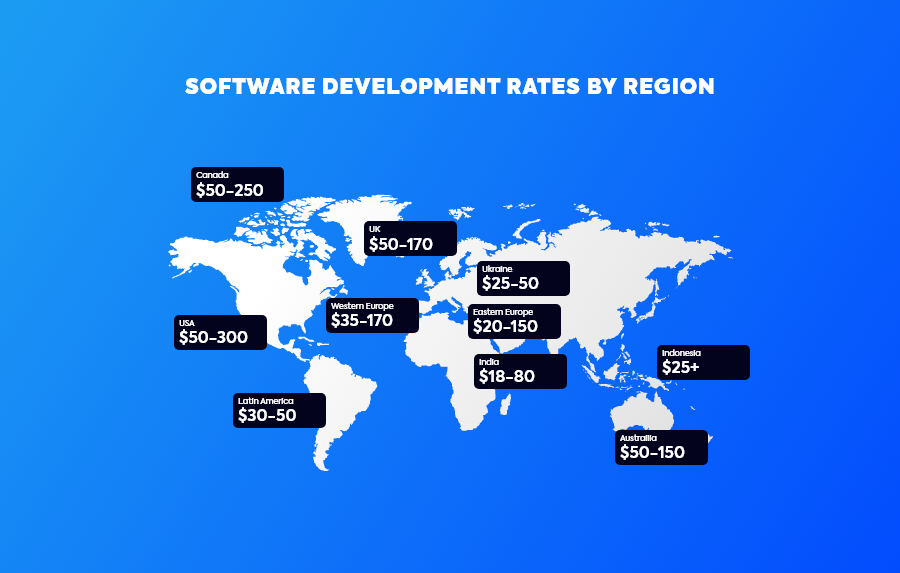
    Here is an image to help you understand how app development rates vary in each worldwide region.

    software_development

    If you take a look at all of these rates, they should look a bit normal except for one thing. The app development rates in India are noticeably cheaper, which is expected since outsourcing is ubiquitous in that region.

    Here comes the tricky part. You can’t just automatically send your app development project to India and expect quality. In fact, here are some things to consider before starting your app development project.

    • There are thousands of app development companies, experienced and new, local and overseas, large and small, and expensive and affordable. Selecting the right one for your brand will require in-depth consumer research.
    • A lot of misconceptions occur about finding the right app development company, such as expensive apps lead to better quality and new app companies are ill-equipped to handle large projects. 
    • Be wary of choosing cheap overseas app development companies. This isn’t to say that all of them do horrible work. Since apps are quite costly, do your research before falling too much in love with the price tag.

    The last bullet is very important and will be discussed in further detail in the next section.

    Local Development vs. Outsourcing

    Local development is simply the act of hiring an app developer close to your place of business. Outsourcing is hiring a company that isn’t local. From a logical standpoint, it seems right to hire a local company. 

    After all, you’ll be able to communicate with them face-to-face on the goals of your project. This isn’t always the case for all businesses. In fact, every business is different. Some may just have the wherewithal to purchase any type of app and wouldn’t care where they procured app development services.

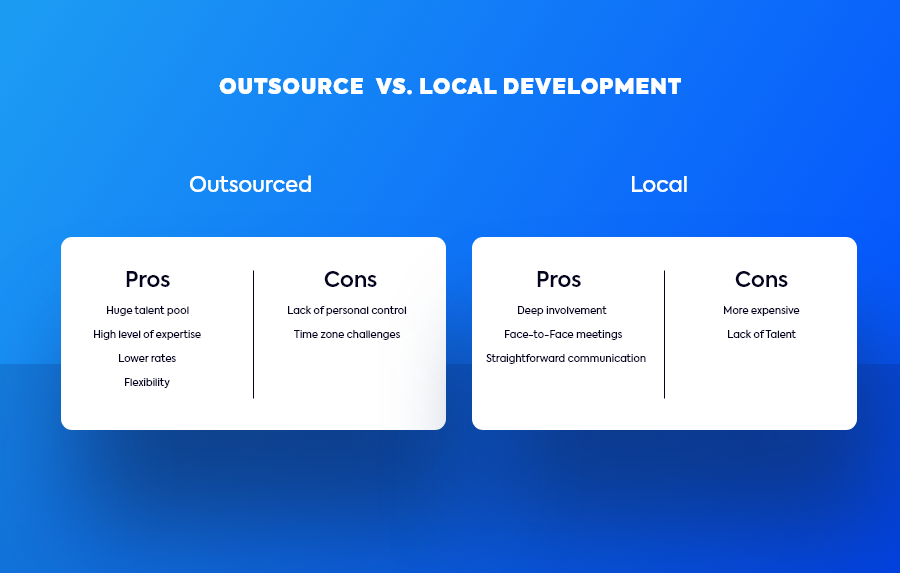
    Some may have a stringent budget and have to be mindful as to where every dollar is going. In the case of the latter, here are the pros and cons of hiring a local app developer vs outsourcing these services.

    outsourcevslocal
    As you can see, local development has its perks. You get to receive deeper involvement and straightforward communication without any hurdles. However, local companies are usually more affordable and have a limited amount of resources.

    Companies outside of your region are cheaper, more flexible, have a huge talent pool along with a high-level of expertise. Though, there are some challenges regarding time zone discrepancies and a lack of being directly involved in your project.

    Depending on the scope of your project and budget, you should think carefully about the selection you make. 

    Time and Money Issues Relating to App Development

    App development companies generally prefer to charge an hourly rate for their projects. This means that you can estimate the amount you’ll spend on an app depending on the hours of development. 

    Here is a breakdown of the typical hours spent on app projects based on complexity. 

    • A basic app will take approximately 500-700 hours to complete. 
    • A basic app with custom functions will take 700-1000 hours to complete.
    • A time-consuming, complex app will often take more than 1200 hours to complete.

    If you were to quickly acquire the hourly rate of a prospective app company, you would be able to determine the ballpark amount for how much you should spend. 

    What Affects the Final Cost?

    When you hire an app developer, you cannot expect to receive an extensive list of development costs right off the bat.

    What usually happens is that you will be sent a proposal, a bill, and the company will estimate the preliminary hours it took to construct the build-out. 

    App companies cannot predict other costs that may be necessary, which include:

    • Platforms
    • App maintenance
    • Functionality and features
    • Specific customizations
    • App administration and backend infrastructure
    • Structure and location of the development team

    Give Us a Call Today!

    Do you want to know more about how you can develop an app for your business? If so, give us a call today at (877) 682-2012 or click here to receive a free quote. 

    Not big on reading? That’s okay. Watch “How Much Does it Cost to Make an App in 2020instead.

    Using the power of Artificial Intelligence, we turned this blog into a video for you. Check it out below!