Category: Big Tech

  • The 9 best AI sales assistant software in 2025

    The 9 best AI sales assistant software in 2025

    Artificial Intelligence has officially moved from being a buzzword to a business necessity, especially in sales. In 2025, AI sales assistant software is no longer just a nice-to-have; it’s the secret weapon for driving conversions, improving lead quality, and boosting productivity. Whether you’re a startup or an enterprise, adopting AI for sales can transform how you connect with prospects, nurture relationships, and close deals faster. 

    As Agency Partner Interactive has seen firsthand, the right AI sales tools can automate repetitive tasks, offer actionable insights, and create personalized customer experiences at scale. But with so many options available, choosing the ideal AI assistant for business can feel overwhelming. 

    In this guide, we’ll break down the 9 best AI sales assistant software for 2025, explain how they work, and help you decide which one fits your business needs. 

    1. HubSpot Sales Hub: AI-Powered CRM and Sales Automation 

    HubSpot’s AI-powered AI sales assistant software integrates CRM, pipeline management, and predictive lead scoring. It uses artificial intelligence in sales to prioritize high-quality leads, automate follow-ups, and suggest the next best actions for your team. 

    Best for: Businesses wanting an all-in-one CRM and AI sales software platform. 

    Key AI Features: 

    • Automated email sequences 
    • Predictive lead scoring 
    • Sales performance analytics 

    2. Salesforce Einstein: Enterprise-Grade AI for Sales 

    Salesforce Einstein takes AI in sales to an enterprise level. It analyzes millions of data points to provide real-time recommendations for sales reps. If you’re wondering how AI sales tools can integrate into your workflow, Einstein is the gold standard. 

    Best for: Large enterprises needing an advanced AI assistant for business capabilities. 

    Key AI Features: 

    • AI-powered opportunity insights 
    • Automated lead nurturing 
    • Forecasting and pipeline analytics 

    3. Outreach: AI for Revenue Acceleration 

    Outreach is a powerful AI sales software focused on accelerating revenue growth. It helps teams engage prospects at the right time with the right message. 

    Best for: Sales teams seeking proactive engagement tools. 

    Key AI Features: 

    • AI-driven sales sequences 
    • Predictive customer engagement scoring 
    • Real-time conversation intelligence 

    4. Gong: AI Sales Conversation Analysis 

    Gong uses artificial intelligence in sales to record, transcribe, and analyze sales calls. This AI sales assistant software doesn’t just track what’s said; it interprets tone, sentiment, and buying signals. 

    Best for: Companies looking to optimize sales communication. 

    Key AI Features: 

    • AI-driven call analysis 
    • Competitor mention tracking 
    • Deal risk alerts 

    5. Zoho CRM: Affordable AI for Sales 

    Zoho CRM’s AI assistant, Zia, is one of the most accessible AI sales tools for small businesses. It predicts sales trends, automates workflows, and suggests optimal times to contact leads. 

    Best for: SMBs wanting budget-friendly AI sales software. 

    Key AI Features: 

    • Predictive analytics 
    • Email sentiment analysis 
    • Automated workflows 

    6. Conversica: Intelligent Lead Engagement 

    Conversica’s AI assistant for business specializes in qualifying leads through two-way conversations, without human intervention. It nurtures leads until they’re ready for sales reps. 

    Best for: Automating lead qualification at scale. 

    Key AI Features: 

    • Natural language conversation engine 
    • Automated follow-up scheduling 
    • Lead engagement scoring 

    7. InsideSales (XANT): AI for Predictive Sales 

    InsideSales uses predictive analytics and AI in sales to identify the best time and method to reach out to prospects. 

    Best for: Teams looking to optimize outreach timing. 

    Key AI Features: 

    • AI-driven lead prioritization 
    • Engagement channel recommendations 
    • Real-time sales performance insights 

    8. People.ai: AI-Powered Revenue Intelligence 

    People.ai focuses on giving you a complete view of customer interactions by pulling data from calls, emails, and meetings into one platform. 

    Best for: Enterprises needing deep AI sales software analytics. 

    Key AI Features: 

    • Automated data capture 
    • Deal progress tracking 
    • AI-powered revenue forecasting 

    9. Clari: AI for Sales Forecasting 

    Clari is a leader in AI sales assistant software that specializes in accurate forecasting. It uses historical data, deal engagement, and predictive modeling to help businesses hit revenue targets. 

    Best for: Businesses focused on sales forecasting accuracy. 

    Key AI Features: 

    • Pipeline risk analysis 
    • AI-driven deal health scoring 
    • Predictive revenue models 

    Why You Need AI Sales Assistant Software in 2025 

    The evolution of AI in sales means that manual prospecting, guesswork in forecasting, and inefficient lead follow-ups are becoming obsolete.  

    With AI for sales, businesses can: 

    • Increase productivity by automating low-value tasks 
    • Improve lead quality through AI-powered scoring 
    • Optimize sales pipelines with predictive analytics 

    As Agency Partner Interactive advises its clients, adopting AI sales tools isn’t about replacing humans; it’s about empowering them to perform at their highest potential. 

    Choosing the Right AI Sales Assistant Software 

    When deciding on AI sales software, consider: 

    1. Business Size: Enterprise vs SMB solutions 
    2. Integration Needs: Compatibility with CRM, marketing automation, and other tools 
    3. Budget: Subscription costs vs expected ROI 
    4. Features: AI forecasting, lead scoring, call analysis, or conversation automation 

    FAQs About AI Sales Assistant Software 

    1. What is AI sales assistant software? 

    AI sales assistant software uses artificial intelligence in sales to automate tasks like lead qualification, forecasting, and personalized outreach. 

    2. How does AI for sales help my business? 

    It improves efficiency, increases conversions, and provides real-time insights to make better decisions. 

    3. Is AI sales software expensive? 

    Costs vary depending on features, but many SMB-friendly options like Zoho CRM offer affordable plans. 

    4. Can AI sales tools replace my sales team? 

    No, AI enhances your team’s capabilities rather than replacing them. 

    5. What’s the best AI assistant for business in 2025? 

    It depends on your goals. For example, Gong is great for call analysis, while Clari excels in forecasting. 

    6. How do I integrate AI sales software with my existing CRM? 

    Most top AI sales assistant software integrates seamlessly with CRMs like Salesforce, HubSpot, and Zoho. 

    7. Does Agency Partner Interactive provide AI in sales solutions? 

    Yes, Agency Partner Interactive offers consultation, implementation, and customization of leading AI sales tools. 

    8. How quickly can I see results from AI in sales? 

    Businesses often see measurable improvements within 3–6 months. 

    Final Takeaway: 

    In 2025, the businesses thriving in sales aren’t just working harder; they’re working smarter with AI for sales. From small businesses to enterprises, the right AI sales assistant software can elevate your entire sales operation. Partnering with experts like Agency Partner Interactive ensures you choose, implement, and optimize the best solution for your needs. 
  • How To Open a Store on Amazon (And Start Selling)

    How To Open a Store on Amazon (And Start Selling)

    Opening an Amazon store is one of the most strategic steps entrepreneurs and eCommerce businesses can take today. With over 300 million active users and a globally trusted platform, Amazon offers unmatched exposure and revenue potential.  

    If you’re wondering how to open a store on Amazon and start selling, this comprehensive guide will walk you through every essential step and tool. 

    What Is an Amazon Store? 

    Before diving into logistics, let’s address a fundamental question: what is an Amazon store? An Amazon store is a customizable, branded storefront on the Amazon marketplace that allows registered sellers to showcase their products, brand story, and customer reviews in a structured, shoppable format. It provides more than just a product listing, it enables complete brand expression, boosting credibility and conversion rates. 

    Whether you’re an individual entrepreneur or a growing business, starting an Amazon store offers a competitive edge by providing direct access to Amazon’s massive audience and robust infrastructure. 

    Why Starting an Amazon Store Is a Smart Move 

    Starting an Amazon store comes with clear advantages: 

    • Unmatched Traffic: Millions of users search for products on Amazon every day. 
    • Built-in Trust: Amazon’s buyer protection policies and Prime services give you immediate legitimacy. 
    • End-to-End Tools: From warehousing to customer service, Amazon simplifies logistics. 
    • Analytics & Ads: Amazon provides performance metrics and advertising tools to scale faster. 

    Step-by-Step Guide: How To Start an Amazon Store 

    Let’s break down the process of how to start an Amazon store into manageable steps: 

    1. Choose Your Selling Plan 

    Amazon offers two primary plans: 

    • Individual Plan: Best for those selling fewer than 40 items a month. 
    • Professional Plan: A better fit for businesses, offering advanced tools, advertising, and more for a monthly fee. 

    2. Register for an Amazon Seller Account 

    Go to Amazon and create your seller account.  

    You’ll need: 

    • Business email address 
    • Credit card 
    • Government ID 
    • Tax information 
    • Phone number 
    • Bank account 

    This step is crucial in how to set up an Amazon storefront correctly. 

    3. Pick Your Niche and Products 

    Successful sellers often start with a focused niche. Conduct thorough product research using tools like Jungle Scout or Helium 10 to identify high-demand, low-competition products. 

    4. Set Up Your Amazon Seller Store 

    Once your seller account is verified, go to the “Stores” tab in Seller Central to begin creating your Amazon storefront. This is where the knowledge of how to setup Amazon storefront comes into play. 

    You can: 

    • Add branded banners and logos 
    • Organize products into categories 
    • Add multimedia (videos, images, etc.) 
    • Tell your brand story 

    This branded experience can turn casual browsers into loyal buyers. 

    5. Optimize Product Listings 

    Every product should include: 

    • A clear, benefit-driven title 
    • High-quality images 
    • Informative bullet points 
    • A compelling product description 
    • Keywords for SEO 

    This step is key to converting visitors and growing your Amazon seller store. 

    6. Choose Fulfillment Options 

    You have two choices: 

    • Fulfilled by Amazon (FBA): Amazon handles storage, shipping, and customer service. 
    • Fulfilled by Merchant (FBM): You manage everything on your own. 

    FBA is ideal for scaling, but FBM offers more control. Choose what aligns with your capacity and goals. 

    7. Launch and Promote 

    Once live, drive traffic to your storefront through: 

    • Amazon Sponsored Ads 
    • External traffic (Google Ads, social media) 
    • Email marketing 
    • Influencer partnerships 

    How Agency Partner Interactive Helps eCommerce Brands 

    At Agency Partner Interactive, we help sellers streamline the setup and scaling of their Amazon storefronts. From branding and SEO to backend optimization and ad strategy, we provide end-to-end eCommerce solutions that elevate your store above competitors. 

    Whether you’re starting an Amazon store or optimizing an existing one, our strategies are engineered to deliver measurable results. 

    FAQs About Opening an Amazon Store 

    1. What is an Amazon store and how is it different from a product listing? 

    An Amazon store is a branded storefront that showcases your entire product catalog, unlike single product listings. 

    2. How much does it cost to open an Amazon seller store? 

    There is no fee to create the store itself, but a Professional Seller account costs $39.99/month plus selling fees. 

    3. How to set up an Amazon storefront if I already have a seller account? 

    Log in to Seller Central, click on “Stores”, and follow the prompts to begin designing your storefront. 

    4. Can I use FBA and FBM at the same time? 

    Yes, many sellers use a hybrid model to maximize efficiency and flexibility. 

    5. How do I drive traffic to my Amazon store? 

    Use Amazon ads, social media marketing, influencer promotions, and SEO-optimized content. 

    6. What are the benefits of using Agency Partner Interactive for my store? 

    We provide technical and creative expertise to accelerate growth, improve discoverability, and boost sales. 

    7. Is it better to sell under a brand name or as an individual? 

    Using a brand name adds credibility and allows you to create a strong presence through your Amazon store. 

    8. How long does it take to get my store approved? 

    Amazon usually approves storefronts within 72 hours, provided all business information is accurate. 

    Final Thoughts 

    Understanding how to start an Amazon store is just the beginning. Success depends on continuous optimization, branding, and data-driven decision-making. Whether you’re a beginner or ready to scale, leveraging platforms like Amazon with strategic insight can significantly grow your revenue. 

    From choosing the right products to setting up your Amazon seller store to tracking your analytics, every detail matters. And if you want expert guidance every step of the way, Agency Partner Interactive is your go-to team. 

    Let’s turn your eCommerce ambition into a thriving Amazon business. 

  • Integrating Veo 3 into Your Creative Workflow: Tips and Best Practices

    Integrating Veo 3 into Your Creative Workflow: Tips and Best Practices

    If you’ve been asking yourself what is Veo, or if you’ve been watching the “Veo Google” trend all over the creative tech scene lately, you’re not alone. Google Veo 3, the latest generative video model from Google DeepMind, is making serious waves across content creation industries, from marketing to film to social media. It’s not just another AI tool; it’s a game-changer. 

    In this blog, we’ll explore how to seamlessly integrate Veo 3 into your creative workflow, streamline production, and unlock visually captivating storytelling like never before. 

    What is Veo and Why Creatives Should Care 

    Before diving into strategy, let’s answer the trending question: what is Veo? Google Veo 3 is an AI-powered video generation model capable of producing high-quality 1080p videos from text prompts, image references, and even rough sketches. Built to understand cinematic language, Veo Google can create stunning visuals complete with realistic lighting, camera movements, and character motion. 

    Why should marketers and creators care? Because content velocity matters. Veo 3 helps you go from idea to visual reality faster, cheaper, and with Hollywood-level flair. 

    Tip #1: Use Veo 3 During the Ideation Phase 

    Start your creative process by plugging your concepts into Google Veo to visualize campaign ideas instantly. Whether you’re building a pitch for a client or brainstorming ad content, Veo can serve as your AI-powered storyboard assistant. Bonus: it cuts down on hours spent in After Effects or Premiere just to test an idea. 

    Best Practice: 

    Use natural language prompts that describe tone, pacing, and style. Example: “A moody 15-second intro showing a lone figure walking through a neon-lit city at night.” 

    Tip #2: Collaborate with Veo Like a Creative Partner 

    Think of Veo Google not just as a tool but as a creative partner. As you refine your prompts, Veo learns and adapts, producing more context-aware results. That means fewer revisions and faster turnaround. 

    Best Practice: 

    Treat iterations like feedback loops. Don’t expect perfection from the first render. Instead, fine-tune as you go, just like working with a human editor. 

    Tip #3: Bridge the Gap Between Concept and Execution 

    Veo excels at bridging the “blank canvas” gap. Let’s say your team is stuck in a visual direction. A few prompts in Veo can generate mood boards, teaser cuts, and scene simulations. That helps align your team and stakeholders early. 

    Best Practice: 

    Pair Veo-generated clips with live-action b-roll or licensed stock footage to create hybrid assets for campaign testing. 

    Tip #4: Streamline Your Video Production Workflow 

    Forget waiting for multiple teams to handle scripts, visuals, and effects. With Veo 3, you can rapidly prototype and even produce finished video sequences entirely in-platform. It’s not here to replace your editor, but it can dramatically cut production timelines. 

    Best Practice: 

    Assign roles within your team: One person for scripting prompts, another for editing Veo footage, and someone to handle voiceover or music syncing. 

    Tip #5: Customize Veo Output to Match Your Brand Style 

    Yes, Veo is a generative engine. But that doesn’t mean your videos have to look “AI-made.” With custom style prompts, you can ensure every output matches your brand’s unique tone, from color grading to font overlays to visual motifs. 

    Best Practice: 

    Develop a “Veo Style Guide” that includes your brand’s key visual elements so every team member generates consistently styled outputs. 

    Tip #6: Use Veo Google for A/B Testing Content 

    Create multiple versions of the same campaign video with subtle variations in tone, style, or call-to-action. Google Veo makes this easy with fast iterations and intelligent tweaking. 

    Best Practice: 

    Push all variations live in micro-audiences and track performance using integrated analytics or your preferred dashboard. 

    Tip #7: Combine Veo 3 with Other Google AI Tools 

    If you’re already using Bard, Gemini, or Google Analytics, Veo fits right into your ecosystem. Use Bard to brainstorm prompt ideas. Use Gemini for deeper content insights. Use Veo to visualize and test it all. 

    Best Practice: 

    Build a creative stack of Google tools where Veo acts as the visual engine. 

    Tip #8: Don’t Ignore Post-Production Tweaks 

    While Veo 3 can output nearly finalized video assets, some human finesse goes a long way. A bit of color correction, motion graphics polish, or audio mastering can elevate your AI-generated video to agency-level quality. 

    Best Practice: 

    Have a creative director review each Veo output before publishing to ensure it fits your campaign narrative. 

    Common Mistakes to Avoid When Using Google Veo 

    • Using vague prompts: Be as specific as possible. 
    • Over-relying on automation: Veo is great, but human review matters. 
    • Not aligning visuals with messaging: Always keep campaign goals in mind. 

    FAQs 

    1. What is Veo, and how does it differ from other AI video tools? 

    Veo Google is a generative AI video model that turns text prompts into cinematic-quality footage. If you’re wondering what Veo is, think of it as Google’s leap into the future of AI-powered content creation, offering control, coherence, and creativity in one platform. 

    2. How do I start integrating Veo 3 into my workflow? 

    Integrating Veo 3 starts with identifying where AI-generated video fits in your content pipeline, whether it’s concept prototyping, social media visuals, or brand storytelling. Build prompts around your brand’s voice and let Google Veo enhance your production process. 

    3. What makes Veo Google different from tools like Sora or Runway? 

    Unlike other video generation models, Veo Google is built for scalability, cinematic detail, and multi-modal input. It integrates seamlessly into professional workflows and supports high-resolution, story-driven content generation. 

    4. Can marketers benefit from integrating Veo 3? 

    Absolutely. Integrating Veo 3 helps marketers speed up campaign production, prototype visuals, and stay ahead of content trends. It’s a powerful tool for those looking to combine creativity with automation—without sacrificing quality. 

    5. Is Google Veo accessible for beginners? 

    While Google Veo is designed for professionals, its prompt-based approach makes it accessible to beginners, too. With the right Veo Google tips and best practices, anyone can start creating compelling AI videos with ease. 

    Final Thoughts: Veo Isn’t the Future. It’s the Present. 

    If you’re still wondering what Veo is or hesitating to dive in, now’s the time. Veo Google is already reshaping the way brands and creators produce content, delivering faster turnarounds, richer visuals, and higher engagement. 

    At Agency Partner Interactive, we help you stay ahead by integrating tools like Google Veo 3 into creative workflows that actually work. Whether you’re a marketer, designer, or strategist, we bring the strategy and technical expertise to unlock Veo’s full potential. 

    Because integrating Veo isn’t just about saving time, it’s about reimagining what’s possible. 

    So, what will you create today? 

  • Top AI Tools for Small Businesses Productivity, Your Need in 2025

    Top AI Tools for Small Businesses Productivity, Your Need in 2025

    Running a small business is not a easy job at all. You wear multiple hats, juggle a million tasks, and constantly chase that ever-elusive dream of work-life balance. But fear not, you intrepid entrepreneur. Artificial intelligence (AI) is here to be your secret weapon. 

    Right, AI isn’t just for Silicon Valley giants anymore. In 2025, a new wave of AI tools is designed to empower small businesses like yours. They can automate repetitive tasks, streamline workflows, and free up valuable time to focus on what you do best: grow your business and make a real impact. 

    So, goodbye to all overflowing and overwhelming inboxes. Let’s get into some of the best AI tools to turn your small business into a productivity powerhouse.

    Unleash the Power of Content Creation with AI

    Content is king, sure, but creating it can be a real pain. AI writing assistants can be your knight in shining armor. These tools can help you: 

    • Kill writer’s block: Staring blankly at a page? AI writing assistants can begin to generate ideas for your content, write headlines, create outlines, or even come up with full blog posts or social media captions. 
    • Write with confidence: Are you worried about your grammar being perfect? AI tools can help check your writing, suggest improvements, and your content will be polished and professional. 
    • Find your voice: Want your content to stand out from the crowd? AI can analyze your writing style and suggest ways to make it more unique and engaging. 

    Try these AI writing assistants: 

    • Jasper: Known for its long-form content generation capabilities, perfect for crafting blog posts and articles. 
    • Rytr: Offers a user-friendly interface and a variety of writing templates, making it a great choice for beginners. 
    • ShortlyAI: It specializes in creating short, impactful content that is perfect for social media posts and email marketing.

    Automate the Mundane with AI-powered Assistants

    Do you spend hours on repetitive tasks like scheduling meetings, sending follow-up emails, or managing your calendar? AI virtual assistants can take those off your plate, freeing you up for more strategic work. 

    Here’s what AI assistants can do for you: 

    • Schedule meetings: No more email ping-pong! AI assistants can find a time that works for everyone and automatically schedule meetings. 
    • Manage your inbox: AI can filter emails, prioritize important messages, and draft personalized responses. 
    • Create tasks, set reminders, and track your progress: Not another missed deadline! AI assistants can help with managing your to-do list. 

    Here are some of the popular AI virtual assistants: 

    • X.ai: The OG AI scheduling assistant is perfect for keeping your calendar streamlined. 
    • Clara by Google: A strong AI assistant that integrates well with Gmail and other Google Workspace tools. 
    • Bonnie: A user-friendly AI assistant that can handle a multitude of tasks, from scheduling meetings to controlling your to-do list.

    Level Up Your Customer Service with AI Chatbots

    The website should be followed by excellent customer care. However, no one expects a business owner to be available 24/7 for assistance. AI chatbots can bridge the gap and provide assurance to your customers that their needs will be met even outside of business hours. 

    The following are how AI chatbots can help: 

    • Answer frequently asked questions: Free up your time as AI chatbots handle basic customer inquiries. 
    • Provide 24/7 support: Never miss a customer query again! Chatbots can answer questions and offer support even when you’re offline. 
    • Personalize the customer experience: AI chatbots can learn from customer interactions and provide more personalized support. 

    Explore these AI chatbot solutions: 

    • ManyChat: A user-friendly platform that allows you to build chatbots for Facebook Messenger, Instagram, and other messaging platforms. 
    • Drift: A powerful chatbot platform that integrates with your CRM and marketing automation tools. 
    • Botsmaker: A no-code platform that eases the process of developing chatbots without writing any single line of code. 
    1. Unleash Valuable Insights through AI-powered Analytics

    Data is king, but what good does it do if one cannot decipher it? AI analytics tools can help you make sense of your data and gain invaluable insights to help you grow your business. 

    Here’s what AI analytics tools can do for you: 

    • Identify trends and patterns: AI can analyze your data to uncover hidden trends and patterns that you might miss on your own. 
    • Make data-driven decisions: Use AI-powered insights to make informed decisions about your marketing, sales, and operations. 
    • Predict future outcomes: Some AI analytics tools can predict future trends, allowing you to proactively adapt your business strategy. 

    Check out these AI analytics tools: 

    • Tableau: A powerful data visualization tool that uses AI to help you explore and understand your data. 
    • Google Analytics: A free tool that offers basic analytics and reporting features. 
    • MonkeyLearn: A platform that uses AI to analyze text data, such as customer feedback and social media posts. 
    1. Enhance Your Marketing Efforts with AI

    Marketing can be the most time-consuming and complex procedure. AI is here to ease your marketing activities and get the best out of it. 

    AI can help in the following ways in marketing: 

    • Audience segmentation and email campaigns: Tailored campaigns that are more likely to convert. 
    • Targeted ads: AI may help you get the right advertisements to the appropriate audience, boosting your ROI. 
    • Social media management: AI can also help you schedule posts, track engagement, and generate content for your social media channels. 

    More AI marketing tools: 

    • HubSpot: All-in-one marketing automation platform with an AI feature. 
    • Albert: A marketing AI that automates your advertising campaign. 
    • Phrasee: AI, which creates the best-performing marketing copy. 

    Beyond the Basics: Emerging AI Trends for Small Businesses 

    The AI world is constantly in flux, with new tools and technologies appearing all the time. Here are a few trends to watch: 

    • AI-powered CRM: Automate tasks, personalize customer interactions, and gain insights into customer behavior. 
    • AI for cybersecurity: Detect and prevent cyber threats. 
    • AI for finance: Automate bookkeeping, invoicing, and financial forecasting. 

    Embrace the AI Revolution 

    With AI, which is no longer futuristic but a new reality, you can change your destiny running a small business. Ready to take your small business to the next level with AI?  

    Get in touch with us to learn how we can help integrate AI into your business. 

    Conclusion

    In 2025, leveraging AI tools to supercharge the productivity for businesses isn’t just an advantage—it’s essential for SME’s and ventures aiming to thrive and subscale. From automating mundane tasks and improve the customer service with chatbots to unlocking data-driven insights and refining marketing strategies, AI empowers you to focus on strategic growth and innovation. These tools democratize efficiency, allowing even resource-strapped teams to compete effectively and efficiently. As in trends like AI-driven CRM and cybersecurity evolve, staying ahead means embracing these technologies today. Ready to transform your operations? Harness the power of AI to streamline workflows, boost the customer experiences, and future-proof for your business. The cutting edge technological revolution is here for the business productivity.

  • DevOps 2025: Faster Delivery, Lower Costs for Enterprises

    DevOps 2025: Faster Delivery, Lower Costs for Enterprises

    Welcome to the Future of DevOps! 

    Imagine this: Faster delivery, lower costs, and seamless collaboration. That’s DevOps 2025! The days of clunky complex operations and processes and extended rollouts are over. If you’re not excited yet, you will be by the end of this blog post. Let’s see how enterprises transform with smarter DevOps developments to outpace the competition, which cut costs, and streamline processes smoothly.

    What’s new in DevOps for 2025? 

    The future is here, and it’s fantastic. Here’s what’s hot in the industry: 

    • Automation is King: Smarter automation tools mean faster DevOps delivery. 
    • AI and ML: Predictive analytics to identify and fix issues before they happen. 
    • Cloud-Native Everything: 85% of enterprises use cloud-native solutions for scalability and speed. 
    • DevSecOps Everywhere: Security is baked into every stage of the DevOps pipeline, so there are fewer vulnerabilities. 
    • Collaboration Overload: New tools for collaboration for development, operations, and security teams. 

    Stat: By 2025, 75% of DevOps workflows will include AI for monitoring and troubleshooting. – IDC 

    How Enterprises Are Cutting Costs with DevOps 

    DevOps is a cost saver. Here’s how: 

    1. Breaking down Silos: Collaboration across teams means no duplication and faster timelines. 
    1. Optimizing Infrastructure: Containerized solutions like Kubernetes can save up to 40% on resources. 
    1. Early Bug Detection: Continuous testing means less downtime and millions saved. 
    1. Cloud Efficiency: Scalable cloud solutions mean less hardware and maintenance costs. 
    1. CI/CD Pipelines: Automated pipelines mean faster delivery and less operational overhead. 

    Did you know that companies using DevOps have 2.5x fewer failures in production than traditional methods? 

     2025 DevOps Trends You Can’t-Miss 

    Here are the trends that will shape the future of DevOps in enterprises: 

    • GitOps is King: GitOps means better version control and smoother deployments. 
    • Low-Code DevOps: Low-code and no-code platforms mean faster implementation, even for non-technical teams. 
    • Edge Computing: DevOps for edge devices means faster processing and lower latency. 
    • Metrics Matter: Enterprises prioritize metrics like MTTR (Mean Time to Recovery) for pipeline performance. 
    • Green Matters: Green DevOps is gaining traction and focusing on energy efficiency in software development. 

    Did You Know? By 2025, 60% of DevOps teams will use low-code to speed project delivery. 

     Enterprise DevOps Implementation: How to Do It 

    Implementing enterprise DevOps solutions can be complex, but a step-by-step approach makes it easier. Here’s how: 

    1. Start Small: Start with a pilot project with a single team to test your approach. 
    1. Choose the Right Tools: Select tools that fit your goals, like Jenkins, Docker, or Terraform. 
    1. Train: Continuous learning means your team is updated on the latest DevOps trends. 
    1. Communicate: Use Slack, Jira, and Trello to align the team. 
    1. Monitor and Optimize: Use real-time metrics to identify bottlenecks and improve. 

    Pro Tip: Enterprises that roll out DevOps in phases see 50% fewer disruptions. 

    DevOps Cost Savings for B2B 

    B2B enterprises are seeing significant benefits from DevOps. Here’s why: 

    • Faster Delivery Cycles: Faster delivery means speedier time-to-market and competitive advantage. 
    • Cloud Cost Savings: Many B2Bs save up to 50% by going serverless. 
    • Better Customer Satisfaction: Faster rollouts and reliable updates mean happy and loyal customers. 
    • Improved Collaboration: DevOps tools mean better vendor communication and external partnerships. 

    Stat: 92% of B2B enterprises using DevOps saw ROI within 18 months. 

    DevOps in Enterprises: What’s Next 

    The future of DevOps is bright and fast. Here’s what’s coming by 2025 and beyond: 

    • Hyper Automation: Experts predict 90% of DevOps tasks will be automated by 2026. 
    • Zero Downtime Deployments: Continuous delivery pipelines will mean no service disruptions. 
    • AI-Driven Insights: AI will give better recommendations for workflow optimization. 
    • Greener Pipelines: Sustainability will drive DevOps practices, focusing on energy-efficient infrastructure. 
    • Universal DevSecOps: Every DevOps process will have built-in security, reducing risk. 

    What It Means for You: The future of DevOps is not just about technology. It’s about better results, faster. 

    Why DevOps in 2025 is a Must 

    DevOps in 2025 combines innovation, speed, and cost savings to give enterprises an edge. It’s not just a strategy. It’s necessary for businesses that want to be first in a digital world. Faster DevOps delivery, lower costs, and better tools mean businesses can quickly achieve their goals. 

    Whether you’re a startup or a Fortune 500, it’s time to act. The sooner you get enterprise DevOps, the better. The future of DevOps isn’t coming – it’s here. 

    Do you have questions about DevOps or want to get enterprise DevOps? Let’s chat! 

    Wrapping Up

    The evolution of DevOps is not just a trend but a transformation reshaping for businesses, and how enterprises operate, innovate, and deliver value. By 2025, DevOps will stand as the cornerstone of efficiency, empowering businesses to achieve unparalleled speed, cost-effectiveness, and collaboration.

    As automation, AI, and cloud-native solutions converge, the potential for growth and innovation becomes limitless. DevOps is no longer a choice but a essential requirement for organizations aiming to stay ahead in an increasingly digital and competitive technology landscape. Whether you’re looking to optimize processes, and the operations, that enhance security, or deliver exceptional customer experiences, embracing DevOps is your gateway to success.

    The future is here. Let DevOps lead the way.

  • How DevOps Team Can Take Advantage of Artificial Intelligence (AI)?

    How DevOps Team Can Take Advantage of Artificial Intelligence (AI)?

    Adopting new tech trends is a must nowadays. In the field of software development, it is important to make reliable software integration delivery, which enhances software quality, improves operational efficiency and reduces cost by taking the help of Artificial Intelligence. If we want to see the bright future of DevOps, we must create a seamless collaboration between AI and human expertise. By doing this we can enter the world of improved codes, without bugs that will result in the fastest working software. So, in this blog, we’ll discuss how DevOps teams can take advantage of AI.

    What is the fundamental purpose of DevOps?

    When we start working in the industry of technology or even when we start learning about it, we get a chance to learn about new and unique terms, one of them is “DevOps”. So, what is that exactly? Basically, it is a process, or a concept used in software development. Whenever a software product is created two sectors are involved, that is the development and operational departments. The intersection between them is called DevOps. The development department works on coding and designing whereas the operational department helps with managing servers, checking security and scaling and backup. DevOps results in improving efficiency.

    EXAMPLE:

    When a development team works on a project in order for the operational team to keep tracking and updating that product while this process is happening the development team can move forward and work on other software products too.

    What is the fundamental purpose of Artificial Intelligence (AI)?

    AI is not a new concept to be introduced, it refers to creating such technology that has human emotions and efficiency. Artificial intelligence is developing day by day and creating such a place in the world that now it feels impossible for businesses and individuals to work without it. It improves efficiency and performs tasks on time. Every field of life including health, education, military, and engineering is somehow dependent on AI.

    Advantages of Artificial INTELLIGENCE in DevOps:

    AI in DevOps includes leveraging technologies that help create products more efficiently it optimizes the process of development. It includes everything from automated testing to reviewing Software Requirement Specifications (SRS). Incorporating AI in DevOps results in improved speed, accuracy, security, and reliability of software development.

    Collaborative Intelligence:

    Collaborative intelligence in the context of the use of AI in DevOps refers to creating a bridge that helps to create a perfect relationship between human expertise and AI-driven technologies.

    Decision Making:

    AI plays a vital role in decision-making in the DevOps process. It demonstrates how to make decisions for the DevOps team based on real-time data. It prioritizes tasks, automates recommendations and also provides insights.

    DevOps teams can take advantage of AI and create perfect products.

    The Synergy Between AI and DevOps: Transforming Software Development:

    If we incorporate AI in DevOps, it will not just help to enhance the speed or quality, but it will also help engineers and operational teams in decision-making, improve security, and provide a continuous cycle of improvement with machine learning.

    DevOps as a service (DaaS):

    DevOps as a service is a platform that provides services to development and operational teams in a collaboration that helps to maintain and integrate the software product and also improve its efficiency.

    Example of DaaS platform and tools:

    1. Amazon Web Services
    2. Microsoft Azure
    3. Google Cloud console

    The above platforms provide different infrastructure and facilities that result in the best product.

    Challenges of integrating AI in DevOps:

    1) Complication of AI models: Sometimes for some teams of DevOps it’s hard to understand the methodologies of AI and even more complex to implement them.

    2) Excessively Reliant on AI: DevOps teams should use AI as a tool but not as an essential part as it can lead to ignoring the critical thinking of humans that helps to make anything stand out.

    3) Expense and Resources: Integrating AI into DevOps can be cost-effective in terms of maintaining the resources.

    Solutions to overcome these challenges:

    1) Emphasis on training: Development and Operational teams both should have vast knowledge about AI. Teams should invest in training.

    2) Start with small steps: On small projects, teams should demonstrate AI, it will help in learning technologies and even it will show whether are they useful which will help in making decisions the should respective team invest or not.

    Case Study:

    Spotify is one of the best cases to understand the concept of AI being used in DevOps. We see when we are listening to songs it keeps suggesting other songs that have similar vibes to the songs we listen to mostly. How does it do that? Here comes AI and its magic. It uses AI algorithms which make this app stand out in the market.

    AI and Quality Assurance:

    Code reviews and quality assurance (QA) are crucial parts of software development. It means to check the quality of the code. Manually it is difficult and even time-consuming to do that, but AI does it seamlessly. It detects bugs, improves efficiency and removes any concern related to security.

    Prediction for use of AI:

    New trends are being introduced in the future. More use of MI (Machine Learning) and AI will be more common things. With emerging times as technologies are improving in the future AI will help in generating codes that will have the best quality it will also automatically improve and optimize software performance.

    Wrapping it up:

    In the end, the above advantages of artificial intelligence in DevOps can help you streamline operations, identify errors and improve workflows. AI empowers efficient resource utilization and higher-quality code development. It enables you to stay invested in creativity rather than monotonous work. Amid the swift progress of technology, you can integrate AI effectively and cultivate agility to refine operations and strengthen system reliability.

  • The Role of Data Science in Enhancing SEO Performance

    The Role of Data Science in Enhancing SEO Performance

    Search Engine Optimization (SEO) has evolved from a niche tactic to an essential strategy when it comes to digital marketing. As industries increasingly rely on data to make informed decisions, the bond between data science and SEO grows stronger. This article highlights how data science plays a big part in improving SEO performance.

    What is Data Science?  

    Data science is the study and practice of extracting knowledge and insights from vast amounts of information. It combines statistics, mathematics, and computer science techniques to analyze and interpret data to make informed decisions. In digital marketing, this means leveraging data to understand consumer behavior, optimize campaigns, and predict trends. By utilizing data science, marketers can tailor their strategies more effectively, ensuring more personalized and impactful outreach to their target audience.

    The Intersection of Data Science and SEO 

    Data science and SEO intertwine in the pursuit of understanding online user behavior. According to Hubspot, about 5.6 billion searches are conducted on Google every day. Given the immense daily search volume, data science sifts through this vast volume to identify patterns, such as popular search terms, user click behaviors, and website engagement metrics. These insights, in turn, guide SEO professionals in optimizing websites, creating relevant content and designing user-centric experiences to enhance a site’s visibility and ranking on the SERP (Search Engine Results Page). 

    7 Pillars of Data Science On-Page SEO Optimization 

    The power of data science extends to various on-page SEO elements, from analyzing user behavior to optimizing content presentation; let’s explore these enhancements in detail: 

    1. Content recommendations 

    Data science algorithms, especially those related to Machine Learning, can analyze search trends and user behavior. This enables recommending content topics that align with current user demands and emerging trends. 

    2. Meta optimization 

    By assessing which meta titles and descriptions get higher click-through rates across the web, data-driven insights can guide the refinement of these elements, ensuring they are both appealing and relevant to potential site visitors. 

    3. Image optimization 

    Data science can help understand the importance of visual content in search queries. This leads to better image indexing by ensuring images have accurate and descriptive alt texts, improving visibility in image searches. 

    4. Content structure and depth 

    We can discern the ideal content length and structure that resonate best with users through data analytics. For instance, specific topics benefit from long-form content due to their complexity, while others require concise, to-the-point explanations. 

    5. Internal linking patterns 

    Analyzing website user navigation patterns can help optimize internal links, ensuring users are directed to the most relevant and valuable content and reducing bounce rates. 

    6. Semantic SEO 

    With the rise of natural language processing, data science helps understand the context behind words. This can guide the content creation to align more naturally with how users phrase their queries, particularly in the age of voice search. 

    7. User engagement metrics 

    By studying metrics such as time on page, bounce rate, and scroll depth, data science provides insights into how engaging a page is. Such metrics can guide adjustments in content presentation and layout.

    By focusing on these specific on-page elements with the backing of data science, websites stand a better chance of delivering content that’s both user-friendly and search engine optimized.

    7 Ways Data Science Enhances Off-Page SEO 

    While on-page SEO is crucial for website optimization, off-page SEO is equally pivotal in determining a website’s authority and relevance in the vast digital space.  

    Data science brings precision and insight into this domain in various ways: 

    1. Backlink analysis 

    Through comprehensive data analysis, the quality, relevance, and authority of incoming links can be assessed. This helps in focusing link-building strategies on sources that carry significant weight in the eyes of search engines. 

    2. Social signal analysis 

    Social media‘s influence on search engine rankings must be noticed. Data science tools track and analyze brand mentions, shares, likes, and comments across platforms, offering insights into how social engagement correlates with site traffic and rankings. 

    3. Brand sentiment analysis  

    By leveraging natural language processing, data science can gauge public sentiment around a brand based on reviews, comments, and mentions. Positive emotions can enhance brand authority, while negative emotions can be addressed proactively. 

    4. Competitor benchmarking  

    By processing large datasets, data science can help identify where competitors gain backlinks, highlighting potential opportunities or industry-standard platforms. 

    5. Influencer engagement 

    Algorithms can identify key influencers in specific niches based on their reach, engagement, and relevance. Partnering with these influencers can drive quality traffic and backlinks. 

    6. Content distribution strategy 

    Data science can optimize content distribution across various channels, ensuring that content reaches target audiences effectively, be it through guest blogs, forums, or press releases. 

    7. Local SEO and citations 

    For businesses with a local focus, data analytics can pinpoint where a brand is cited across the web, ensuring consistency in name, address, and phone number, which is crucial for local search engine rankings. 

    Using data science in off-page SEO initiatives ensures that efforts are targeted, efficient, and aligned with the evolving digital landscape. 

    Harnessing Data Science Using Predictive Analytics in SEO 

    By forecasting, data science can use predictive analytics as an advantage in the SEO landscape. Businesses can anticipate emerging trends by analyzing past and current search behaviors, ensuring a proactive approach. Recognizing data patterns can also hint at potential search engine algorithm shifts, enabling strategic adjustments in advance. 

    The Challenges of Merging Data Science with SEO 

    Despite the immense potential, integrating data science and SEO presents challenges. Over-reliance on data might lead to neglecting qualitative factors crucial to SEO, such as user experience and content quality. Furthermore, it’s essential to acknowledge that while data can guide, it can only partially automate SEO’s nuanced and multifaceted realm, where human intuition and expertise remain crucial. 

    Agency Partner Interactive: Your Solution to Using Data Science and SEO 

    Data science and SEO fusion promise a transformative impact on digital marketing. As technological advancements continue, the potential to leverage intricate data patterns for SEO grows exponentially. For businesses, adopting a data-driven approach can substantially elevate their SEO strategies, setting the stage for success in the digital domain.

    At Agency Partner Interactive, we offer SEO services in Dallas. Our status as an award-winning SEO agency reinforces our skills in merging data science and SEO. One of our clients saw a 2K+ increase in organic users starting from 0 within 6 months of our targeted SEO strategy. We also helped them rank over 2.2K keywords organically within the same time period, giving them a fantastic ROI that increased month over month. 

    Get in touch with us today and let’s start developing a winning data science SEO strategy for your brand! 


  • RevOps Process Optimization: Core Elements of an Effective RevOps Strategy

    RevOps Process Optimization: Core Elements of an Effective RevOps Strategy

    In today’s hyper-competitive business landscape, achieving streamlined operations and maximum revenue is paramount. Enter RevOps optimization, a strategy that promises just that. But what is RevOps, and how can it catalyze your business growth? This blog post will dive into the key components of an effective RevOps strategy, how to build it, and how to implement it across your organization to achieve your revenue goals.

    What is RevOps?

    RevOps, or Revenue Operations, is a holistic approach, merging sales, marketing, and customer service under one strategic umbrella with a shared focus on revenue generation. When implemented correctly, it can lead to improved collaboration, increased efficiency, and, ultimately, business growth.  

    At its core, RevOps is an operational strategy that seeks to break down silos within organizations. Instead of viewing sales, marketing, and customer service as separate entities, RevOps combines them into a synchronized unit. It’s not just a change in structure but a shift in mindset: one that prioritizes the customer journey from awareness to retention.  

    The Importance of Revenue Operations for Your Business

    Why is this holistic approach catching on? Because companies are recognizing the inefficiencies of isolated departments. When sales, marketing, and customer service operate in tandem, there’s a clearer understanding of the customer, leading to better targeting, smoother conversions, and enhanced post-sales services.  

    Key RevOps Statistics 2023

    • Companies that invest in RevOps report a 10-20% increase in sales productivity. They also noted that tighter alignment of go-to-market teams led to a 100% to 200% increase in digital marketing ROI (Boston Consulting Group).   
    • Companies that implemented RevOps grew revenue 3x faster than those that didn’t (Forrester).   
    • Organizations that used RevOps reported a 10-20% increase in sales productivity (Boston Consulting Group).  
    • Because of RevOps, 21% of companies saw an improvement in alignment, particularly between sales and marketing teams. (Revenue.io

    Key Components of an Effective RevOps Strategy  

    Let’s delve into the core of RevOps and take a look at the foundational tenets that drive its success.

    1. Integrative Organizational Alignment  

    RevOps optimization weaves all revenue-generating departments – sales, marketing, and customer service – under a single umbrella of purpose. No longer are teams bound by their specific roles. Instead, there’s a shared responsibility for revenue. This alignment means smoother communication, fewer hiccups, and a collective push toward shared milestones.  

    • Aligned Objectives: Through RevOps, departments work in unison, using shared tools and processes, often in real-time. This alignment isn’t just about collaboration but about leveraging collective intelligence. It ensures that marketers understand sales teams’ pain points and that customer service is looped into feedback, driving product improvements.  
    • Consolidated Platforms: Different departments leveraging diverse tools lead to fragmented operations and isolated data. RevOps introduces a singular platform, like an integrated CRM, enhancing teamwork and smooth data transitions.  
    • Unified Approaches: Imagine your customer service and marketing department sending varied messages to the same audience. RevOps stitches these approaches together, assuring a harmonized and consistent communication strategy.

    2. Prioritizing the Customer Journey

    At its heart, RevOps seeks to refine and magnify the customer experience. The vision is to increase client satisfaction, build lasting trust, and extend the customer’s lifetime value through regular touchpoints.

    • Tailored Outreach: Utilizing RevOps paves the way for an aligned client database, facilitating customized marketing initiatives that amplify engagement and conversion rates.
    • Unified Client Support: By weaving RevOps services into your operations, all client-centric teams garner insights from comprehensive client interactions, ensuring more consistent and potent support.
    • Integrated Client Path: By bringing marketing, sales, and client success under the RevOps strategy, the customer’s path becomes fluid from the first interaction, enhancing loyalty and retention.

    3. Data-Driven Decision Making 

    RevOps works on a unified data landscape, offering a panoramic view of the customer’s journey and organizational health to make data-driven decisions. Luckily, we live in an era that provides unprecedented access to data. From customer behavior on your website to feedback on social media, every touchpoint offers insights. In RevOps, these insights guide strategy.

    • Enhanced Predictions: A holistic data outlook is instrumental in sharpening sales predictions, which translates into optimal stock management and slashed expenses.
    • Customer Analytics: Capitalizing on RevOps to accumulate and dissect data from each customer touchpoint can unearth profound insights into client preferences, shaping a user-focused marketing approach.
    • Unified Evaluation: The power of RevOps lies in offering a composite performance dataset, equipping businesses to gauge their efficacy and adjust strategies dynamically.

    4. Technology Stack & Automation  

    RevOps success hinges on the blend of robust technology frameworks and automation. These elements serve as the nexus, fostering streamlined operations and consistent growth.  

    • Unified Infrastructure: At the heart of RevOps lies a consolidated technology stack. Picture an environment where sales, marketing, and customer service draw from a singular, harmonized system. This unification ensures seamless communication and data sharing, amplifying overall efficiency.
    • Smart Automation: Automation isn’t just about replicating manual tasks but enhancing them. Within a RevOps framework, automation tools ensure processes are reproduced and optimized. From automating lead nurturing to providing timely communication, it removes friction and accelerates the revenue lifecycle.
    • Adaptive Mechanisms: As the digital landscape evolves, so must the technology and automation strategies within RevOps. The strength of an infused technology stack is its ability to adapt — integrating new tools, refining automation strategies, and ensuring the organization stays ahead of the curve.

    5. Optimizing Operations

    RevOps optimizes operations by pruning inefficiencies and overlapping tasks. It thrives on refining procedures, ushering in automation, and maximizing technology to boost productivity.  

    • Process Streamlining: Beyond mere alignment, charting processes is vital to RevOps. It’s essential to craft a solid offline strategy; then, as you start your RevOps strategy, the following automation can yield monumental time and cost dividends.
    • Maximizing Resources: RevOps can spotlight operational snags, granting the opportunity to reassign resources, smoothen processes, and slice down project timelines.
    • Reducing Overlaps: Recognizing and nullifying duplicated efforts translates into resource conservation, crafting a more streamlined workflow.

    6. Continuous Evaluation & Iteration

    Just like any strategy, RevOps isn’t something you can set and forget. It demands regular attention, monitoring, and adjustments in real time. By continuously evaluating performance and iterating strategies based on feedback and results, your businesses can stay agile and adaptive, increasing the effectiveness and efficiency of your revenue generation process.

    • Ongoing Analysis: Infusing Dallas RevOps services into your operations and initiating periodic reviews can foster a culture of perpetual growth, allowing strategies to be tweaked for amplified outcomes.
    • Feedback Mechanisms: Instituting feedback channels across all units under RevOps ensures that shared insights lead to collective growth and creativity.
    • Swift Adaptations: The tenets of RevOps empower organizations to swiftly modify their game plan in sync with market dynamics, ensuring that they remain at the pinnacle of their industry.

    RevOps is a journey, not a destination. It emphasizes constant introspection, fostering a culture of relentless refinement and adaptability.

    Steps to Implementing a Robust RevOps Strategy 

    Now, let’s turn these insights into action! Here’s a step-by-step guide to start building your RevOps strategy.

    1. Assess the Current State  

    You wouldn’t start a journey without knowing your starting point. Dive deep into your existing processes. Understand where you’re efficient and where there’s room for improvement. Use this assessment as the foundation for your RevOps strategy. You can begin with a SWOT analysis to gain insights into your current operational model. Gather feedback from individual team members and foster a culture of open collaboration and idea sharing.

    • What challenges does your sales team face?
    • Is your marketing ROI declining on certain platforms?

    These questions help with clarity and give you a sound foundation for mapping your RevOps strategy.

    2. Set Clear Objectives

    Define precise KPIs and revenue goals. Regardless of their department, every team member should understand these objectives and how their role feeds into them. The clearer and more precise your objectives are, the better your team members will understand how their role contributes to it.

    One way to do this is by setting SMART (Specific, Measurable, Achievable, Relevant, Time-bound) goals.

    Break down what you need to achieve instead of just aiming for generalizations. Instead of “increase sales,” an example of a SMART goal would be “achieve a 20% increase in sales from organic traffic in Q3.”

    3. Assembling a Cross-Functional RevOps Team

    RevOps thrives on diversity. By bringing together professionals from sales, marketing, and customer service, businesses can harness diverse perspectives, leading to richer strategies and more innovative solutions.

    4. Leveraging the Right Technology

    Choosing the right tools can make or break your RevOps efforts. Look for platforms that integrate well and cater specifically to your business’s needs. It’s not about having the latest tech but the most relevant and valuable for your business needs.

    5. Regularly Review and Refinement 

    Markets evolve. Customers’ preferences change. A static plan won’t cut it. Regularly reviewing, monitoring, and auditing your strategy ensures your approach aligns with the market pulse. 

    6. Measuring Success in RevOps 

    Measuring success in RevOps goes beyond just revenue. Dive into metrics like churn rate, customer satisfaction scores, and average deal cycles. Each metric offers a unique perspective on performance, guiding decision-making.

    Beyond this, focus on customer-centric metrics like Net Promoter Score (NPS) or Customer Satisfaction Score (CSAT). Monitor the sales funnel for drop-off points. Track the efficacy of marketing campaigns not just in engagement but in actual conversions.

    Metrics for Monitoring RevOps Performance

    Here are some metrics to monitor:

    • Customer Lifetime Value (CLV): Total revenue a customer can bring during their association with the business.
    • Customer Acquisition Cost (CAC): Total cost of acquiring a new customer.
    • Lead Conversion Rate: Percentage of leads that become paying customers.
    • Customer Churn Rate: The rate at which customers stop doing business with you.

    Setting Your Organization Up for RevOps Success

    Here are some best practices to ensure your company starts off on the right track.

    Common Pitfalls to Avoid

    While embracing RevOps promises a unified approach to driving revenue, there are common pitfalls that organizations should be wary of:

    • Lack of Communication: The essence of RevOps lies in collaboration. The process becomes disjointed without open communication channels among sales, marketing, and customer service.
    • Overloading with Technology: While technology is a cornerstone of RevOps, indiscriminately adding tools without a clear plan can create confusion and hamper efficiency.
    • Resistance to Change: Teams may resist the shift to RevOps, particularly if they feel their autonomy is threatened. Change management strategies are crucial to address these concerns.
    • Not Aligning KPIs: Metrics should reflect the goals of RevOps – holistic growth and customer satisfaction. Ensure that all teams know which metrics matter.

    Change can be daunting, and with any organizational restructuring, challenges will arise. Beware of miscommunication, resistance to tech adoption, or misalignment of objectives. Being informed helps in crafting proactive solutions.

    Tapping into Expertise

    RevOps is complex, and it can be daunting at first. Collaborate with experts who’ve been there and done that. Their insights can be the difference between a good strategy and a great one.  

    • Engage with Thought Leaders: Attend seminars, webinars, or workshops led by RevOps pioneers. They offer invaluable insights derived from real-world challenges and successes.  
    • Hire or Consult Experts: Consider bringing in a RevOps expert or consulting with agencies like Agency Partner Interactive that specialize in the field and have implemented RevOps in their organization. They can help in tailoring a strategy specifically suited to your business needs.

    Why Choose Agency Partner Interactive for RevOps Services

    In today’s digital-first world, having a partner that understands your business and the digital landscape is crucial. Our expertise is not just theoretical; it’s battle-tested. We implement RevOps across our organization and operate with the same principles, bringing our experience and success to yours.

    From groundbreaking digital marketing campaigns to innovative software solutions, our experience is vast and varied. Being a seasoned web design agency and digital marketing agency, we ensure your digital assets are optimized for both performance and revenue generation.

    Tailored RevOps Solutions for Every Business

    Every business is unique, and a one-size-fits-all approach rarely succeeds. We emphasize:

    • Custom Strategies: After thorough analysis, we craft RevOps strategies tailored to your business model, industry, and target audience.
    • Client Success: Over the years, we’ve helped hundreds of businesses achieve sustainable growth through data-driven marketing. From increasing lead generation by 150% for a tech startup to reducing sales cycle time for an eCommerce client, our tailored solutions deliver results.

    Your Dallas RevOps Service Provider

    Being a Dallas RevOps service provider, we bring the best of both worlds – global expertise with local insights. Our deep understanding of the Dallas market adds a layer of finesse to our strategies, ensuring they resonate with your target audience.

    The promise of RevOps is undeniable – a cohesive, efficient, and revenue-maximizing strategy. It’s the future of business operations. As you embark on your RevOps journey, remember: it’s not just about change but evolution. And as always, Agency Partner Interactive is here to guide you every step of the way.

    Looking to craft a winning RevOps strategy? Get in touch with Agency Partner Interactive today and unlock unparalleled growth.

  • Newsmax: Musk’s Evolving Twitter Policies Part of ‘Greater Plan’ for Platform

    Newsmax: Musk’s Evolving Twitter Policies Part of ‘Greater Plan’ for Platform

    Originally published on December 20, 2022 at Newsmax.com, Written by Marisa Herman

    In the weeks since billionaire Elon Musk took over as Twitter CEO, he’s instituted a range of decisions — from moderation to site policy to transparency — in rapid succession that has left even some supporters of his $44 billion bid to purchase the social media behemoth scratching their heads.

    But even those who question the wisdom of his recent moves warn that you “can never underestimate” the (frequently) world’s richest man who earned his vast fortune building cars that drive themselves and rockets that may one day ferry the first human to Mars.

    Musk had been applauded by conservatives and libertarians for shining a light on Twitter’s previously shielded internal machinations, particularly those involving coordination with government entities, censorship of right-leaning accounts, and suppression of news stories. The latest “Twitter files” revelations went public on Monday afternoon.


    Some of his subsequent decisions, however, have been more difficult for free speech advocates to square.

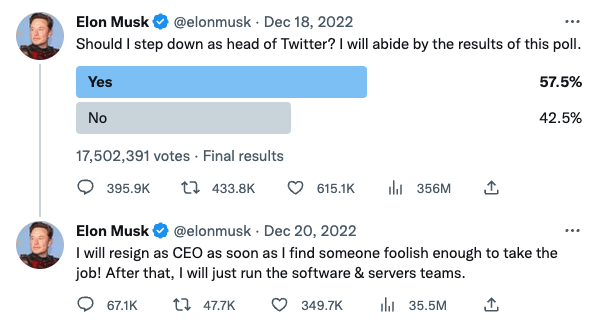
    Musk has, in recent days, briefly suspended the accounts of journalists who he accused of “doxxing” his location; decided to prohibit linking to several rival sites, including Facebook, Instagram, and Mastodon; and appeared to govern, at least partially, by user poll, with one of the latest surveys asking if he should step down as head of the company.

    “Whether Elon Musk is operating according to plan or is making it up as he goes along is hard to tell,” said entrepreneur Jeff Webb, the founder of Varsity Spirit who also serves as senior news editor of Human Events.

    But whether the initiatives are spur-of-the-moment experiments or more calculated moves, Webb cautions not to dismiss Musk.

    “Just look at what he has done with Tesla, SpaceX, and now Twitter,” Webb said. “You can never underestimate him, regardless of how far out he has planned his next move.”

    Musk may have been surprised that more than half of the 17.5 million users who voted felt that he should step down as Twitter CEO when the poll closed on Monday. He hasn’t made any announcements about leadership changes despite vowing to adhere to the poll’s results.

    But Webb points out that the poll may also be part of the plan.

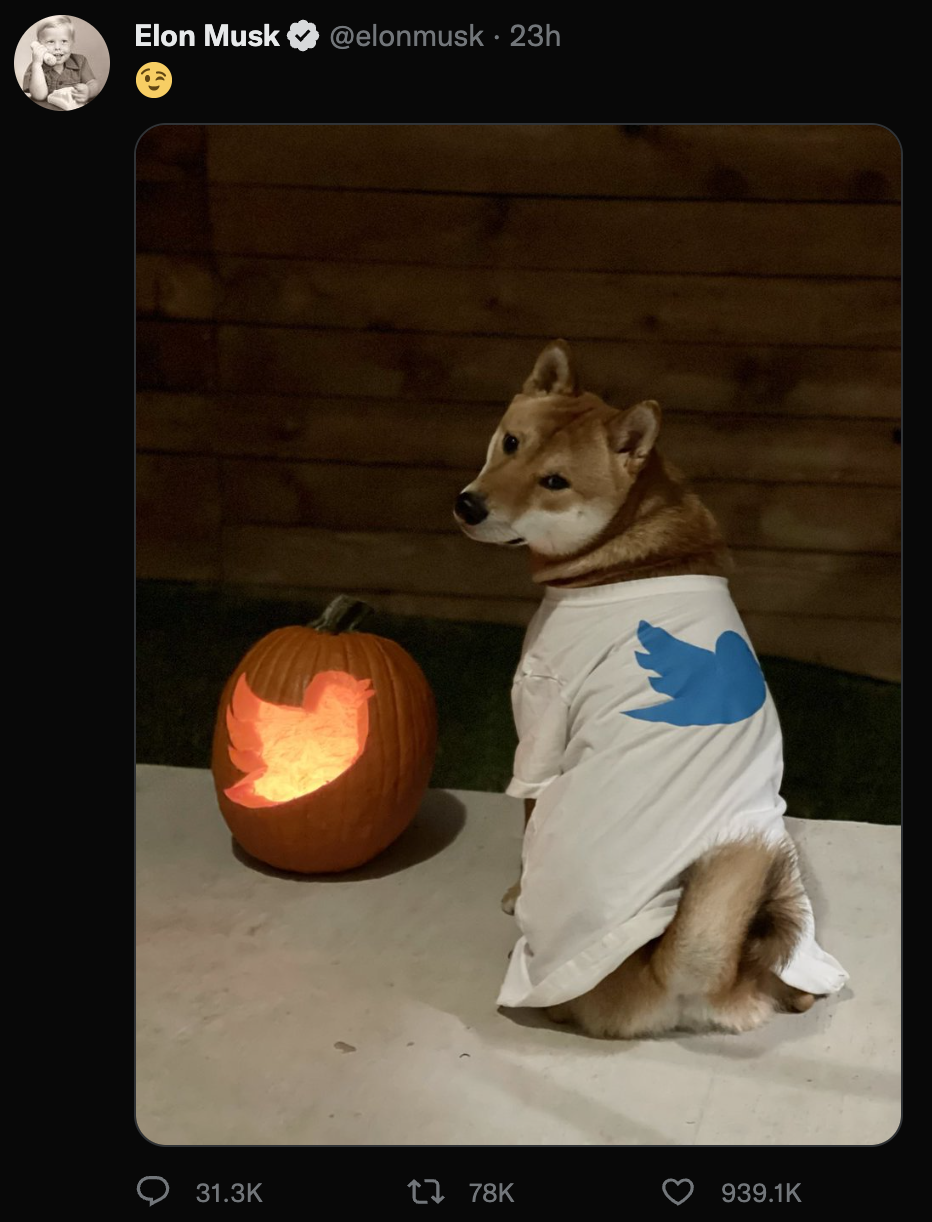
    Elon Musk Twitter CEO Poll Dec 2022Many people predicted a “transition period” would occur during which Musk would “bring the bias to light and put Twitter on the road to a transparent and fair medium before stepping down for another CEO once he did that.”

    “We may very well be at that moment now,” he said.

    Jeff Bermant, founder and CEO of Tusk, a free speech-based web browser, agrees that Musk may be inching toward taking on the role of the “big picture guy” and not the “day-to-day guy” at Twitter.

    In posting the poll about his future at the company, Bermant said it appears like Musk is “probably leaning toward giving up the CEO role and bringing someone else on,” something which he called a “good business decision.”

    Dallas-based digital marketing expert and CMO of Agency Partner Interactive Adam Rizzieri points out that all of Musk’s decisions since his takeover have been aimed at taking private an unprofitable public company that was surviving on “Wall Street’s big bank funny money” so that he could make “drastic changes” that the former management was unable or unwilling to make — and do it “without being called out for breaching their fiduciary responsibilities.”

    “The fact is that when a business is actively fixing big problems, smaller problems may pop up along the way, and that’s what we’re seeing with Twitter 2.0,” Rizzieri said.

    And with every change Musk makes, he said Twitter users have a rare front-row seat “witnessing a live social experiment.”

    Because some experiments are bound to fail, Rizzieri said he expects to see Musk “mitigate loss and allow a quick pivot towards something else that may create value.”

    “We will likely see a lot of this, especially as it pertains to fixing Twitter’s policies and community standards,” he said.

    As soon as a wide spectrum of Twitter users began to express frustration at the swath of journalists’ accounts being suspended, many of the accounts in question were restored following an online poll by Musk. He also admitted he made a mistake in launching new speech restrictions that banned mentions of rival social media websites.

    Despite the negative press and the occasional failed experiment, Rizzieri believes it is “all part of Musk’s greater plan” in creating a free speech platform.

    “From day one, Twitter required extensive, expensive changes,” he said. “Since Old Twitter became Twitter 2.0, the organizational chart has been rightfully cut in half, decimating operating costs. And the Twitter Blue revenue channel has been reinvigorated as user growth is hitting all-time highs.

    “The future has never been brighter for Twitter.”

    As Musk continues his massive overhaul, Andrew Selepak, a social media professor at the University of Florida, said some of the fallout from his decisions are merely “growing pains” that are “natural to any tech company.”

    He notes that Twitter is receiving more scrutiny right now than other social media sites that have gone through rough patches because it is a widely used platform that has existed for a decade.

    “[Twitter] is in a very odd position because there’s been a big change on a well-known platform in a short period of time,” he said.

    As Musk works out the kinks, however, Selepak said the self-proclaimed “chief twit” isn’t doing himself any favors when he contradicts himself on certain policies, using as an example the recent account bans despite portraying himself as a “free speech absolutist.”

    And though Selepak said it appears that Musk is quickly “making up some of these things as he goes along,” Sarah Johnson, a media relations expert, advises that Musk is “much smarter than most of his critics are giving him credit [for.]”

    She points out that as Musk sets out to transform the microblogging site into a “town hall forum” where “all voices could be heard,” he has “proven his chops by showing that Twitter can function, and even thrive, without the myriad workers the company once employed, and there’s a night and day difference in terms of transparency.”

    While he operates in a manner that “many might describe as a ‘fly-by-the-seat-of-your-pants’ style,” she suspects Musk “wants to make as many changes as quickly as possible.”

    She notes that he also “learns quickly from his mistakes or from policies that haven’t always been thought out to the fullest.”

    “He owns the mishaps and tweaks the execution until it’s where he wants it to be,” Johnson said. “Overall, the changes he’s implemented in the last two months are staggering.”

    © 2022 Newsmax. All rights reserved.


    Catch Us In the Media

    Agency Partner’s award-winning team often contributes expert opinions and perspectives on things that matter. Follow our contributions to the latest news and media topics or head over to the newly reinstated/uncancelled Agency Partner YouTube page to see us on TV and hear us on the radio or podcasts.

    If your business is looking to utilize a digital marketing strategy or perhaps you need help with your web design and mobile needs, we’re happy to help! For no risk and no obligation, give us a shot!

    Make the team at Agency Partner your next call.

  • Newsmax: Meta Likely to Reinstate Trump’s Facebook Account, Experts Say

    Newsmax: Meta Likely to Reinstate Trump’s Facebook Account, Experts Say

    Originally published on December 19, 2022 at Newsmax.com, Written by Marisa Herman

    Despite the efforts of leading Democrats to pressure Meta into extending the ban keeping former President Donald Trump off Facebook, social media experts predict the tech company will reinstate Trump’s account once the company’s self-imposed two-year suspension expires next month.

    Trump was suspended from the platform due to what the site alleged was his involvement in inciting a “riot” at the Capitol on Jan. 6, 2021.

    But with Meta set to reevaluate that ban in January, Sen. Sheldon Whitehouse, D-R.I., penned a letter with Reps. Adam Schiff, D-Calif., André Carson, D-Ind., and Kathy Castor, D-Fla., arguing that reinstating Trump’s account will allow him to post “conspiratorial rhetoric” that could “only serve as a motivation to incite violence.”

    Andrew Selepak, a social media professor at the University of Florida, called their claims that posting “misinformation leads to violence” flawed, and an argument that Meta is likely to overlook when making its decision.

    Ultimately, he believes Meta will reinstate Trump’s account under the condition that he doesn’t violate the platform’s terms of service, which apply to any user.

    While Schiff and other Democrats may believe Trump is “more unhinged and dangerous than ever,” Selepak said that, even accepting that argument, there is a difference between inciting violence and posting information that may be factually incorrect or untrue.

    “Any user has the ability, as long as they are not violating the terms of services, to post whatever they want whether it’s factually true or untrue,” he said.

    While Meta will likely make it clear that Trump can’t advocate for “death, murder, or mayhem” on his Facebook or Instagram accounts — which he’s never done, and no user is allowed to do — Selepak said it is likely that Trump will have the ability to post his contention that the 2020 election was stolen or use his account to fundraise for his 2024 presidential campaign.

    Entrepreneur Jeff Webb, who serves as senior news editor of Human Events, also expects Trump’s Facebook ban to be lifted, especially since the new Twitter owner and CEO Elon Musk allowed the former president to regain access to his Twitter account despite facing a lifetime ban.

    “Elon Musk has set a new standard,” Webb said. “He’s walking the talk by being transparent and evenhanded.”

    After Musk decided to expose the inner workings of the social media giant via the “Twitter files,” Webb said he has “come down squarely against blatant discrimination and suppression of free speech.”

    Because extending Trump’s Facebook ban would likely “require additional disclosures on their processes,” an undertaking Webb believes Meta is not inclined to pursue, he believes Trump’s accounts will be reinstated.

    Selepak agrees, noting that while Musk’s decision to allow Trump back on the microblogging site put “slight pressure” on Meta to do the same, it was the “Twitter files” dump that really puts Meta in a position where they are going to have to make a “very public decision” to allow Trump back on.

    He said the “Twitter files” — which revealed that some top employees at the social media behemoth believed that tweets written by Trump about the events of Jan. 6 did not actually violate the site’s policies — also puts pressure on Meta to release their own version of the “Facebook files” to show what discussions led to Trump being banned.

    “Without revealing what led to that decision, people are going to assume it was done in a similar way to what Twitter did,” Selepak said.

    Webb agrees that Meta “should let the public see how their decisions on banning were made, who made them, and whether or not they had any kind of rational basis at all, or if it was just blatant discrimination.”

    “In the U.S., one of the real pillars of a modern democracy is free speech and the ability to have dissenting political views,” he said. “When you start methodically and institutionally diminishing that, you see the real threat to democracy take shape.”

    Dallas-based digital marketing expert Adam Rizzieri points out that Meta isn’t only facing pressure from Musk and the Twitter files when it comes to lifting the ban on Trump. The social media company also soon must answer to a GOP-controlled House that will “undoubtedly focus on prior censorship, electioneering, visibility filtering, and suspension decisions.”

    “As we forge into 2023, Meta will be under increasingly aggressive pressure to un-ban President Trump’s account,” he said. “They will also face tough questions about how they will treat elected officials and candidates in the future.”

    With Trump a declared candidate for the 2024 presidential election, Rizzieri said that official status “strongly favors that his account be reinstated on Meta.”

    Although the former president has not yet returned to Twitter, opting to stick with his own social media platform, Truth Social, experts agree that he may be tempted to return to Facebook.

    While Truth Social, like Twitter, is a microblogging site, Rizzieri points out that Facebook offers a different style of social media platform — and broadcasts it to a far larger audience.

    Also, because Facebook, which “allows for much longer form content styles and user groups,” isn’t in “direct competition” with Truth Social, Rizzieri said he could see a rationale for Trump’s return to the site.

    Even if Trump doesn’t personally use the account, he said his campaign staff will “almost certainly use it.”

    © 2022 Newsmax. All rights reserved.


    Catch Us In the Media

    Agency Partner’s award-winning team often contributes expert opinions and perspectives on things that matter. Follow our contributions to the latest news and media topics or head over to the newly reinstated/uncancelled Agency Partner YouTube page to see us on TV and hear us on the radio or podcasts.

    If your business is looking to utilize a digital marketing strategy or perhaps you need help with your web design and mobile needs, we’re happy to help! For no risk and no obligation, give us a shot!

    Make the team at Agency Partner your next call.

  • Newsmax: Could Musk Create Legitimate TikTok Competitor?

    Newsmax: Could Musk Create Legitimate TikTok Competitor?

    Originally published on November 29, 2022 at Newsmax.com, Written by Marisa Herman

    The clock might be running out for TikTok.

    With officials in both parties raising national security concerns over the threat posed by the popular Chinese-owned video app TikTok, tech experts say Elon Musk’s recent purchase of Twitter could potentially hold the key to crushing the controversial Chinese creation.

    Since his $44 billion takeover of the social media platform, Musk, the world’s richest man, has been looking for ways to make his investment profitable. Techies say the answer could lie in creating a video component that rivals TikTok and even cuts into views of dominant video platform YouTube.

    Dallas-based digital marketing expert and CMO of Agency Partner Interactive Adam Rizzieri believes Musk is already on his way to creating a viable go-to video platform as he works toward his overall goal of growing Twitter into a “super app” that is capable of not only providing users with a forum to micro-blog, stream video, and even a way to pay for things.

    “What is true of a social platform today may be very different from tomorrow’s reality,” Rizzieri said.

    Even before Musk officially took over, Twitter had been moving toward integrating more video components into its social media platform.

    In September, it announced two new video-focused features for its app. One feature, known as the “immersive media viewer” allows users to open videos in a vertical “full-screen mode” and view more videos by swiping up. Both of those features mirror TikTok.

    The second video-focused feature Twitter announced is a new video carousel located in the “Explore” tab. In the section, there is a “Videos for you” spot that displays a series of popular videos a user may be interested in viewing.

    Musk has also expressed interest in adding more video components to the app.

    One of his first moves involved asking Twitter engineers to reboot Vine, a video platform that Twitter purchased in 2012 for $30 million.

    In a Twitter exchange with YouTube personality Mr. Beast about daily active users on Twitter compared to YouTube, Musk hinted that the numbers could shift “when Twitter offers good video with higher compensation for creators…”

    In order for Twitter to “really compete” against TikTok, Rizzieri said it must “continue to invest in their video sharing and event streaming capabilities.”

    He points out that Twitter users go to the app for breaking news, trends, and the resulting commentary, while TikTok users are often looking for entertainment and diversion.

    One area where he believes Twitter has an advantage over TikTok is the coverage of live, real-time events.

    “Twitter is in the moment and TikTok captures and shares something that has already happened,” he said. “Because of that, Twitter offers a value proposition that TikTok doesn’t have.”

    Even with a push into video underway, Andrew Selepak, a social media professor at the University of Florida, doesn’t believe Musk will be able to whisk TikTokers away from the popular video app – unless the government steps in.

    Multiple agencies, including the FBI and Federal Communications Commission, and several congressional lawmakers have expressed fears over the possibility of the Chinese government tapping into the video-sharing app to influence users and even control their devices.

    FCC Commissioner Brendan Carr has called for the Committee on Foreign Investment in the United States to ban the app over concerns about users’ data security. FBI Director Christopher Wray has voiced similar concerns.

    He told lawmakers earlier this month that risks include “the possibility that the Chinese government could use to control data collection on millions of users or control the recommendation algorithm, which could be used for influence operations.”

    The red flags about TikTok and its influence are not new.

    The Trump administration began sounding the alarm on the app being linked to the Chinese Communist Party and tried to ban the app in 2020.

    But former President Donald Trump’s attempts were overturned by President Joe Biden in 2021 after he withdrew a spate of Trump executive orders that sought to ban new downloads of the apps and ordered the Commerce Department to conduct a review of security concerns posed by the apps.

    In 2020, the Committee on Foreign Investment in the United States, which reviews U.S. acquisitions by foreign acquirers for potential national security risks, ordered ByteDance to divest TikTok because of fears that U.S. user data could be passed on to China’s communist government.

    In September, TikTok executive Vanessa Pappas told lawmakers that TikTok was making “progress toward a final agreement with the U.S. government to further safeguard U.S. user data and fully address U.S. national security interests.”

    With calls for the app to be banned again circulating, tech experts say Musk could easily swoop in with a replacement.

    Selepak believes it would take a total government ban on TikTok for Musk to be able to compete.

    That’s because currently, he is not only up against TikTok but Instagram’s video component “reels,” which has tried to compete with TikTok.

    Selepak said video creators typically post their clips to TikTok and then repurpose them to reels, instead of abandoning TikTok for Instagram.

    Under the current landscape, he highly doubts that Twitter’s revamped Vine would be a “TikTok killer.”

    That, however, could change if TikTok is no longer an option.

    In that scenario, he said Vine and Twitter could dominate as it moves into the void – if Musk can convince creators to post to his platform over Instagram.

    If TikTok remains available, Selepak said Musk could use Twitter to make a “big push” exposing the dangers of TikTok by essentially launching a “direct attack” against the CCP to convince people to switch platforms.

    But that may not be a likely course of action considering Musk’s other companies, including Tesla, have a major presence in China.

    © 2022 Newsmax. All rights reserved.

    Catch Us In the Media

    Agency Partner’s award-winning team often contributes expert opinions and perspectives on things that matter. Follow our contributions to the latest news and media topics or head over to the newly reinstated/uncancelled Agency Partner YouTube page to see us on TV and hear us on the radio or podcasts.

    If your business is looking to utilize a digital marketing strategy or perhaps you need help with your web design and mobile needs, we’re happy to help! For no risk and no obligation, give us a shot!

    Make the team at Agency Partner your next call.

  • KNX Radio Los Angeles: Now What For Elon Musk & Twitter?

    KNX Radio Los Angeles: Now What For Elon Musk & Twitter?

    Agency Partner’s CMO Adam Rizzieri joins KNX News in Los Angeles

    It finally happened. Elon Musk officially owns Twitter. It only cost him $44 Billion and yes, he way over-payed for the typically underperforming social media company. This purchase is a major win for all of the former shareholders who really didn’t stand a chance of earning $54.20 per share based on the company’s rocky trajectory. $54.20 is literally 8 times the company’s revenue projection over the next 12 months and in context, social media companies like Meta have only a 3x revenue multiple in their company valuation. So an 8x multiple is just huge! Elon bought Twitter for $54.20 per share when in reality, a market standard would have put the company closer to $24 per share.


    So… yes, it’s true. Elon Musk is the new, self-appointed “Chief Twit” and the social media company’s former CEO, Parag Agrawal is now unemployed, as is the company’s former CFO Ned Segal and the former Chief Censorship Officer, Vijaya Gadde. But don’t feel bad for them. Apart from suppressing extremely relevant news stories around the time of the 2020 election, this leadership team routinely abused their power to silence conversations that did not mesh with their personal political beliefs. Twitter’s leadership team used their extreme power to dictate national discourse. As of now, the damage has been done, and while their leadership team was rapidly fired leading up to Halloween, collectively, they are set to bring in some $90 Million from the deal. So again, don’t feel bad for them. They’ll be fine.

    The Twitter purchase saga was no doubt, entertaining for bystanders, and Musk was extremely public about his concerns of the ratio between real humans and bots on the platform. Once he expressed his interest in buying the company, he gained access to internal information that made the purchase much less attractive. Despite that, from day one Musk has been adamant that his intentions for buying Twitter were not purely money motivated.


    He wants to create a super app called “X” that truly enables and facilitates free speech. So maybe it’s okay that he over-payed? Sure, $44 Billion is literally billions of dollars… it’s a ton of money! But maybe, just mayyybe he will turn this social media company into a profitable business that creates value beyond just dollars and sense.

    Moving forward, Twitter could change in major ways. In the short term, the now private company can do a lot of things that public companies cannot do. Musk, as the owner, will fire everyone that cannot handle a simple “mean Tweet.” Expect to see his army of engineers work to defeat bots and authenticate all real human users. A true measure of actual humans will help enable to platform to cater to advertisers that funnel revenue into the business.

    Additionally, Twitter will likely become an open-source application. With its algorithm open to the public, it can avoid the secrecy and perceptions of bias that the company has carried on its back for many years. In the short-term, users should expect to enjoy expanded character counts, moving away from the 280 character limit, and also an ability to post videos that exceed the current 140 second limit. Elon loves a good parody video, and many of those videos are longer than 140 seconds.

    Must Twitter DOGE cryptoWhat about DOGE and blue checkmarks? We have heard insight that Twitter will enable payment processing and we know that Elon loves him a good DOGE coin meme. Tesla accepts DOGE so expect to see that cryptocurrency boost in value as Twitter adds some interest to it. As far as the blue checkmark users, we know that Elon wants to see the company authenticate all users. It is possible that Twitter Blue subscribers will be given access to the blue check, typically reserved for celebrities and influencers, but it is also possible that blue checks will be subjected to a monthly fee as Musk looks to make the company more financially healthy.
    Over the long-term, Musk truly believes that he can turn Twitter into a super app. When we think of “super apps,” think of China’s WeChat app, which allows for everything from payment processing, to direct messaging, public micro-blog posting, file sharing and more…. What China’s government doesn’t want you to know is that WeChat is also used to track the movement, behavior, and relationships of Chinese nationals that are traveling abroad – we expect that Musks’s “super app” will be way less creepy and not totalitarian in nature. And get this: he might even bring Twitter’s founder, Jack Dorsey BACK into the mix.

    To opine on the issue, Adam Rizzieri of Agency Partner Interactive joins Audacy’s Los Angeles business news radio show “KNX In-Depth,” with hosts Mike Simpson and Charles Feldman.

    Listen to their conversation below.


  • KNX Radio Los Angeles: Twitter Finally Tests An Edit Button

    KNX Radio Los Angeles: Twitter Finally Tests An Edit Button

    Agency Partner’s CMO Adam Rizzieri joins KNX News in Los Angeles

    It’s finally happening, Twitter is now going to test its much-anticipated “edit” function.

    Twitter said in April it would come out with it due to popular demand. Twitter Blue subscribers will get to tinker with it in the coming weeks first. Adam Rizzieri of Agency Partner Interactive joins Audacy’s Los Angeles business news radio show “KNX In-Depth,” with hosts Mike Simpson and Charles Feldman.

    Listen to the radio coverage below.


    For more information, click to read the blog, “Is Twitter Finally Adding the Edit Button?

  • Is Twitter Finally Adding the Edit Button?

    Is Twitter Finally Adding the Edit Button?

    Twitter Testing Edit Button Before Rollout to Twitter Blue Subscribers

    At long last, Twitter is responding to an overwhelming majority of users that have waited years to see the rollout of an Edit button for Tweets. For years, Twitter has danced around the issue and offered little to no guidance about whether or not they would offer such an app feature.

    Just a few months ago, Elon Musk polled his followers to ask this same question and it came as no surprise that of nearly 4.5 million respondents, nearly 75% of them indicated that “yse” they would like to see an Edit button.

    Elon Musk Tweet About Edit Button - Twitter Poll

    How the Edit Button Will Rollout 

    As of September 1, 2022, 99.9% of Twitter users have not seen the Edit feature within their own user experience. The Edit button is being tested by a very small group of users in order to iron out any bugs and troubleshoot things before offering it to a wider audience. This is a very typical, cautious to rollout a new feature with a mobile application.

    Once Twitter’s team has decided that it is time to offer the Edit feature to a larger group, they have indicated that Twitter Blue subscribers will get the first crack at the new feature. Shortly after that rollout to Twitter Blue, general users might expect to see that functionality hit their in-app experience.

    Twitter Edit Button for Twitter Blue

    What The New Edit Button Will Do

    Once available, it will allow users to make changes to Tweets after they’ve been published. Though things may change, for now, the plan is to allow users up to 30 minutes to make a change to newly posted Tweets. After any edits, the Tweet will transparently display the text “Last edited” followed by a timestamp.

    Twitter Edited Tweet - testing

    In addition to that, Edited Tweets will also include a version history that will allow users to see what was included in the original Tweet. The point of this is to ensure integrity and transparency behind what people are posting. Unfortunately for users, this won’t necessarily solve the issue of inadvertent, quickly corrected misspellings and punctuation issues that may come from quick Twitter fingers.

    Business Impact of the Edited Tweet Feature

    The Twitter edit feature has been one of the most requested Twitter additions to date, so Twitter shareholders were really hoping that the market would react favorably to this news.

    However, in the immediate Twitter’s stock has not reacted to this. As it pertains to investors, it seems that Elon Musk headlines continue to have more sway over Twitter’s value than of news related to new app features and functionalities.

    Twitter Share Price This Year Sep 2022

    Twitter’s legal team continues to try and force Elon Musk into carrying out his $44 Billion purchase of the company, a sale price that today is arguably way too high. A $44 Billion sale price indicates a share price of $54.20, yet this week Twitter’s average share price has teetered around $38 to 39 per share. Generally, today’s valuation indicates something like a $15 discount per share.

    As for the future of Twitter and whether or not Elon Musk will be the new owner, it remains to be seen! Elon Musk is demanding reliable data about how many bots are on the platform and concurrently, he is arguing that Twitter is failing to provide that information. Claiming that this is in breach of their Merger Agreement, Musk’s legal team is demanding a termination of that deal. As to what comes next, much of that will be decided by a Delaware judge in October.

  • What The World Must Know About TikTok and ByteDance

    What The World Must Know About TikTok and ByteDance

    Social Media News: Is TikTok a Trojan Horse for the Chinese Communist Party?

    Last month, BuzzFeed reported on leaked audio from 80 internal meetings at TikTok offices revealing that the company routinely allows Beijing-based employees to access private US user data.

    This comes after public statements to news outlets and the US Congress, swearing under oath that TikTok user data would not be compromised or shared with Chinese Communist Party (CCP) officials. For years the company promised that US user data would be stored on US-based servers and would not be shared with officials from our largest foreign adversary. 

    The trouble is that, as one TikTok employee from the Trust and Safety department said, “everything is seen in China.”

    Irrespective of where the servers are physically located, as easily as accessing a song or iMessage from the cloud, Beijing-based ByteDance employees tap into US-based servers with ease. From one headline to the next, US-based TikTok spokespersons continue to contradict themselves, gaslighting the American public and US regulators instead of owning up to their ugly truth.


    The concerns here are vast and we must dig deeper.

    On one hand, TikTok’s 1 billion users (and growing) are sharing vast amounts of in-app usage, device, and biometric data. The social entertainment app can track where you go and when, and then process that data into meaningful patterns of behavior. All of this data goes through a process of machine learning, which optimizes TikTok’s “For You” algorithm.

    If you stop right there, this isn’t really a story worth talking about. After all, American social media companies do this kind of stuff everyday for purposes of generating advertising revenue.

    But scratch the surface just a bit deeper. TikTok is not like an American social media company. TikTok is an app that’s owned by a Chinese tech company called ByteDance Ltd.

    To be clear, ByteDance is an asset that is owned and controlled by the People’s Republic of China. That’s why US regulators and lawmakers such as Senator Ted Cruz warn that TikTok is “a Trojan horse for the Chinese Communist Party [that can be used] to influence what Americans see, hear, and ultimately think.” He’s not wrong.

    What You Need to Know About ByteDance’s Power Structure

    Founded by Zhang Yiming, ByteDance Ltd. was incorporated in the Cayman Islands in 2012, though Beijing is its global headquarters. As a company ByteDance designs, develops, and operates several applications, including TikTok, other social media apps, news apps, business apps, and more.

    In Communist China, there is no real concept of private ownership.

    All ownership is collectively held by the government and any sense of private ownership is a temporary allowance that is granted by the socialist market economy. Why do you think counterfeit goods and a black market flourishes in China? Because like in North Korea and other totalitarian states, they need it! The ruling Chinese Communist Party owns the economic output of all companies and no one gets to operate or “own” anything without expressed consent from the CCP. Think about home ownership in the United States. In China, no citizen or business can own the land that their home or office rests on. The closest you can get is an allowance from the government to lease the land for 70 years.

    ByteDance HQ Isn’t Staffed with Hipsters and Tech Bros

    Looking specifically at ByteDance’s corporate structure, we’re not talking about a company that is run by software engineers with Star Wars shirts and digital marketers that portray themselves as over-manicured hipsters.

    The company is a Chinese state-controlled enterprise that has government officials in corner offices. While it happens to have non-Chinese investors including Sequoia Capital, SoftBank Group, and Kohlberg Kravis Roberts, these non-Chinese financiers have no actual control over ByteDance.

    In fact, the CCP controls the company through a state-owned enterprise called the Cyberspace Administration of China, and a government appointed official, Wu Shugang, sits on ByteDance’s board of directors. That relationship, coupled with Chinese national security laws, gives the CCP sole decision-making authority at ByteDance HQ.

    Further to that, within the ByteDance org chat, there is a group that functions as an “internal Chinese Communist Party committee,” managed by ByteDance vice president, Zhang Fuping. This group routinely meets to study speeches and instruction from President Xi Jinping. Their purpose is to ensure that the company works in lockstep with CCP political goals.

    As for any business executives that defy or embarrass the CCP, punishments include public humiliation, indefinite detainment, or worse. Like Canadian-Chinese billionaire Xiao Jianhua or Jack Ma, some executives simply disappear, only to reappear months or years later — if at all.

    Even ByteDance’s founder and first CEO, Zhang Yiming, has been negatively impacted by the CCP’s thirst for absolute control. In May 2021, he quickly resigned from his position due to a lack of censorship on two of ByteDance’s other apps that were exclusive to mainland China. The company is now run by Zhang’s former roommate, Liang Rubo.

    Seriously Think About The Back Office and Its Motivations

    Here’s the thing… every concern expressed by Senator Cruz and FCC Commissioner Carr is founded on reality.

    TikTok isn’t just an app and ByteDance isn’t just a company. These are direct extensions of a Xi Jinping controlled Chinese Communist Party that seeks to dominate the world and so far, they have managed to build a weapons-grade attention engagement algorithm into TikTok. That’s why it works so well.

    Xi is a leader that has big aspirations. He dreams of a world where China is the single dominant world power, both economically and militarily. Xi assumed power in 2012 and under his leadership, political observers have cited an increase of mass surveillance, state-controlled censorship, a deterioration of human rights, and a cult of personality developing around his persona.

    In 2018, Xi Jinping removed his 2-term limit, elevating his status to “president for life.” Sounds like Vladimir Putin, right? This makes him the most powerful leader the country has had since Mao Zedong. Under his leadership, his government has been repeatedly exposed for committing some of the worst, most frequent human rights atrocities on Earth. I’m talking about genocide, child slavery, and so much more.

    In Xi’s China, apps have already been used to assert power and suppress dissent. Most recently China used a COVID health tracking app to restrict citizens from lawfully leaving their apartments. This COVID app leverages QR codes and a color code system to allow citizens access to buildings and transportation. QR code scans take place after routine COVID screenings (every 48 hours), and if you have a green light in your app, it means you can leave your apartment. The CCP has been using this app and giving a red light to citizens that have been deemed politically unfavorable, restricting their ability to travel for work, to get food, and more. This concept is in essence, an extreme version of vaccine passports.


    The fact of the matter is that China already uses apps to control and manipulate their own people. WeChat is another popular “super app” that the CCP uses to monitor and control Chinese nationals that travel abroad.

    Xi Jinping and the CCP view apps as a tool that strengthens their surveillance capabilities and to assert power. It would be extremely naive for US national security analysts and consumers to view ByteDance or TikTok as anything other than malignant… a wolf in sheep’s clothing.

    A Rare Glimpse At How ByteDance Has Already Targeted US App Users

    A new report from Emily Baker-White highlights that TikTok’s parent company intentionally used one of its apps to distribute pro-China messages to millions of Americans.

    A now defunct news app called TopBuzz was used to secretly share and promote pro-China messages to Americans, while actively suppressing anything that was critical of the CCP. This app, TopBuzz, was basically a news aggregator app that the Communist Party could use to influence the world of news and entertainment. In the US, the concept of “fake news” has been all the rage, and in 2018 TopBuzz took that to the next level for its 80 million users.

    ByteDance Beijing Headquarters
    CCP members and employees in ByteDance Beijing Office (NetEase Hao photo)

    Following interviews with over 15 former ByteDance staffers that were assigned to TopBuzz, it became apparent that a content review system would filter content in such a way that allowed government fueled censorship. The Hong Kong “freedom protests” were suppressed, and oddly, the cartoon Winnie the Pooh was banned as it has become a vehicle in China to mock President Xi Jinping.

    Xi Jinping Winnie the Pooh
    Image Credit: unknown source

    Don’t forget, commies can’t take a joke without trying to take your head.

    Thankfully, TopBuzz shuttered in June 2020 but during its time, here are some of the things it was up to:

    • Removing all coverage of Honk Kong Freedom Protests
    • Removing any news and editorial content depicting openly gay people
    • Removing all content critical of Xi Jinping and the CCP
    • Scraping content from 3rd party publishers & running fake bylines to support political objectives
    • Creating fake user accounts to promote and comment on politically relevant stories
    • Running news and editorial content specific to US elections, politicians, & current events

    If that isn’t smoke, this headline from the DailyMail is fire:

    China Asked TikTok for Stealth Account Where it Could Spread Propaganda in the West

    TikTok Election Interference

    New information from Bloomberg hit the press after a TikTok whistleblower shared that the Chinese government made a “sensitive request,” asking TikTok leaders to create a stealth propaganda account.

    The DailyMail notes that the CCP was facing harsh global scrutiny in the early days of the COVID-19 pandemic and this request was designed to try and mitigate damage to China’s international reputation.

    [Cough, cough, “Wuhan lab leak,” cough, cough..]

    The request went to the company’s international management team, including US-based Global Head of Corporate Affairs and General Counsel, Erich Andersen, as well as Elizabeth Kanter who heads TikTok’s government relations for the UK, Ireland, Netherlands, and Israel.

    Since President Trump worked to remove TikTok from the US market in 2020, the company has been under increased scrutiny, prompting its PR teams to try and create a perceivable distance from its direct association with the Chinese government.

    Perhaps because of this, and the fact that internal whistleblowers shared the story, this particular request was not implemented. But how far and frequent are requests like this? Will we have to rely on future whistleblowers to expose injustices within the ranks of ByteDance or is there already enough information to give us a clear answer for how we must move forward? It seems there are a lot of sparks here — and tons of smoke. As we know, where there is smoke, there is fire.

    As Americans, business leaders, taxpayers, patriots, and freedom-loving people, we have to really come to terms with reality here.

    How far are we willing to let this go and, given ByteDance’s power, can it impact future elections and world events? It seems that it’s already happening.


    Author: S. Adam Rizzieri
    Co-founder & Chief Marketing Officer // Agency Partner Interactive

    Can Agency Partner Interactive Help Me With Social Media?

    As Dallas’ top digital marketing agency, we optimize marketing investments in real-time with our digital marketing and social media management services. We help businesses determine how and to what extent they should be leveraging social media marketing. TikTok is a very murky place right now, though there are many businesses that are finding ways to create value with it. The future is uncertain and when it comes to lead generation, our digital marketing team can help diversify risk and create a multitude of online channels that add value to your business. 

    If you’re looking to safely navigate online marketing, our digital marketing experts will work to understand your business goals and objectives — thereby working to help you attract valuable customers, drive sales, increase your leads, build brand awareness, and more.

    Are you ready to optimize your business with an award-winning social media marketing agency? Maybe you just have some basic questions? Let’s talk — Contact us today!

  • Newsmax: Will Trump Still Shun Twitter if Musk Reinstates Him?

    Newsmax: Will Trump Still Shun Twitter if Musk Reinstates Him?

    Originally published on April 27, 2022 at Newsmax.com, Written by Marisa Herman

    Even though former President Donald Trump is swearing off a return to Twitter, social media gurus aren’t so sure he’ll stick to that promise – if his account is reinstated.

    The chances Trump’s account will be reinstated – enabling him to instantly communicate with his 89 million followers – grew significantly after entrepreneur and self-proclaimed “free speech absolutist” Elon Musk purchased the social media platform for $44 billion on Monday.

    The world’s richest man vowed to make the platform “better than ever” with new features bolstering free speech.


    But just how much of a free-speech champion the outspoken Tesla and SpaceX boss really is could be put to the test when it comes to deciding what to do about Trump’s account.

    Trump was permanently banned due to a so-called “risk of further incitement of violence” following the Jan. 6 breach of the Capitol.

    While Musk hasn’t specifically addressed plans to continue the ban or overturn it once he takes the reins of the company, he has publicly commented on his feelings toward permanent bans in general.

    During a recent TED interview, he said he would be “very reluctant” to delete posts or permanently ban users who violate the company’s rules.


    Big tech experts so far are betting on Musk reinstating Trump’s account. And while Trump has said he is sticking with his own platform, Truth Social, politicians have been known to change their positions.

    Andrew Selepak, a social media professor at the University of Florida, said that if Trump is allowed back on Twitter, he has “absolutely no doubts” that he will eventually return to his prolific tweeting.

    “There is a very good chance that Trump will be allowed back on,” he said. “And if he is allowed back on, he 100% will do so.”

    Considering Trump boasted 89 million followers on Twitter and has just 1.6 million so far on the relatively new Truth Social, experts don’t see him abandoning such a large audience, especially if he plans to make another run for the White House.

    Selepak said Trump’s political aspirations could dictate what moves both Trump and Musk make when it comes to Twitter.

    If Trump decides to run for another term in 2024, Selepak said Musk won’t want to “limit the voice” or get into “any type of battle” with a person who could ultimately be able to sign executive orders or champion legislation that could hurt his other companies like Tesla or SpaceX.

    Selepak points out that Musk’s companies have enjoyed tax breaks, incentives, and government contracts and he won’t want to risk any existing relationships his other ventures enjoy with the government.

    “If Trump does run, Musk could make the decision to allow him to be back on to not create an enemy with someone who could be in the White House,” he said.

    Because Twitter has a longstanding policy about providing world leaders with a presence on the platform, Selepak said Musk could use that argument to easily reinstate Trump.

    “Musk could make a much stronger argument to users and everyone else, if Trump decides to run, to give him access back to Twitter than giving it unilaterally before then,” he said.

    Ultimately, he believes that Musk’s decision on Trump’s account will come down to what is going to benefit the entrepreneur.

    While Selepak doesn’t believe Trump will be able to stay off Twitter if allowed to return, he said there is still a chance he keeps his word.

    Because Musk will have the ability to call the shots on what is and isn’t allowed on the site, Selepak said Trump may decide he does not want to be “beholden to Musk.”

    Dallas-based marketing expert, Agency Partner’s CMO, Adam Rizzieri agrees that Musk will likely extend the invitation to Trump to return to the platform, calling it a “good business decision for Twitter.”

    But he doesn’t necessarily think Trump should accept — if he is serious about getting Truth Social up and running.

    He likened a Trump Twitter return to the CEO of Coca-Cola being caught drinking Pepsi in public because the two platforms are “extremely similar in form and function” and are competing for the users.

    Stocks tied to Truth Social fell nearly 13% after Musk’s Twitter takeover was announced Monday. On Tuesday, Trump issued a statement highlighting Truth Social as No. 1 among the “Top Free Apps” in the Apple App Store.

    Rizzieri said Trump could use a reactivated Twitter account to promote his own venture. But he cautioned that Trump would have to walk a “very fine line” to do so successfully.

    “He has to ensure that exclusive, value-added insights are added to Truth Social alone, and Twitter must be nothing more than a teaser for whatever content he is sharing to a Truth Social audience,” he said. “Anything less and he could undermine the growth of his own social platform.”

    Rizzieri points out that Truth Social users have doubted Trump’s commitment to the platform because he has only posted once since creating his profile in February. He also noted that Donald Trump Jr. “posts multiple times per waking hour on Twitter,” while he places only two to four posts per day on Truth Social.

    Rather than use Truth Social to promote his appearances and news, Rizzieri said Trump’s updates only seem to reach users via proxy updates from his son’s Twitter account or after broadcasts of weekend rallies on TV outlets.

    Trump told Fox News Monday that he plans to formally join his own network within the next week.

    Still, Rizzieri said Trump’s absence from the platform since its debut has prompted many to question whether they will receive the “direct, real-time access” they had to the former president when he was on Twitter.

    Now that Musk and Trump are competing to promote free speech, he said Truth Social’s team will be forced to “dig deep and more rapidly define a unique value proposition that no one else offers.”

    “Today, they are a light version of Twitter but without the annoying and unfair politically biased censorship,” Rizzieri said. “It’s a great start. But with a guy like Elon Musk vowing to make Twitter ‘great again,’ Truth Social has to be more innovative.”

    As Musk promises to turn Twitter into a “de facto town square,” Selepak said conservatives, who felt their voices were silenced on the platform, will likely return.

    He expects that, even before any major changes are announced or implemented, just the news of Musk being at the helm will prompt many users who backed away from Twitter to “change their mind and come back to start using it again.”

    A group of House Republicans immediately rejoiced at the news Musk would be taking over, calling on the new social media mogul to “free” Trump.

    “Hey, @elonmusk it’s a great week to free @realDonaldTrump,” tweeted the House Republican Conference, which represents 209 lawmakers.


    If enough “big voices on the right” return, he said the presence of their posts will increase without Musk even having to institute changes to the site’s algorithm, which dictates how users see certain posts on their timelines.

    Musk has proposed making changes to the platform’s algorithm in order to increase trust.

    “Free speech is the bedrock of a functioning democracy, and Twitter is the digital town square where matters vital to the future of humanity are debated,” he said.

    Whether Musk will be able to eliminate “wokeness” from the platform, however, is what Rizzieri called the “$44 billion question.”

    “Like President Trump, Elon Musk views wokeness as a virus that has infected Big Tech, the mainstream media, and Netflix,” he said. “The common denominator here is an unelected, ruling class of elitists that all march to the beat of their own drum.”

    He said Musk knows that Twitter’s “woke algorithm ignores the mainstream user, giving preference to an out-of-touch class of blue check elites,” referencing the journalists, celebrities, and politicians who are “verified” on the platform.

    In order to protect “American exceptionalism,” by “effectively standing up to wokeness,” Rizzieri said Musk knows he has to “allow for good ideas to circulate without unfair censorship.”

    He believes that, on Musk’s Twitter, “both good and bad ideas will circulate freely – and the best ones will survive.”

    © 2022 Newsmax. All rights reserved.

    Catch Us In the Media

    Agency Partner’s award-winning team often contributes expert opinions and perspectives on things that matter. Follow our contributions to the latest news and media topics or head over to the newly reinstated/uncancelled Agency Partner YouTube page to see us on TV and hear us on the radio or podcasts.

    If your business is looking to utilize a digital marketing strategy or perhaps you need help with your web design and mobile needs, we’re happy to help! For no risk and no obligation, give us a shot!

    Make the team at Agency Partner your next call.

  • Newsmax: Musk’s Twitter Swerve Positions Him for Hostile Takeover

    Newsmax: Musk’s Twitter Swerve Positions Him for Hostile Takeover

    Originally published on April 13, 2022 at Newsmax.com, Written by Marisa Herman

    In declining a seat on Twitter’s board of directors, experts say billionaire entrepreneur Elon Musk is likely positioning himself to take an even bigger role in the social media platform.

    Just 24 hours after he invested more than $3 billion to secure a 9.2% stake in the company – instantly making him the company’s largest shareholder – it was announced last week that Musk would serve on the company’s board of directors.

    But in a shocking reversal, Twitter CEO Parag Agrawal said Musk had changed his mind – prompting many to question just what Musk’s plans for the company might be if he isn’t using his influence as a board member.

    Because he isn’t serving on the board, Virginia-based marketing expert Eric Alonzi said, Musk is in a “good position to enact a hostile takeover” of the company.

    “He does such radical things he very well could take over Twitter and have a unique communication channel in his portfolio of entrepreneurship,” Alonzi said. “He might try to create a platform with true free speech.”

    Musk’s decision to abandon the plan to join the board could have to do with a financial stipulation that would have limited Musk to owning no more than a 14.9% stake in the company. It could also have to do with something he has been long advocating for on the platform: free speech.

    Dallas-based marketing expert Adam Rizzieri of Agency Partner said Twitter’s leadership team “believed it could tame Musk’s involvement by inviting him to the board with the caveat that he could not own anything more than 14.9% of the company.”

    “But there was more to it,” he said. “That invitation also included conditions that could have forced Elon to be less outspoken, less free in his speech.”

    In ditching the board seat, the Tesla and SpaceX CEO is free to increase his financial stake above that limit or possibly even become the leader of another company.

    Rizzieri points out that Musk owns four times more shares of Twitter than founder Jack Dorsey and has the liquid capital to “do as he pleases,” considering his billionaire status.

    “Out of desire he could choose to buy the entire company, even going so far as to remove it from public trading and take it private,” he said. “This would free up the company from regulatory burdens and allow some truly significant changes to take place.”

    While Rizzieri believes Musk is more focused on his other business ventures, he said he wouldn’t rule out the possibility.

    Andrew Selepak, a social media professor at the University of Florida, agrees that Musk’s decision to turn down a seat on the board of directors is a savvy move that will allow him the freedom to both increase his stake and protect his own presence on the platform.

    Selepak said that the more of a financial interest Musk owns in Twitter, the harder it will become for the company to censor the self-professed free speech advocate – who’s now not only the company’s largest shareholder but even, potentially, an outright owner.

    While a board seat would have certainly afforded Musk a powerful voice, Selepak said he would have been only “one of many voices.”

    “By not taking a seat on the board, he can purchase more of the company and become an even louder voice,” he said. “This gives him the ability to say whatever he wants and not be worried about having his content taken down, or suspended, or de-platformed.”

    According to a new document filed with the Securities and Exchange Commission Monday, in addition to his new financial options, Musk is also able to express his opinions about Twitter freely and is allowed to “change his plans at any time, as he deems appropriate.”

    If he became a director, Musk likely would have to adhere to the board’s corporate governance, which would have required him to act in the best interests of the company and its shareholders.

    Rizzieri said Musk, who “calls it as he sees it, often via a tweet,” didn’t want to bend to the requests of the board.

    Musk also has a history of flouting corporate governance. In 2018, he faced securities fraud charges after inaccurately tweeting that he had secured funding to take Tesla private. He agreed to pay a $20 million fine and step aside as the car manufacturer’s chairman for three years.

    Shortly before Musk’s ownership in Twitter became public, he publicly criticized the platform’s commitment to free speech and even pondered creating his own rival platform, tweeting the musings to his 81 million followers.

    Last month, he created a poll asking his followers whether they believed Twitter adheres to the principle of free speech. An overwhelming majority – 70% of the more than 2 million Twitter voters who chimed in – selected “no.”

    Over the past week, he posted a series of tweets making suggestions for the company, taking jabs at the platform, and even tossing out a few jokes.

    He suggested the company he just sunk millions into was “dying,” considering that celebrities with massive followings, such as Taylor Swift and Justin Bieber, rarely tweet.

    In another snarky post, he suggested deleting the “w” in Twitter in a poll, which garnered support from 57% of his followers.

    He then got into a conversation with former Amazon CEO Jeff Bezos after he asked users whether Twitter’s San Francisco headquarters should be converted into a homeless shelter “since no one shows up anyway.”

    In a way, Selepak said, Musk was sending Twitter’s employees a message that there is a “new sheriff in town,” which he called a “pretty strong move for someone who just purchased into the company.”

    While he also deleted some of his posts, it is unclear what role – if any – they may have played in his decision to walk away from the board seat.

    Agrawal announced Musk’s change of heart in a lengthy statement he shared on his Twitter page. He said he and the board were excited to work with Musk and, even though he isn’t taking his seat on the board, they will “remain open to his input.”

    Alonzi said he wouldn’t be surprised if Musk is just trolling everyone with a “charade,” pointing out he has leveraged tweets about crypto positions that “made him richer” before he ultimately reversed course.

    But even without a clearly defined role, Rizzieri said Musk is already shaking things up.

    He said just the “idea” of Musk’s involvement in Twitter “sent a positive shock to the market, boosting Twitter’s value.”

    “The market knows that Twitter, as is, needs change,” he said.

    Rizzieri said the fact that some of Twitter’s internal team has responded negatively to Musk’s presence in the company shows that those working for the platform are “happy with their woke status quo.”

    “Contrary to boosts in value, an opposite reaction was detected within the emotionally fragile ranks of Twitter’s employee base,” he said.

    He pointed out that some employees flagged Musk’s tweets as “in violation of their HR policies” and asked if Musk would have to adhere to the rules.

    Several current and former employees told The New York Times they were concerned about Musk’s tweets criticizing the company considering he has no knowledge of the internal operations. While many were relieved that he wouldn’t be taking a board seat, they told the newspaper they are fearful of what he could do next.

    “Even without him on the board and without implementing any actual changes to the platform, Musk’s current involvement in the company has put it on the defensive and already prompted the resignation of many of Twitter’s more politically extreme employees,” Rizzieri said. “Already, that’s a positive return on investment for Twitter, its shareholders, and its users.”

    © 2022 Newsmax. All rights reserved.

    Catch Us In the Media

    Agency Partner’s award-winning team often contributes expert opinions and perspectives on things that matter. Follow our contributions to the latest news and media topics or head over to the newly reinstated/uncancelled Agency Partner YouTube page to see us on TV and hear us on the radio or podcasts.

    If your business is looking to utilize a digital marketing strategy or perhaps you need help with your web design and mobile needs, we’re happy to help! For no risk and no obligation, give us a shot!

    Make the team at Agency Partner your next call.

  • Newsmax: Musk’s Free Speech Fight May Hit Entrenched Resistance at Twitter

    Newsmax: Musk’s Free Speech Fight May Hit Entrenched Resistance at Twitter

    Originally published on April 6, 2022 at Newsmax.com, Written by Marisa Herman

    It took billionaire entrepreneur Elon Musk fewer than 24 hours to muscle his way onto Twitter’s board of directors after securing a 9.2% stake in the social media platform Monday morning, instantly making him the company’s largest shareholder – and one not content to remain a “passive” investor.

    The Tesla and SpaceX CEO’s nearly $3 billion surprise investment came just weeks after he began increasingly criticizing the platform over a dubious commitment to free speech, at one point even mulling the creation of his own rival platform in posts that went out to his 80 million Twitter followers.

    Before his role on the board was announced Tuesday, Musk was already flexing his fresh influence, asking Twitter users in a poll if they wanted to see the platform add an edit button – a function long desired by users but that the site has never implemented.

    After his board term, which is set to run through 2024, was made public Tuesday, Musk hinted that he would be swiftly pushing for changes.

    “Looking forward to working with Parag & Twitter board to make significant improvements to Twitter in coming months!” Musk said in a tweet, referring to Twitter CEO Parag Agrawal.

    But while social media experts never would have expected Musk to take a backseat role in the operations of a social media platform for which he’s now the largest shareholder, they question just how much of an impact he will actually be able to make considering he’s still not in the driver’s seat of the organization.

    His board seat certainly affords him a degree of influence, but Big Tech experts don’t expect Musk to parlay that into becoming the new CEO of Twitter anytime soon – mostly due to Musk’s preoccupations and interests in his other ventures, which include Tesla, SpaceX, and The Boring Company.

    Tech and media expert Victoria Mendoza, who serves as CEO of MediaPeanut, an online digital media community, said Musk’s investment in Twitter shows he’s, at the very least, banking on an “if you can’t beat ’em, join ’em” strategy in order to have a “voice” in the company.

    Mendoza also doesn’t see Musk taking over as the face of the platform, but she thinks he “definitely wants to be part of the decision-making process,” pointing out he’s unlikely to have “spent that much cash without wanting something out of it.”

    She said Musk’s involvement “could provide a huge headache” for Agrawal if he puts pressure on the company to make changes to its controversial policies on free speech.

    Publicly, Agrawal welcomed Musk to the board tweeting: “Through conversations with Elon in recent weeks, it became clear to us that he would bring great value to our Board.”

    “He’s both a passionate believer and intense critic of the service which is exactly what we need on Twitter, and in the boardroom, to make us stronger in the long-term,” he added.

    But experts question how cordial the relationship will remain.

    Dallas-based marketing and big tech expert Adam Rizzieri noted that Musk’s decision to get involved in Twitter came after founder Jack Dorsey stepped down from the role of CEO and Agrawal took over.

    He said that the move from Dorsey to Agrawal signaled “more of the same” was ahead when it comes to “censorship, unimpressive business growth, and more virtue signaling from a notably progressive, often hypocritical leadership team.”

    Twitter has faced criticism from Musk and conservatives who feel the platform unfairly censors its content and users.

    Last month, Twitter suspended the account of The Babylon Bee, a satirical site, for jokingly naming Rachel Levine, the transgender assistant secretary for health, “Man of the Year.”

    The Babylon Bee’s CEO, Seth Dillon, tweeted that Musk contacted him about the suspension and even “mused on that call that he might need to buy Twitter.”

    Rizzieri said Musk’s decision to invest in Twitter is his attempt to respond to a “societal pain.”

    “This is typical of great entrepreneurs,” he said. “They start with a big problem and then reverse engineer the solution. Society’s problem is that mainstream social media companies unfairly censor free speech, and he believes he can solve that.”

    Society’s problem is that mainstream social media companies unfairly censor free speech…

    Musk’s move on Twitter was well received by conservatives, many of whom saw the investment as the key to stopping the censorship of right-leaning opinions – and potentially even reinstating former President Donald Trump to the platform. Trump was booted off Twitter following the breach of the Capitol on Jan. 6, 2021, due to what the platform called a “risk of further incitement of violence.”

    “Now that @ElonMusk is Twitter’s largest shareholder, it’s time to lift the political censorship,” tweeted Rep. Lauren Boebert, R-Colo. “Oh… and BRING BACK TRUMP!”

    But Twitter on Tuesday made it clear that it still has no plans to reinstate Trump’s account.

    “Twitter is committed to impartiality in the development and enforcement of its policies and rules,” the company told the DailyMail. “Our policy decisions are not determined by the Board or shareholders, and we have no plans to reverse any policy decisions.

    “As always our Board plays an important advisory and feedback role across the entirety of our service. Our day to day operations and decisions are made by Twitter management and employees.”

    Whether or not Musk is ultimately able to end Trump’s Twitter exile, Rep. Jim Banks, R-Ind., tweeted that if Musk could “clean up Twitter and stop online censorship” he would be all for him “taking over the whole damn thing.”

    And if Musk’s tweets are any indication of his plans, free speech policies appear to be a priority.

    He publicly questioned Twitter’s free speech practices in several tweets on March 26. Musk even tweeted a poll on his Twitter account questioning whether Twitter unfairly censors speech.

    “Free speech is essential to a functioning democracy,” he wrote. “Do you believe Twitter rigorously adheres to this principle?”

    An overwhelming majority, 70%, of the more than 2 million Twitter voters who chimed in, selected “no.”

    Rizzieri believes that Musk’s financial interest in the company has to do with his belief that “free speech is essential” and “still cool.”

    “Preserving free speech through social media is a means to an end for him,” Rizzieri said of Musk. “He needs innovation, collaboration, and communication to thrive and promote a marketplace of good ideas. Musk knows that social media plays a big role in facilitating conversations and, with this investment, he’ll promote freedom of speech because he’s passionate about it.”

    While Musk’s vision for Twitter involves creating a “public sphere where you have free and open discussion,” Andrew Selepak, a social media professor at the University of Florida, said that achieving that aim is much “easier said than done.”

    “A free speech zone, no matter what, is still going to have limitations,” he said.

    He points out that Dorsey had been a “huge proponent” of free speech from the platform’s inception, but his initial goals “didn’t happen because there’s a utopian view of what things can be and then there’s the reality.”

    He said Musk will ultimately face the same realities that Dorsey encountered when he set out to create a platform that championed free speech, including the competing viewpoints of employees, other shareholders, and users.

    And even with a board seat and huge financial stake, Selepak said Musk won’t necessarily be able to unilaterally decide to do things such as reinstating Trump’s account.

    “I don’t think people realize that Musk having less than 10 percent of the stock is not going to be this earth-shattering change to the platform,” Selepak said. “Even if he is able to make changes, those changes are going to be limited by the engineers and moderators and everyone who works at the company who are still the same people.”

    While Musk’s ability to influence Twitter’s internal operations remains up for debate, Selepak said Musk’s involvement has already had one major impact – it put Twitter “back in the news.”

    After Trump was suspended from the platform, he said Twitter has been stagnant and was being overshadowed in the news by stories such as the debut of Trump’s Truth Social, the growth of TikTok, and the decline of Facebook.

    “Twitter has not been the social media platform people have talked about,” he said. “People are using it, but not talking about it.”

    Now that Musk is involved, he said “it’s going to be a news story and people are going to be talking about Twitter.”

    © 2022 Newsmax. All rights reserved.

    Catch Us In the Media

    Agency Partner’s award-winning team often contributes expert opinions and perspectives on things that matter. Follow our contributions to the latest news and media topics or head over to the newly reinstated/uncancelled Agency Partner YouTube page to see us on TV and hear us on the radio or podcasts.

    If your business is looking to utilize a digital marketing strategy or perhaps you need help with your web design and mobile needs, we’re happy to help! For no risk and no obligation, give us a shot!

    Make the team at Agency Partner your next call.

  • Are Small Businesses at the Mercy of Big Tech?

    Are Small Businesses at the Mercy of Big Tech?

    Short Answer: Yes.

    We all experience the web in different ways, but what happens when the web outsmarts us?

    Where there’s a problem, there’s someone out there with a solution, or an idea of some magnitude that requires nurturing, maybe they need access to the right resources before they can move to the development phase. Big Tech offers that, and more; yet “Do they really?” is the question on Congress’ floor.

    Over the last decade, there has been growing concern surrounding large tech companies and their anti-competitive practices, like buying out the small guy with rivaling potential. Why would a company as big as Facebook, for instance, need Instagram? Did they have a good enough reason for the merge, and can they prove their intentions weren’t to stifle the opposition?

    The U.S. government is shifting that burden off of themselves and onto these tech titans, with Sen. Amy Klobuchar (D-MN) spearheading the effort.

    “When you start deliberately buying up what we call nascent competitors for the purpose of dominating the market, then you stop that innovation that might develop,” said the newly appointed chair of the Senate Judiciary Committee’s Antitrust Subcommittee. “No one has a chance of having a new product when they buy them all up and are the monopoly provider.”

    Klobuchar’s bill seeks to revamp present antitrust laws that have been, in her perspective, ignoring the needs of the modern day consumer.

    The Past

    In truth, these laws were made decades and decades ago to combat the issue of corruption in business and politics. Big firms in the late 1800’s and early 1900’s would consolidate and form one giant entity called a “trust” company, an example of this being the oil industry that merged into Standard Oil Trust, or the tobacco industry coming together to represent the American Tobacco Company. As these enormous trusts banded together, so did their bank accounts.

    The real problem wasn’t that they were rolling in dough, it was the threat that their partnership posed to entrepreneurship and competition, not to mention their growing influence over government affairs.

    The Present

    But where this concern once existed with retail, it has now permeated across a market that is digital, a territory that, to note, won’t be as easy to regulate, especially if Big Tech has also contributed to the success of many of those consumers.

    Facebook makes for a good example as very recently the Federal Trade Commission and 48 attorneys general called for the tech giant to be broken up, alleging that the company was “suppressing, neutralizing, and deterring serious competitive threats” in order to establish more dominance online.

    On the other hand and in their defense, Facebook has brought about much needed exposure to the smaller players, especially during the pandemic. If anything, the number of users soared as business owners everywhere were forced to get creative. There’s a whole hub of tools that the social network has made available, for free, from taking your store online to making consumer data work in your favor.

    And studies from Pew Research Center report that roughly eight-in-ten adults go online daily, with three-in-ten of them being constantly plugged into the world of social media a reach that exists in plain, virtual view for anyone looking to capitalize on that. It gets more tedious when we factor in the role that artificial intelligence plays in accessing, storing, even selling consumer data.

    As Big Tech continues to expand, so does their power and influence over the individual and the economy:

    Consider the effects that a casual tweet from the “Technoking” Elon Musk had over the market back in February, to be able to make money with “One word: Doge.”

    Or consider Amazon, and the convenience it brings for both buyers and sellers everywhere. For the consumer, there are more options and cheaper buys; for retailers, there are cuts to overhead costs and the hassle-free experience of delivery. It’s an empowering platform, until, as critics of the retail giant bring up, the math paints a different story.

    According to a study done by ProPublica in 2016, Amazon’s search engine algorithm was set up to bury bargains from independent merchants and utilize sales data to decide which products to create their own versions of, ultimately competing with the very sellers that operated on the platform.

    The Effects On SMBs

    Scott Galloway, a professor at NYU’s Stern School of Business and author of The Four, a book about digital monopolies, warns of this developing concentration of power that Big Tech has and how it’s the reason for “infanticide” in small firms. “If they’re not stopping (innovation), they’re the main cause behind the slowdown in American startup creation.”

    While Congress has been more willing to have the conversation, the pace at which technology is taking over has only accelerated. Some would argue that this gap between inaction and action, respectively, is increasingly killing the economy. By the time any legislation is passed, statistics suggest there’ll be more casualties on the enterprise front.

    Maybe another question to consider here is whether there needs to be any government intervention at all.

    When these leading tech companies are offering immediate access to vast markets, ability to target ads, budget-friendly and reliable infrastructure, why would startups want to look anywhere else when the framework has already been laid out for them? Developers can reach hundreds of millions of customers overnight via Apple’s and Google’s app store; brands can rent out Amazon’s and Google’s cloud-computing power; Facebook and Instagram might be the smoothest, cost-effective marketing tool in the history of everdom.

    That also explains why Congress has yet to come to a consensus over this matter; it’s no easy feat to go against Big Tech, and then there’s the problem of whether our legislators are intellectually equipped to be making those decisions for users of technology.

    The Future

    One thing is for certain: the small business owner can use more support.

    Is the answer here to break companies up? Should they be prevented from buying out up-and-coming ventures, just because they have the capital to do so? Whatever comes of the resolution, Klobuchar’s antitrust bill may be a better place to start than any.

    For a market to remain a breeding ground for exploration and innovation, it’s essential that there’s the room and the resources there to foster those ideas.

    It might be safe to say that Big Tech is much like that room, a Pandora’s box that’s full of the bells and whistles that appeal to many of its clients, but a box is also just a box: it’s restrictive. And Klobucar’s proposal to put more resources toward smaller agencies could be the backbone that the entrepreneurial spirit of today needs.

    As she puts it,

    “You can’t take on trillion dollar companies with bandaids and duct tape.”

    Work With A Reputable Web Agency

    Agency Partner Interactive is a world-renowned web agency that empowers many of its users to lead with more autonomy in the field. To learn more about how we can help you, call us today at  (877) 682-2012 or contact Agency Partner for more information.